
8 Stamped Concrete Driveway Ideas for Ottawa Homes

Your Ottawa home may be asking for one of several very different driveway treatments. A Centretown heritage property might suit a refined ashlar slate pattern, while a Glebe brick home may look better with traditional cobblestone or basketweave. In Kanata, random stone, coordinated brick, or a custom geometric feature can connect a newer exterior with more natural landscaping.
The best stamped concrete driveway ideas don't begin with a pattern catalogue. They begin with the relationship between the driveway, the home's brick or stone, the walkway, planting beds, and the street. Pattern scale, colour, borders, drainage, winter maintenance, and installation complexity all affect whether the finished surface looks intentional and performs well.
Ottawa's climate makes those decisions practical as well as visual. The city experiences nearly 80 freeze thaw cycles per year across about 6,000 kilometres of roadway, and city crews have filled more than 1.1 million potholes since 2018, according to Ottawa climate and pothole reporting. A well designed driveway needs more than attractive texture. It needs an air entrained mix, effective joints, sealing, drainage, and careful curing.
Ottawa Stamped Concrete is a relevant local option for custom work serving Barrhaven, Nepean, Kanata, Stittsville, and Orleans. The eight concepts below connect visual character with installation and maintenance decisions.
Table of Contents
1. Ashlar Slate Pattern Driveways in Centretown - Details that protect the pattern
2. Cobblestone Pattern Driveways in the Glebe - Keep small patterns orderly
3. Random Stone Pattern Driveways in Kanata - Test colour before committing
4. Slate Texture With Border Accents in Centretown - Treat the border as a construction detail
5. Basketweave Pattern Driveways in the Glebe - Use colour variation with restraint
6. Brick Pattern Driveways With Colour Variation in Kanata - Build the colour story first
7. Travertine Look Driveways With a Slip Resistant Finish in Centretown - Design for winter movement
8. Geometric Medallion Pattern Driveways in the Glebe and Kanata - Custom work needs a paper plan
Turn Inspiration Into a Driveway Plan - Review the practical details
1. Ashlar Slate Pattern Driveways in Centretown
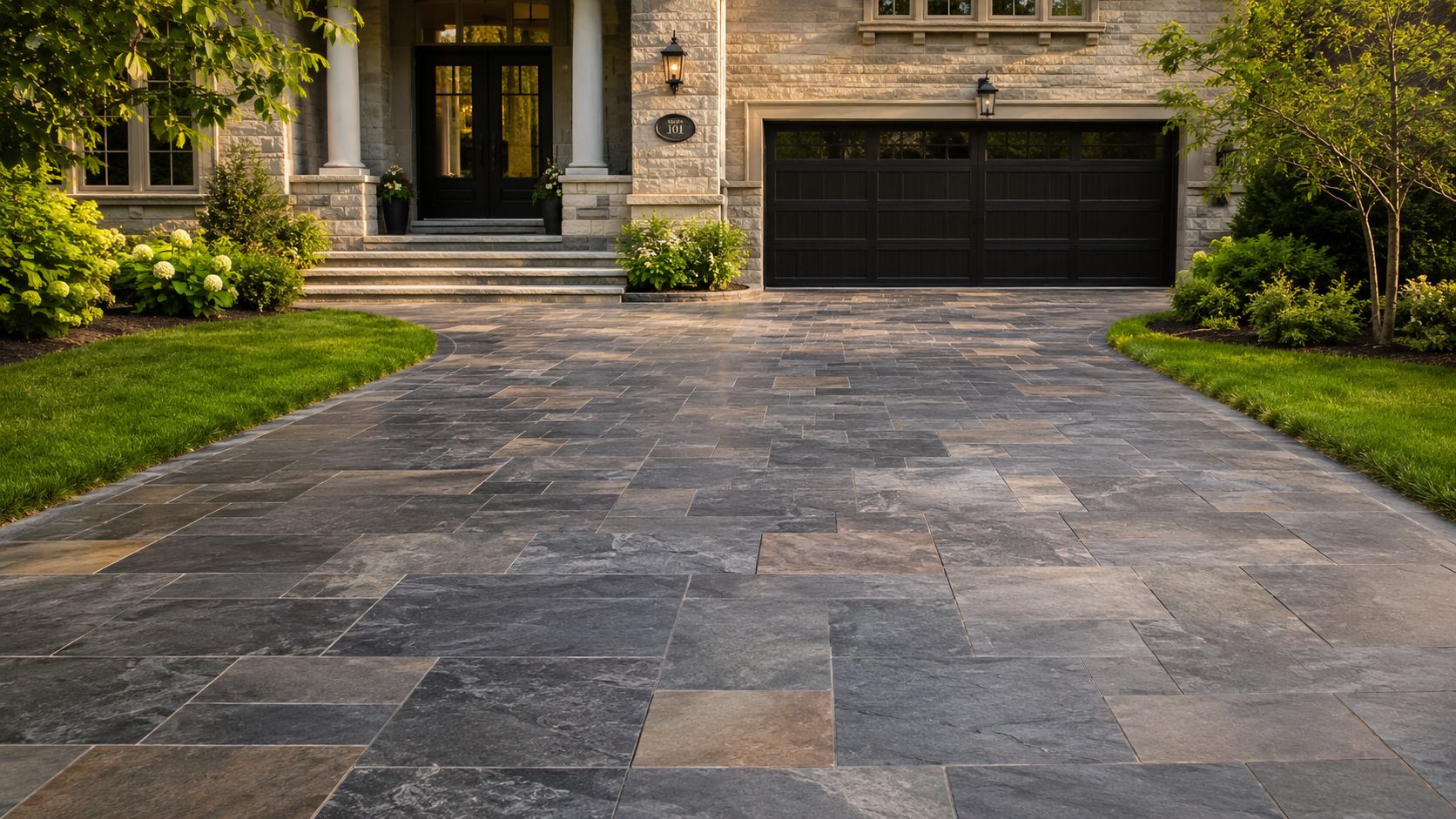
A restored Centretown home on Gilmour Street may need a driveway that supports formal masonry without imitating original natural slate. Ashlar slate uses large rectangular impressions in varied proportions, giving the surface an architectural rhythm suited to heritage influenced façades, brickwork, and masonry steps.
Slate tones can echo an existing stone foundation, while a renovated Edwardian home on Cooper Street may suit restrained charcoal with warm grey. A substantial Metcalfe Street residence could take a deeper border around a lighter central field. Keep the colour relationship deliberate. Test the proposed integral colour and antiquing release beside the actual brick, stone, siding, and front door.
Darker finishes can look refined, but medium neutrals usually make tire marks, organic debris, and minor staining less conspicuous.
Practical rule: Large patterns expose layout errors. Set accurate reference lines before stamping, because misaligned impressions, uneven joints, and distorted edges remain visible across broad slate shapes.
Details that protect the pattern
Set drainage before the pour. The installer should establish a slope that directs water away from the garage and foundation, then coordinate control joints with the slate layout. Planned joint locations help guide cracking away from prominent stone faces.
Review the stamped concrete finishes guide to compare slate, stone, and related surface treatments before selecting a finish. Plan the pour for stable, dry weather, specify an air entrained concrete mix, and confirm curing procedures in writing. Ottawa winters make premature finishing and poor sealing higher-risk choices.
Border details also affect installation. If posts, railings, or other fixtures meet the driveway, confirm their attachment method before placement. The XTREME EDEALS INC. anchoring guide offers relevant guidance for anchoring posts to concrete.
A quality sealer protects colour and reduces moisture and salt penetration. Annual resealing is not a universal rule, so match maintenance to exposure and surface condition. Confirm that the sealer suits the stamped texture, and keep garden borders clear enough for inspection and cleaning.
2. Cobblestone Pattern Driveways in the Glebe
Cobblestone works because its smaller repeated units create a familiar, established streetscape. In the Glebe, that visual rhythm can complement tree lined roads, older brick houses, and compact front yards without making the driveway look like an oversized modern slab.
A property near Fifth Avenue might use a consistent warm grey cobblestone field with a narrow darker edge. On Clemow Avenue, a muted variation of brown, clay, or sandstone can relate to surrounding brick. A Bank Street property could use a more defined border to separate the entrance from adjacent commercial paving and planting.
The pattern's strength is texture, but texture also collects debris. Leaves, grit, and winter residue settle into deeper joints, so seasonal cleaning needs to be part of the design decision rather than an afterthought.
Keep small patterns orderly
The installer should establish the driveway crown or slope before placing the forms, directing water away from the foundation. That grade matters more than the apparent irregularity of the stamp. A visually convincing cobblestone surface still fails if meltwater sits beside the garage or crosses a pedestrian route.
Choose a border that supports the field pattern instead of adding another competing texture. A simple soldier course effect can frame the driveway, while a contrasting release colour can define edges without requiring a separate material.
Coordinate with masonry: Compare samples against the home's brick in daylight, not only under showroom lighting.
Clean the joints: Use manual brushing or controlled pressure washing to remove seasonal buildup without damaging the sealer.
Moderate the colour: Earthier combinations tend to sit more comfortably beside mature landscaping than stark black and white contrasts.
Plan resealing: The appropriate interval depends on exposure, traffic, and sealer condition. One Ontario guide places resealing for decorative concrete within a broader 2 to 5 year range, as explained in this Ottawa concrete driveway lifespan discussion.
Cobblestone is a good choice when the goal is continuity. It's less suitable when the homeowner wants a visually quiet surface, because the repeated joints remain prominent from the street.
3. Random Stone Pattern Driveways in Kanata
Random stone suits Kanata homes that need a softer transition between contemporary architecture and informal landscaping. Instead of repeating identical rectangles, the pattern uses irregular stone shapes and organic joints, creating an impression closer to fieldstone or flagstone.
That approach can work particularly well in west end subdivisions where the home may have clean siding, dark trim, and a planting scheme built around ornamental grasses or natural stone. A Bridlewood property could use medium grey stones with subtle brown variation, while a Katimavik residence might pair a cooler palette with crisp concrete borders.
Randomness doesn't mean improvisation. The installer still needs a deliberate layout that avoids awkward slivers at the garage, sidewalk, and street apron. A pattern that looks natural in the middle of the driveway can appear careless if its edge pieces are too narrow or its joints terminate abruptly.
Test colour before committing
Ask for several full scale colour mockups, not only small chips. Irregular shapes distribute colour differently from uniform units, and a release agent may emphasize some joints more strongly than expected. View the samples beside the exterior masonry and proposed stone.
A random stone pattern is forgiving visually, but it isn't forgiving of a weak base or uncontrolled water.
The base must be compact and properly graded before concrete placement. Canadian driveway guidance recommends a minimum slab thickness of 100 millimetres for passenger vehicles, with 125 millimetres or more where trucks or recreational vehicles may park, as outlined in Canadian concrete driveway guidance. Reinforcement can help manage control joint spacing, but it doesn't eliminate cracking.
Use a sealer that unifies the colour without making the surface excessively glossy. A high sheen may highlight every irregularity and become slippery when wet. Ask the contractor how the finish will balance depth, traction, and winter cleaning.
The best landscaping border is usually simple. Repeating one stone tone in a low retaining edge or planting bed can make the driveway feel connected to the property rather than stamped as an isolated decorative surface.
4. Slate Texture With Border Accents in Centretown
A slate field with a contrasting border gives a driveway a defined frame. That distinction matters on urban lots where the driveway may sit close to a walkway, front steps, retaining wall, or neighbouring property line.
The central slate texture keeps the surface refined, while the border provides visual control. A multi storey heritage property on Metcalfe Street might use a charcoal edge around a soft grey field. A renovated townhouse near Sparks Street could reverse that relationship, with a darker slate centre and a restrained warm border that relates to brick or architectural trim.
Border width should respond to the driveway's actual proportions. A narrow drive can look crowded if the frame is too broad, while a large frontage may need a stronger edge to remain visible from the street. Draw the design to scale before construction, including the garage threshold, sidewalk connection, planting beds, and any required approach.
Treat the border as a construction detail
Multi colour concrete requires disciplined timing and placement. The contractor should explain how the border colour, release agent, stamp alignment, and control joints will be managed so the transition stays clean. A border that wanders or changes width weakens the entire design.
The stamped concrete border guide is useful when comparing framed layouts with full field patterns. Keep the border colour tied to an existing material, such as brick, stone, or dark window trim. Introducing a completely unrelated accent often makes the driveway look decorative for its own sake.
Ottawa's winter conditions also make sealing and drainage essential. For exterior concrete exposed to freeze thaw cycles and de icing chemicals, guidance citing CSA A23.1 recommends curing at a minimum of 10°C for 7 days, or until 70 percent of 28 day design compressive strength is reached, followed by at least one month of air drying before freeze thaw and deicer exposure, according to technical stamped concrete guidance. Discuss how the planned installation will meet that requirement.
5. Basketweave Pattern Driveways in the Glebe
Basketweave is a natural fit for homeowners who prefer traditional patterning over a more dramatic stone imitation. Its interlocking rectangular units create a woven visual effect that relates easily to the brick houses common throughout the Glebe.
On Fourth Avenue, a classic basketweave driveway can reinforce the proportions of an established façade. Along Bank Street, a two tone version may provide enough distinction to separate the property from the public realm. For a single family home in the residential core, a restrained earth tone often looks more convincing than a high contrast combination.
Pattern orientation affects the way the driveway meets the house. Run the visual direction toward the entrance when you want to lead the eye forward, or use the pattern to emphasize the width of the frontage. The contractor should review the layout at the garage and street edges before the concrete is placed.
Use colour variation with restraint
Two tones can add depth, but they should share a clear relationship. Warm brown and muted red may complement older brick, whereas a strong red and black combination can dominate the façade. Compare samples against both clean and weathered sections of the home's masonry.
Consistent joint depth is particularly important in a basketweave design. Uneven stamping can make the woven units appear to shift, especially where the driveway changes direction. The crew also needs to place control joints thoughtfully so they don't cut through the most visible parts of the pattern.
A light to medium surface usually offers a practical balance for a driveway. It can maintain the traditional look without making every tire mark or leaf stain obvious. Regular sweeping, prompt cleaning of fluid spills, and condition based resealing will help preserve colour depth.
Winter care should be conservative, especially during the first season. The Ontario Ready Mix Concrete Association recommends keeping stamped concrete clear of snow and ice during the first winter and using no deicer at all in that period. Its Ontario de icing guidance identifies sodium chloride as the preferred salt after the first winter, while sulfate and nitrate based products should never be used on concrete.
6. Brick Pattern Driveways With Colour Variation in Kanata
A brick pattern driveway can make a newer Kanata home feel more cohesive by extending the exterior masonry into the approach. The stamped surface imitates individual rectangular brick units and mortar joints, while controlled colour variation prevents the result from looking mechanically uniform.
For a brick colonial style home, match the driveway to the existing brick palette without trying to reproduce every individual shade. A Bridgeland property might use a warm clay base with subtle darker variation. A Katimavik new build could use a quieter taupe and red combination that supports contemporary trim rather than competing with it.
Herringbone is a useful layout when the homeowner wants stronger movement. A running bond feels calmer and can visually lengthen the approach. Either pattern needs a clear plan at the garage, sidewalk, and street transition, because poorly placed cuts can interrupt the brick illusion.
Build the colour story first
Request samples that show the full proposed range, including the base colour and release colour. The driveway should coordinate with the home's brick, but it doesn't need to be an exact match. A slightly quieter version often looks more integrated than a near identical copy that competes with the façade.
Confirm the base: Proper preparation supports a stable surface and cleaner pattern edges.
Control interruptions: Lay out the pattern to reduce awkward cuts around drains, corners, and thresholds.
Choose the sealer carefully: A compatible sealer helps protect the multi colour finish, but excessive gloss can make the surface look artificial.
Coordinate planting: Use gravel, edging stone, or planting bed mulch that supports the warm or cool direction of the brick palette.
Brick patterns can require more visual discipline than random stone. Their straight lines expose alignment errors, so ask to see previous driveway work rather than relying only on a brochure sample.
7. Travertine Look Driveways With a Slip Resistant Finish in Centretown
Travertine look concrete brings a warmer, more upscale stone character to an urban driveway. Its textured surface can soften the transition between a formal home, masonry steps, and carefully designed planting, but the finish must be selected with safety in mind.
A premium Centretown property near Metcalfe Street may suit pale limestone inspired colours with a darker edge. A high rise adjacent residence might use a restrained travertine texture to introduce warmth without adding another strong pattern. For households with older residents, traction deserves equal billing with appearance.
The surface should provide grip without becoming so rough that snow shovels catch or dirt becomes difficult to remove. Ask the contractor to explain the proposed slip resistant treatment, how it performs when wet, and how the texture will be maintained after sealing.
Design for winter movement
The driveway needs a drainage plan that prevents meltwater from collecting in textured depressions. Cleaning the surface regularly helps reduce the buildup that can harden into winter ice. Snow removal should be prompt, with care around decorative edges and joints.
The non slip stamped concrete sealer guide can help frame the conversation with a contractor. Don't accept a vague promise that a coating is “safe.” Ask what product will be used, how it changes the appearance, and what maintenance preserves its traction.
Safety first: During the first winter after installation, use mechanical snow removal and traction materials rather than deicer. Decorative concrete needs time to cure and dry before freeze thaw and chemical exposure.
A slightly more deliberate slope may help surface water move away, but the final grade must still connect properly with the garage, sidewalk, curb, and public approach. Avoid choosing travertine only for its luxury appearance. It works best when the homeowner is prepared to maintain the texture and renew the protective finish as needed.
8. Geometric Medallion Pattern Driveways in the Glebe and Kanata
A medallion turns the driveway into a focal point. The design may be a Celtic knot near a Glebe entrance, a starburst at a contemporary Kanata home, or a family crest inspired motif on a larger Ottawa property.
Placement matters more than size. Centre the feature where it can be seen from the approach without forcing vehicle tires to track directly over its most delicate details. At a narrow urban property, positioning it near the entry can create a clear arrival point. On a broader suburban frontage, a centred medallion can anchor the entire composition.
The surrounding field should remain relatively calm. Ashlar slate, a quiet stone texture, or a simple border gives the medallion room to read. Too many colours or secondary patterns turn a focal point into visual noise.
Custom work needs a paper plan
Develop the concept with the contractor or designer before the pour. Confirm the scale, orientation, colour contrast, relationship to the front door, and locations of control joints. Detailed designs require accurate stamping, and the crew may need additional installation time to keep curves, angles, and repeated elements consistent.
A high contrast medallion can look striking, but it also reveals fading and maintenance differences more readily than a single colour surface. Document the colour formula and layout for future repairs or sealing. Keep a record of the product names used, especially when the field and medallion receive different treatments.
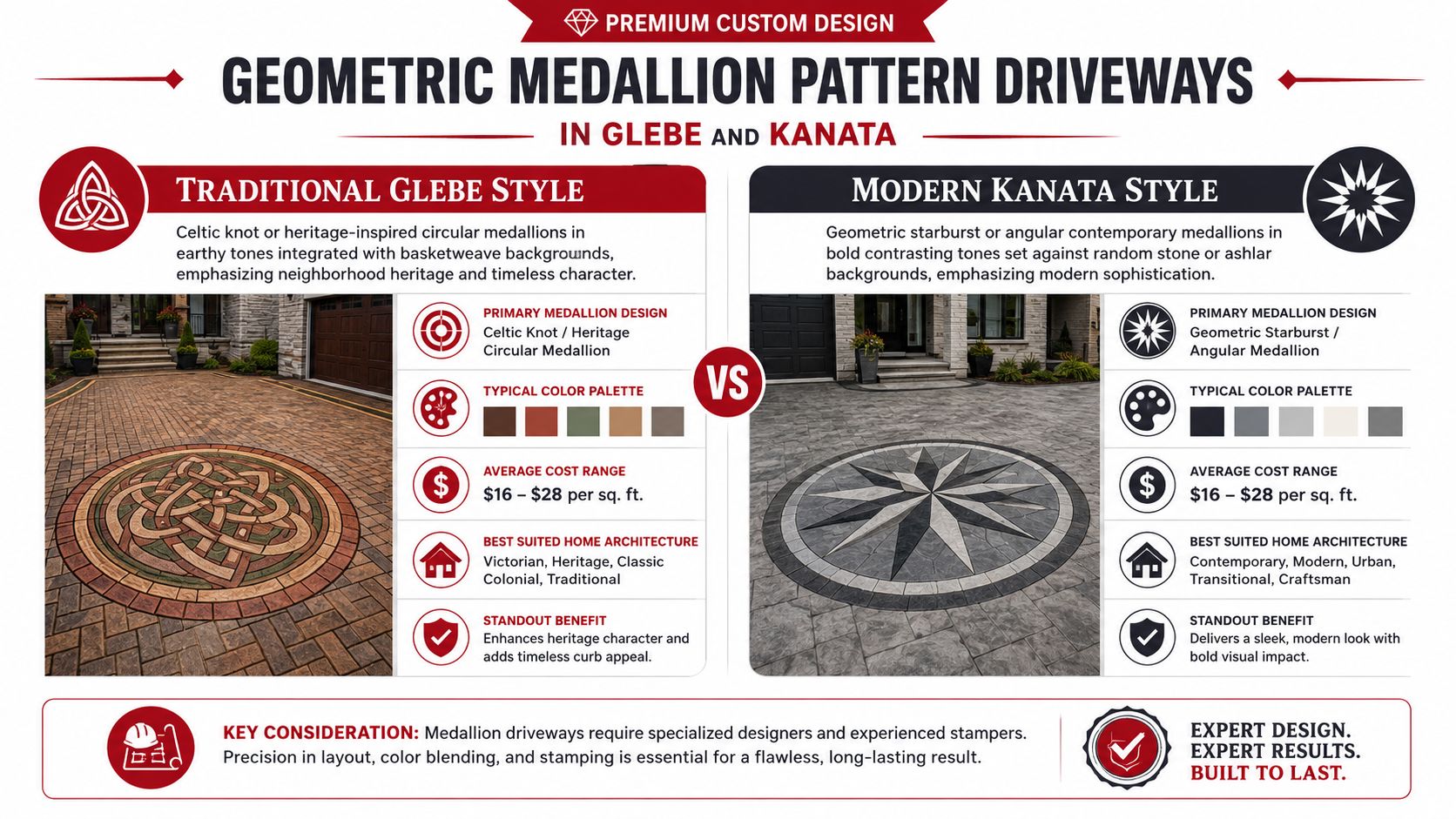
A medallion is the least forgiving option if the surrounding architecture has no connection to it. Use heritage geometry beside established brick and stone, modern angular forms beside contemporary façades, and a restrained palette when the landscaping already provides strong colour.
8-Style Stamped Concrete Driveway Comparison
Design | Implementation complexity | Resource requirements | Expected outcomes | Ideal use cases | Key advantages |
|---|---|---|---|---|---|
Ashlar Slate Pattern Driveways (Centretown) | Medium–High, professional stamping for authentic look | Skilled installer, quality sealer, colorants, proper base and drainage | Elegant large-rect stone appearance with durable concrete performance | Historic Victorian/Edwardian homes and heritage restorations in Centretown | High-end stone look at lower cost, durable in freeze–thaw, low maintenance vs real slate |
Cobblestone Pattern Driveways (Glebe) | Medium, detailed stamping with deep grout lines | Experienced stamper, regular cleaning tools, periodic sealing | Textured, dimensional European-style surface that hides minor settling | Tree-lined Glebe streets, traditional brick homes, small commercial fronts | Authentic European charm, visual depth, improved winter traction vs smooth concrete |
Random Stone Pattern Driveways (Kanata) | Medium–High, irregular stamping requires skill | Skilled contractor, color mockups, careful base prep | Natural, irregular fieldstone appearance that conceals imperfections | Contemporary suburban homes and new Kanata subdivisions | Forgiving installation, modern natural aesthetic, flexible color customization |
Slate Texture with Border Accents (Centretown) | High, multi-step stamping and color transitions | Specialized installers, multiple stamp techniques, higher labor | Framed, sophisticated driveway with defined edges and enhanced visibility | High-value Centretown properties and heritage restorations needing refined edges | Elegant framed look, improved property definition and nighttime visibility |
Basketweave Pattern Driveways (Glebe) | Medium, straightforward interlocking stamping | Standard stamped-concrete crew, optional two-tone coloring | Classic woven appearance that complements traditional architecture | Established Glebe neighborhoods and brick homes | Affordable, time-tested traditional design that hides minor surface variations |
Brick Pattern Driveways with Color Variation (Kanata) | Medium, multi-color application increases complexity | Color samples, careful layout planning, sealing, experienced stamper | Authentic brick-like paving look with flexible layouts (herringbone, running bond) | Brick-exterior homes and colonial styles in Kanata | Seamless match with brick exteriors, variety of layouts, durable concrete base |
Travertine Look with Slip Resistant Finish (Centretown) | High, textured surface and slip-resistant treatment required | Specialized slip-resistant materials, skilled applicator, periodic reapplication | Warm travertine appearance combined with improved traction and safety | Urban properties prioritizing safety (elderly residents) and Centretown residences | Superior slip resistance with luxury appearance; good for safety-conscious sites |
Geometric Medallion Pattern Driveways (Glebe & Kanata) | Very High, custom design and precision stamping | Designer collaboration, custom tools, expert stamper, longer install time | Distinctive artistic focal point that elevates curb appeal | High-end or custom homes seeking unique identity and statement drives | Unique property identity, bespoke artistic expression, high perceived value |
Turn Inspiration Into a Driveway Plan
The best stamped concrete driveway ideas are the ones that solve several problems at once. The pattern should suit the home, the colour should relate to existing materials, the borders should clarify the edges, and the installation plan should account for Ottawa's water, cold, and winter maintenance demands.
Established architecture usually benefits from ashlar slate or basketweave. Ashlar offers larger, more formal stone geometry, while basketweave reinforces traditional brick character. Cobblestone can support the Glebe's established streetscape, particularly when the colour stays close to surrounding masonry and the border remains restrained.
Random stone is more flexible for natural suburban integration. It works well in Kanata when the setting includes informal planting, stone edging, or mixed textures. The pattern can look relaxed, but the base, grade, joints, and slab thickness still need careful control. Decorative texture doesn't compensate for water moving toward the foundation or a poorly compacted base.
Brick patterns make sense when the house already has strong masonry. Coordinate the driveway with the exterior brick palette rather than chasing an exact copy. A herringbone arrangement can add movement, but straight patterns require precise layout at the garage, sidewalk, curb, and planting beds.
Add borders when the driveway needs definition. A framed edge can separate the vehicle surface from a walkway or planting bed and make a broad frontage feel more deliberate. Confirm the border width, colour transition, joint layout, and sealer before installation.
Reserve medallions for a clear focal point. A Celtic knot, starburst, or crest should connect to the home's architecture or the homeowner's story. It shouldn't be added because the centre of the driveway feels empty.
Review the practical details
Compare colour samples beside the actual house in changing daylight. Confirm how the contractor will handle drainage, control joints, air entrainment, curing, sealing, snow removal, and deicer restrictions. The Ontario guidance for first winter care is especially important, because keeping the new surface clear without deicer protects the vulnerable early exposure period.
Budget for the decorative finish as a premium surface. Regional Ottawa guides place stamped or decorative concrete at about $22 to $35 per square foot, compared with roughly $16 to $25 per square foot for standard broom finished concrete. On a typical 300 to 500 square foot driveway, that represents about $8,000 to $17,500 installed, according to Ottawa stamped concrete pricing guidance. Broader Ontario estimates place concrete driveways around $9 to $19 per square foot, with stamped finishes adding roughly $7 to $10 per square foot for the decorative upgrade.
Permits and property rules also belong in the first conversation, not after the design is complete. Ottawa requires a private approach permit to create, widen, or close a driveway, and the City states that permits are required for many driveway installations or modifications in its building permit FAQ. Zoning rules can also limit placement, width, and hard surface area. The City's zoning guidance states that a private approach must be at least 2.4 metres wide and no wider than 9.0 metres, and it can't exceed 50 percent of frontage in the stated circumstances, as described in the Ottawa zoning bylaw.
For a widening project, review the landscaping requirements as well. The City guide says hard surface into the public right of way can't exceed 50 percent of total frontage width, must maintain 0.3 metres from the neighbouring property line, and should remain at least 6 metres from an intersection, according to the Ottawa landscaping guide. These restrictions matter in Barrhaven, Nepean, Kanata, Stittsville, Orleans, the Glebe, and Centretown alike.
Ottawa Stamped Concrete is a local option for custom patterned driveways and related concrete work across Ottawa. Discuss the pattern, colour, drainage, winter care, permitting responsibilities, and sealing plan before approving the design. For homeowners planning other practical exterior improvements, even a resource about tips for a home wash bay can prompt useful questions about runoff, cleaning access, and surface maintenance.
Ottawa Stamped Concrete offers custom stamped driveway patterns, borders, finishes, and related concrete installations for homeowners across Barrhaven, Nepean, Kanata, Stittsville, Orleans, and the wider Ottawa area. Visit Ottawa Stamped Concrete to discuss a driveway concept that fits your home's character and Ottawa's winter conditions.
Comments