
Stamped Concrete Sealer Non Slip Safety for Ottawa Homes

When it comes to choosing a non slip stamped concrete sealer, the short answer is straightforward: pick a sealer system that is rated by wet Dynamic Coefficient of Friction, and pair it with a proven anti slip additive to achieve safe traction levels for outdoor spaces.
Table of Contents
Understanding the Key Concepts - Quick Benefits of Selecting High DCOF Sealers - Friction Comparison for Sealed Surfaces - How to Put This Into Practice
How Anti Slip Additives Transform Traction - How the Particles Create Grip - Application Tips for Consistent Distribution - Choosing Additives Available in Ottawa - Numbered Checklist for Homeowners
Regional Safety Standards and Performance Metrics - How Tests Work And What They Mean - Practical Performance Metrics For Ottawa Conditions - Local Application Notes
Selecting the Right Sealer for Pool Decks and Driveways - Pool Deck Recommendation - Driveway Recommendation - Comparing the Options - Sealer Selection by Application Area - Tips for Evaluating Proposals and Products
Professional Application Techniques for Lasting Safety - Mixing and Additive Suspension - Application Methods and Distribution - Environmental and Seasonal Considerations - Common On Site Mistakes and Contractor Checks
Maintenance Strategies to Preserve Traction Over Time - Seasonal Care for Ottawa Neighbourhoods - Monitoring Wear and Knowing When to Reseal - Quick Field Test and Local Example
Understanding the Key Concepts
Here is the problem with stamped concrete a glossy sealer creates a smooth film that drastically reduces traction, and it gets worse when the surface is wet.
If you are a homeowner in Ottawa, the number that actually matters is the Dynamic Coefficient of Friction, or DCOF. Think of it as a way to put a reliable number on something you would normally judge by feel alone.
Most regional safety guidelines flag a surface with a wet DCOF below 0.42 as risky for exterior walking areas. That is your baseline.
To put it in real numbers: standard sealed stamped concrete without any additive often lands in the 0.30 to 0.40 wet DCOF range. Add the right anti slip additive, and you are looking at 0.50 to 0.65 or higher. That jump on paper translates to the difference between a pool deck where people slip regularly and one where kids can run barefoot without worry.
Key insight: A glossy finish that looks beautiful when dry tells you absolutely nothing about how safe it will be during an Ottawa, Ontario spring rain or after a winter thaw.
Quick Benefits of Selecting High DCOF Sealers
Safer barefoot conditions around pool decks in Orleans, where splashing is just part of the routine
Reduced liability if you have got a busy walkway in Nepean seeing constant foot traffic
More reliable performance through Ottawa’s freeze thaw cycles, which tend to expose weak points in sealer films
Friction Comparison for Sealed Surfaces
One of the best things about the DCOF system is that it removes the guesswork. Instead of arguing about whether a surface "feels" grippy enough, you can look at actual measured values and compare them side by side.
Surface Condition | Wet DCOF Range | Safety Rating |
|---|---|---|
Sealed without additive | 0.30–0.40 | Unsafe |
Sealed with medium grit additive | 0.45–0.55 | Acceptable |
Sealed with fine high density additive | 0.50–0.65+ | Preferred |
This comparison shows that a non slip approach for stamped concrete is measurable, not subjective. Those numbers give you a way to push back on vague product claims or contractor promises.
How to Put This Into Practice
Ask your contractor for wet DCOF test results from the exact sealer and additive combination they plan to use not a similar product, the actual one.
Request a test patch in an inconspicuous spot so you can see and feel the finished result before committing to the whole project.
Prioritise systems that document a DCOF above 0.50 for pool edges and above 0.45 for driveways those are the areas where a slip carries the most consequence.
Read also: Walkway Sealing Best Practices in Ottawa
How Anti Slip Additives Transform Traction
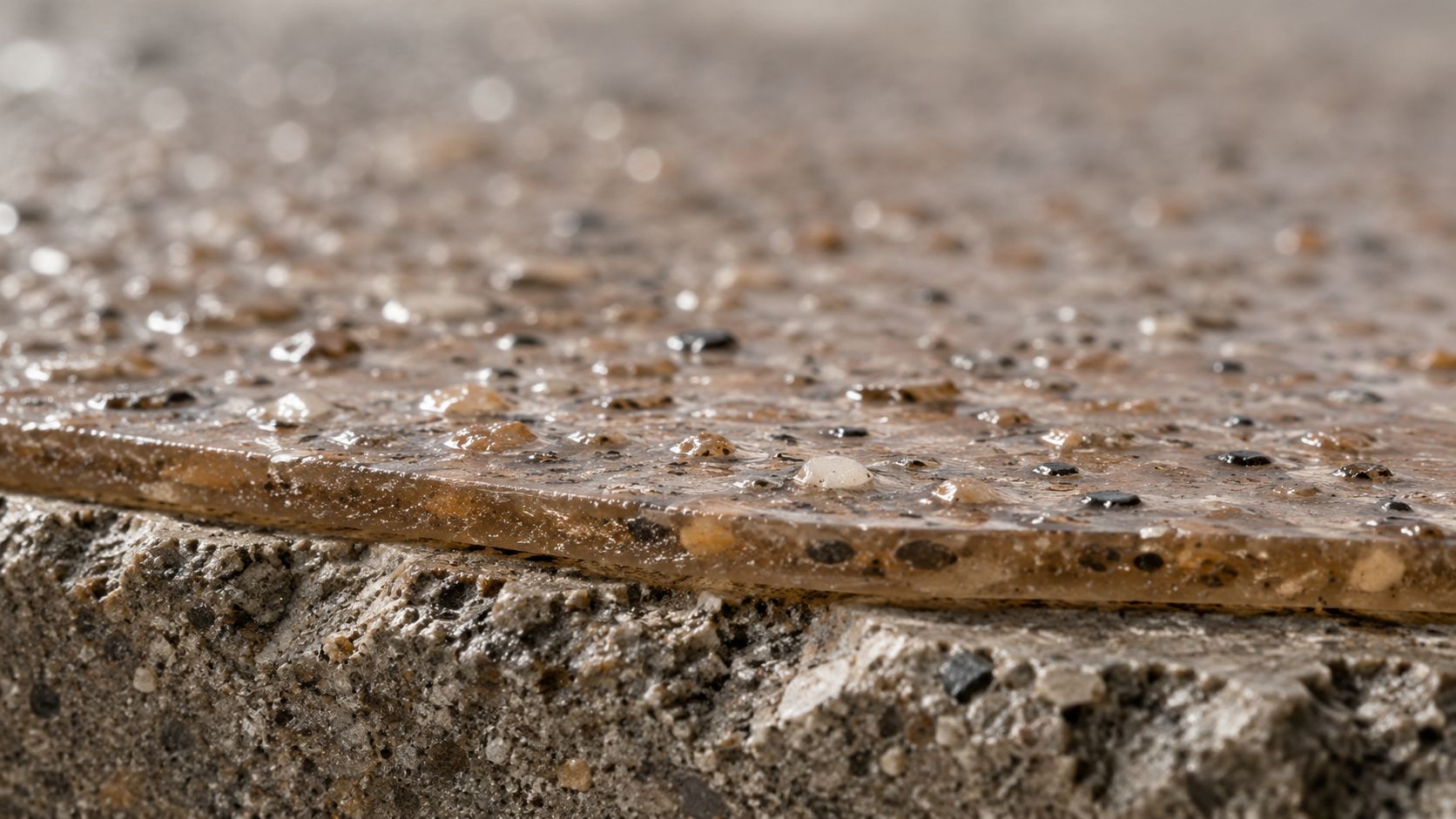
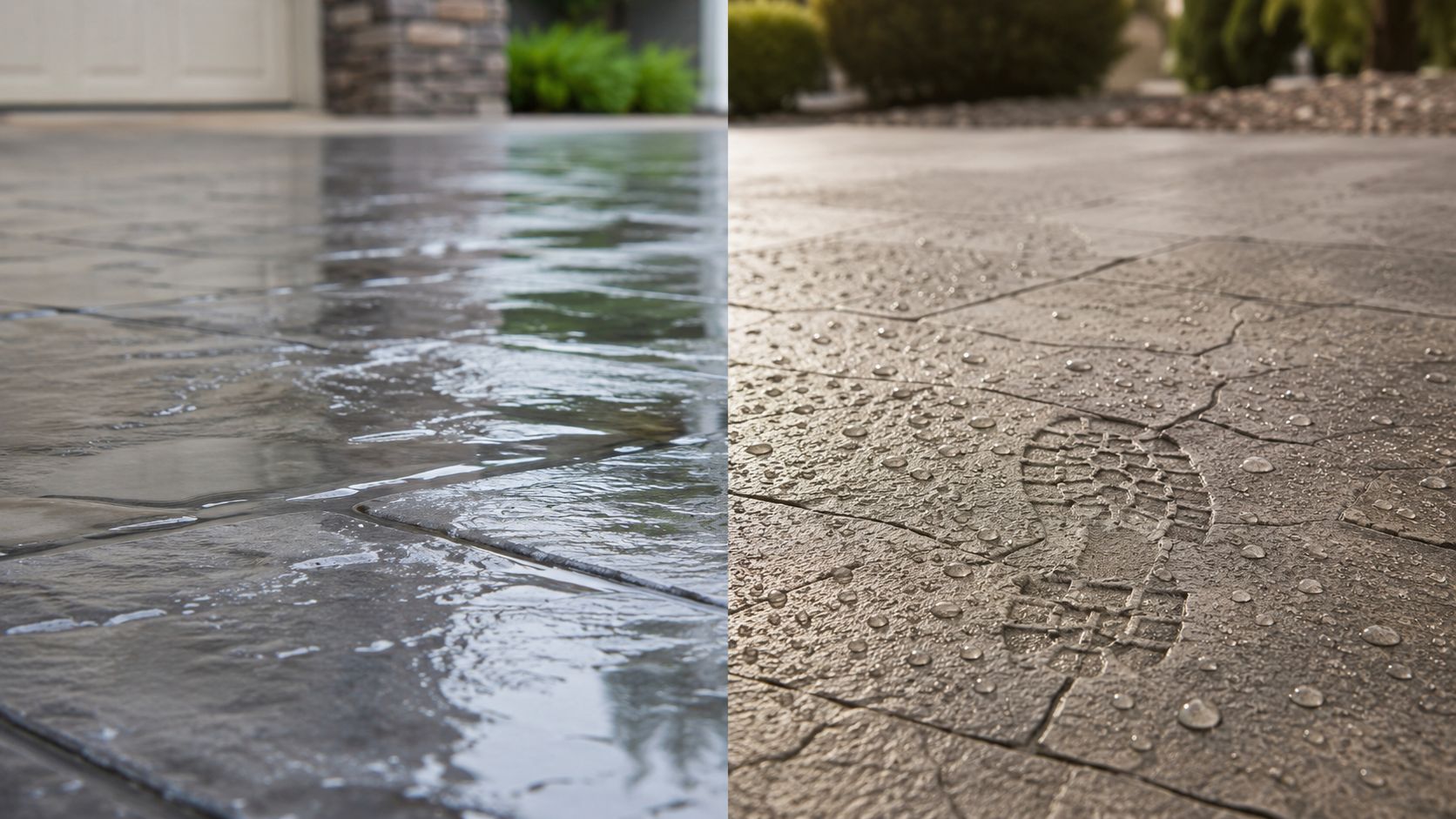
Picture a fresh coat of sealer on your stamped concrete. It looks great and protects the surface, but add a little water and the floor becomes slick. Anti slip additives act like microscopic grit embedded in that sealer, breaking up the slickness and giving your feet something to hold onto.
Not all additives work the same way, though. Think of them like different types of road surfaces. Fine polymer grit feels relatively smooth underfoot but boosts wet traction into the 0.50 to 0.60 DCOF range, making it perfect for barefoot zones. Coarser silica or aluminium oxide feels more like textured asphalt, which is exactly what you want on a driveway where tyres need to bite.
How the Particles Create Grip
When the sealer cures, it creates a smooth, continuous film that naturally reduces friction. The additive particles push through this film, breaking up the flat surface and creating tiny anchor points for shoes and bare feet. Because of this, even a thin layer of additive can significantly raise the wet DCOF, cutting down on slips around pool edges in Orleans.
Small particles do the heavy lifting here. They break up the film and offer bite right where water would otherwise create a slippery layer.
How you mix and apply the additive matters just as much as which type you choose. If the grit settles to the bottom of the can during application, you end up with patchy traction and inconsistent safety. Proper mixing keeps the particles suspended long enough to spread evenly across large patios in Kanata.
Application Tips for Consistent Distribution
Pre mix additives according to the manufacturer's ratios to prevent clumping and under dosing.
Use a garden sprayer for light coats, or a roller for higher density applications, depending on the sealer's viscosity.
Always test an inconspicuous patch first to confirm the feel for both barefoot traffic and tyre interaction.
The right density depends entirely on how the space is used. Pool decks require a higher density of fine grit to ensure comfortable barefoot grip. Driveways, meanwhile, need a medium density of coarser grit to balance traction with tyre wear and overall aesthetics.
Choosing Additives Available in Ottawa
Silica sand variants provide long lasting mechanical grip and resist polishing underfoot.
Polymer beads are gentler on bare feet, making them the go to choice around pools in Barrhaven.
Aluminium oxide offers the highest abrasion resistance for heavy traffic areas in Nepean, though it can feel quite rough under bare feet.
Think of the choice like picking out shoe soles. Polymer beads are like running shoes soft yet grippy. Aluminium oxide is like a hiking boot sole, sacrificing softness for serious durability.
Tip from the Field: Additives are not one size fits all. Choose based on traffic type and comfort expectations.
Short term tests are simple but revealing. Apply a test patch, wet it down, and walk across it both barefoot and in shoes. If the patch improves the slip feel and scores above 0.50 DCOF on your contractor supplied test, you have a practical match for poolside use.
Numbered Checklist for Homeowners
Identify the primary use zone barefoot heavy or vehicle traffic.
Choose the additive type based on comfort and longevity.
Confirm the mixing and application plan to prevent settling.
Request a test patch and DCOF measurement from your installer.
With the right additive and a proper application, traction becomes a predictable property you can specify. This turns a decorative stamped concrete sealer non slip system from a hopeful claim into a measurable safety feature for Ottawa homes.
Regional Safety Standards and Performance Metrics
If you are a homeowner in Stittsville or anywhere around Ottawa, you need reliable ways to judge how well a stamped concrete sealer will perform when wet. The key metric here is the Dynamic Coefficient of Friction, or DCOF a repeatable number that lets you compare products objectively. As a rule of thumb, most regional safety guidance flags wet DCOF below 0.42 as risky for outdoor walking surfaces, so that is a solid baseline to keep in mind.
But what do these numbers actually mean in real life? Think about the difference between walking on a glass tabletop and a rough sidewalk after a rainstorm. A surface with a DCOF of 0.30 feels like stepping on polished stone smooth and potentially slippery. Bump that up to 0.55, and you are walking on textured tile that grips your feet even when wet.
How Tests Work And What They Mean
Wet DCOF testing mimics what happens when your foot slides slightly across a wet surface. It is a practical method that contractors rely on when choosing sealers for pool decks in Orleans or driveways in Kanata. Rather than quoting generic numbers for entire product lines, manufacturers typically provide DCOF data for specific sealer and additive combinations.
The test methods mirror real world use, so the numbers actually reflect what you will experience at home.
For pool edges where people walk barefoot, aim for 0.50 or higher.
For driveways where tyres and shoes need reliable traction, target 0.45 or above.
Having a measurable DCOF takes the guesswork out of the equation. It gives you documented proof that a stamped concrete sealer non slip system will hold up when it matters most.
The data backs this up. Studies and field trials consistently show that fall incidents drop significantly when wet DCOF climbs from the 0.30–0.40 range into 0.50 and above. That is not just a statistical blip it is a meaningful difference for family safety and liability protection, especially in areas like Barrhaven and Nepean.
Practical Performance Metrics For Ottawa Conditions
Local suppliers focus heavily on slip resistance around pools and busy entrances where moisture is a constant factor. Ottawa’s freeze thaw cycles and deicing salts take a toll on surfaces, affecting how products age and how long their DCOF holds up. A sealer that tests at 0.55 when fresh but drops below 0.42 after a few seasons is not cutting it.
Here is a straightforward checklist for choosing products:
Ask for wet DCOF data specific to the exact sealer and additive mix your contractor plans to use.
If liability is a concern, insist on a test patch and independent DCOF measurement.
Look for systems that document sustained DCOF above 0.50 for pool areas and 0.45 for driveways.
Local Application Notes
For pool decks in Orleans, finer grit additives can achieve 0.50–0.65 without feeling rough under bare feet.
For driveways in Kanata and Nepean, coarser blends offer a good balance between grip and tyre wear while maintaining wet DCOF above 0.45.
Consistent testing and straightforward metrics give Ottawa homeowners a clear way to compare stamped concrete sealer non slip options and to protect their families from preventable slips.
Selecting the Right Sealer for Pool Decks and Driveways
Picking the right non slip sealer for stamped concrete really comes down to how the space will be used and what it has to endure. Pool decks and driveways face completely different challenges, so a one size fits all approach just does not work.
Pool decks need a barefoot friendly surface that performs well when constantly wet and exposed to chlorine. Driveways demand abrasion resistance and freeze thaw durability to survive Ottawa, Ontario winters.
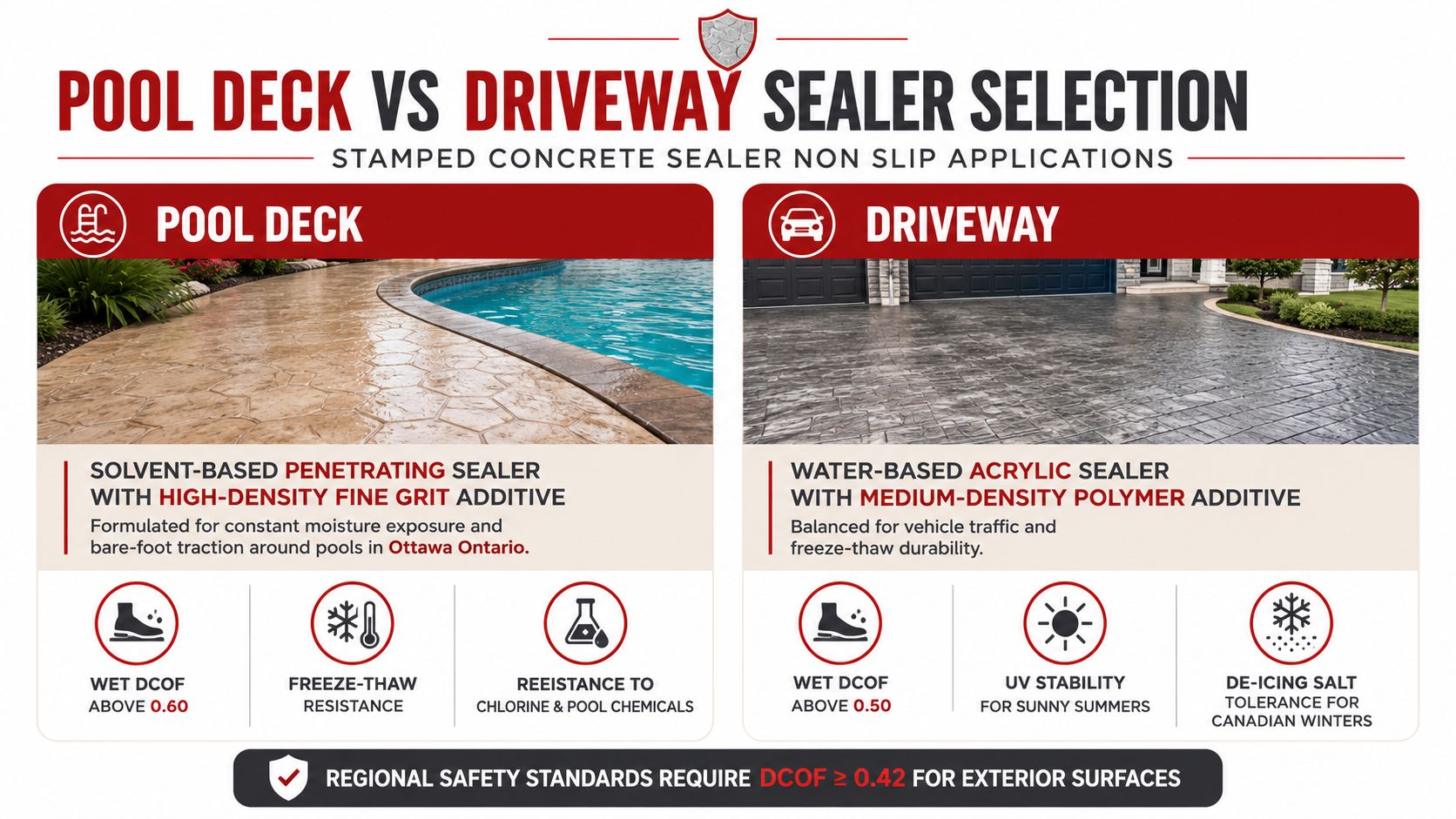
The comparison chart above breaks down the trade offs between two common setups: a solvent based penetrating sealer with a high density fine grit additive for pool decks, and a water based acrylic sealer with a medium density polymer additive for driveways.
Looking at the data, pool decks need a wet DCOF above 0.60 to keep barefoot traffic safe, whereas driveways can target a wet DCOF above 0.50 to protect tyres and footwear. For context, regional safety standards set a baseline wet DCOF of 0.42 for exterior surfaces, meaning both recommended options provide a comfortable safety margin.
Pool Deck Recommendation
When it comes to pool surrounds, solvent based penetrating sealers usually win out. They soak into the concrete rather than sitting on top, which prevents that thick film from peeling apart during freeze thaw cycles.
These systems handle brief water pooling and resist chlorine exposure far better than most water based acrylics.
Mix in a high density fine grit additive to hit those wet DCOF targets above 0.60 without making the surface uncomfortable to walk on barefoot.
Stick to a low to medium gloss level. High gloss might look nice, but it creates a slick sheen when wet that kills traction.
Expert takeaway: A penetrating solvent system with fine grit behaves like textured tile underfoot when wet, giving confident barefoot traction right next to the pool.
If you own a home in Barrhaven with a tiled stamped pattern, go with the solvent option and ask your supplier for the specific DCOF data.
Driveway Recommendation
Water based acrylic sealers are a solid pick for driveways. They hold up well against UV rays, meet VOC regulations, and form a tough protective film over the concrete.
Choose a water based acrylic paired with a medium density polymer additive. This balances grip with tyre wear.
Aim for a wet DCOF above 0.50. This keeps things safe without creating an aggressive roughness that wears down tyres prematurely.
You can opt for a medium to high gloss finish, but understand the trade off: you will sacrifice a bit of traction and likely need to maintain the surface more often.
Numbered checklist for selection:
Verify the wet DCOF values for the exact sealer and additive combination.
Weigh the pros and cons of solvent based versus water based systems for your specific site conditions.
Request a test patch and actually walk on it barefoot and with shoes when it is wet.
Comparing the Options
Choosing the right product depends heavily on the application area and the specific demands of that space. Below is a quick guide to matching sealer types and additive densities to your project.
Sealer Selection by Application Area
Application Area | Recommended Sealer Type | Additive Density |
|---|---|---|
Pool Deck | Solvent based penetrating sealer | High density fine grit |
Driveway | Water based acrylic sealer | Medium density polymer |
Matching the sealer to the environment ensures the finish lasts and performs safely under pressure.
Living in Ottawa, Ontario, means dealing with harsh freeze thaw cycles and heavy deicing salt use. Solvent based penetrating systems reduce the risk of peeling around pool areas, while water based acrylics resist UV fading and handle the spring sun better on driveways.
Safety insight: Driveway systems should prioritise sustained DCOF retention across seasons, not just initial numbers.
Tips for Evaluating Proposals and Products
Ask contractors for DCOF test results for the exact product mix they plan to use.
Insist on a written maintenance plan that specifies reseal intervals, factoring in Ottawa's freeze thaw stressors.
If you are a DIY buyer, pick products with clear mixing and settling instructions to avoid uneven additive distribution.
For a deeper dive into safety and finishes, learn more about pool decks and non-slip options in our detailed guide for Ottawa homeowners.
Professional Application Techniques for Lasting Safety
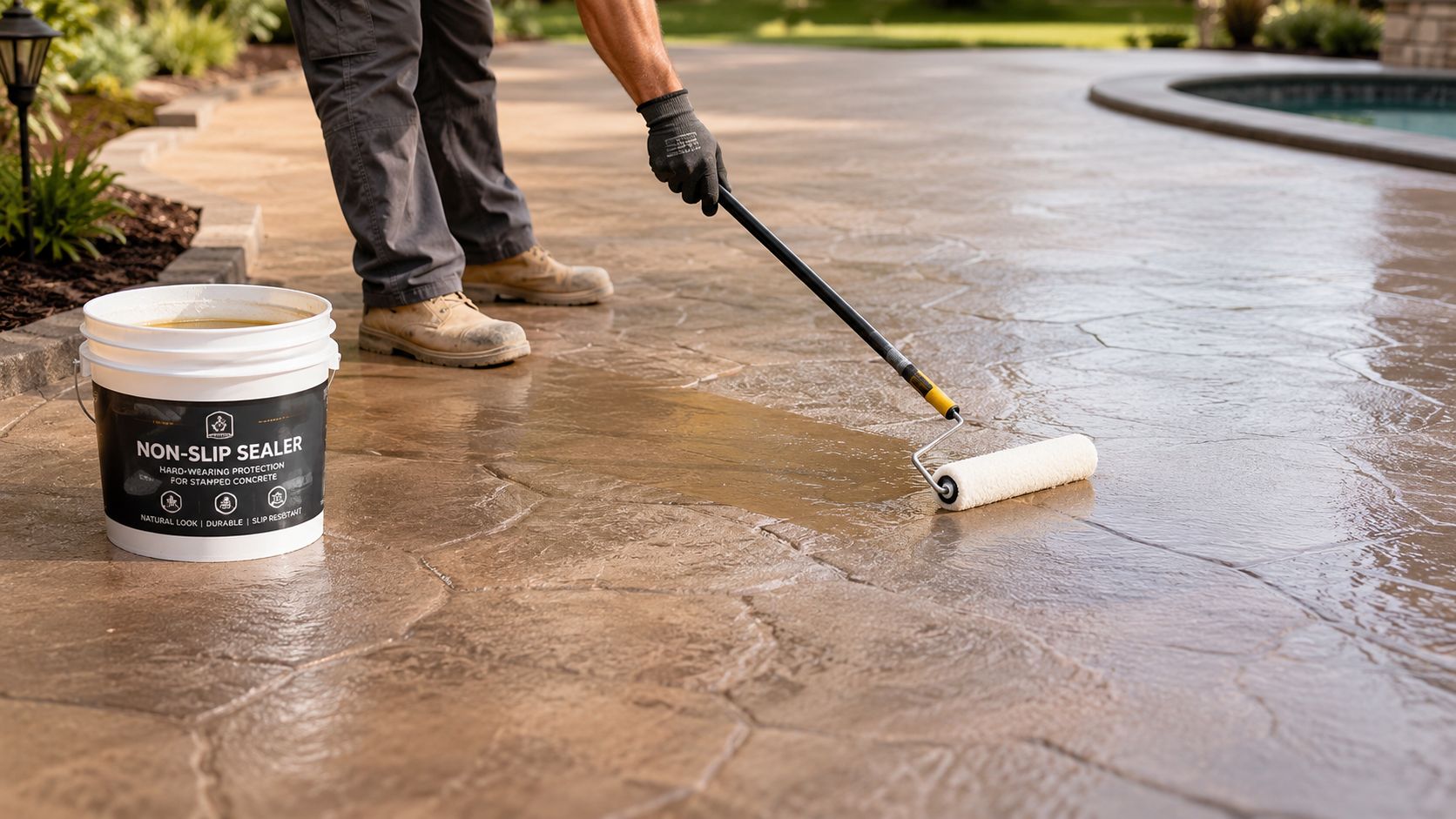
Getting the application right is what transforms a non slip stamped concrete sealer from a marketing claim into actual safety for your family and guests. It all starts with the surface.
You need a clean, repaired base for the sealer to bond properly. That means pressure washing at the correct PSI, clearing away efflorescence, and filling in any hairline cracks before you even pop the lid on the sealer. Skip the etching or leave debris behind like we often see on rushed Kanata patio jobs and you will notice patchy traction in a matter of weeks. Once the prep is solid, you can move on to mixing and applying.
Mixing and Additive Suspension
Always follow the manufacturer's ratio when blending additives into the sealer; under dosing is a fast track to a slippery surface. Keep the mixture stirring slowly and constantly while you work to stop the grit from settling at the bottom, which leaves you with uneven grip.
A drill with a paddle attachment keeps polymer beads or silica sand fully suspended.
Mix in smaller batches to cut down the time between mixing and rolling for a more consistent finish.
For longer projects, like driveways in Stittsville, plan to remix every 20 to 30 minutes.
Keeping the mix agitated is the simplest trick I know to prevent half the reseal failures I see on Ottawa job sites.
Application Methods and Distribution
How you apply the sealer changes how the anti slip particles land. Rollers push the additive into the top film, while low pressure spraying gives you a lighter, more even dusting.
For pool decks, use a roller to embed fine polymer grit it is much more comfortable under bare feet.
For driveways, a spray and back roll technique spreads medium density grit evenly without clumping.
Overlap your passes by 30 percent to avoid striping and make sure you cover joints and accents completely.
Before committing to a whole area, always test a small patch to check the texture and DCOF performance.
Environmental and Seasonal Considerations
Ottawa's temperature and humidity play a huge role in how the sealer cures and sticks. Aim to apply when it is between 10 and 25 degrees Celsius, and make sure there is no freeze in the forecast for at least 24 hours.
High humidity drags out the cure time and can trap moisture beneath the film.
If it is too hot, the sealer skins over too fast, trapping the additive and creating weak spots.
Common On Site Mistakes and Contractor Checks
One of the biggest mistakes we see is skipping the test patch or not double checking the mixing ratios right there on site. If you are hiring this out, ask your installer for a wet DCOF reading from the exact mix they are using.
Watch to make sure the contractor remixes the batch during application.
Check their equipment settings, whether it is spray atomization or roller nap size.
Ask to see a cured test patch and walk across it yourself both barefoot and with shoes while it is wet.
The quality of the workmanship matters just as much as the product itself. A proper mix and even coverage are what separate a surface that tests at 0.50 DCOF from one that fails.
These simple checks protect both your investment and your family. Any reputable contractor serving Barrhaven, Nepean, Orleans, Kanata, and Stittsville should be willing to provide written mixing ratios, a test patch, and a clear timeline for cure and recoat windows.
Maintenance Strategies to Preserve Traction Over Time
Maintaining a non slip sealer system is an ongoing process, one that protects both safety and curb appeal for your stamped concrete in Ottawa, Ontario. Regular care prevents those crucial additives from wearing away, helping the surface hold onto its wet Dynamic Coefficient of Friction through multiple freeze thaw cycles.
Start with gentle cleaning methods that lift grit and organic debris without stripping the additive. A soft bristle broom or a low pressure power wash staying under 1500 PSI does the job. This approach removes buildup that masks traction while avoiding high pressure that can erode the sealer film itself.
For stubborn stains, a two step routine works well.
Apply a pH neutral cleaner to loosen the grime, then rinse thoroughly.
Spot treat oil or grease with an appropriate concrete degreaser, and rinse well to avoid any residue that can reduce slip resistance.
Seasonal Care for Ottawa Neighbourhoods
Winter maintenance in Orleans and Barrhaven demands special attention because deicing salts and heavy shovelling can degrade sealer integrity. Skip metal shovels that scrape the film. Instead, use plastic snow shovels or snow blowers that move snow without abrading the surface.
When it comes to deicing products, lean toward brine or calcium magnesium acetate options where you can. Rock salt and sodium chloride melt ice effectively, but they can leach into sealer binders and reduce DCOF over time especially on driveways in Kanata where the exposure is constant.
Monitoring Wear and Knowing When to Reseal
Track wear patterns by inspecting high traffic zones monthly: think driveway entrances, porch steps, and pool edges. Look for shiny pathways where the additive has polished away, or smooth spots near garage thresholds where tyres and boots concentrate wear.
Regular checks prevent surprises later and let you schedule resealing before safety drops below acceptable levels.
A practical reseal schedule for most Ottawa homes runs every two to three years for driveways, and every one to two years for pool decks that see heavy barefoot use. Adjust the timing based on traffic, chemical exposure, and observed DCOF trends from test patches.
Quick Field Test and Local Example
Try a simple home test: wet a small patch and walk across it in shoes, then barefoot. If it feels noticeably slick compared to a less used area, plan a test patch with your contractor to measure wet DCOF and confirm the right additive density.
As a real world case, residents in Nepean noticed reduced grip after three winters of salt use. A spot test and a targeted reseal with a fine polymer additive restored barefoot friendly traction without significantly altering the finish.
Maintenance Best Practices Checklist
Sweep and rinse weekly to prevent abrasive grit buildup.
Use pH neutral cleaners and avoid solvents that dissolve polymer binders.
Shovel with plastic blades and choose low corrosive deicers.
Keep a reseal log with dates and materials used to spot patterns.
Request a DCOF check after resealing to verify performance.
For restoration projects and professional reseal options in Ottawa, check practical guidance and contractor services at Learn more about restoration and resealing in Ottawa by visiting our restoration guide.
For reliable stamped concrete work in Ottawa, trust Ottawa Stamped Concrete https://www.stampedconcrete-ottawa.ca
Comments