
Stamped Concrete Driveway Border: Design and Installation

You step outside after Ottawa's first serious thaw and notice the driveway edge has started to crumble. The surface may still look acceptable from the street, but the border is chipping near the curb, separating at a joint, or holding dirty meltwater against the slab. That small strip of concrete often tells you more about the driveway's installation quality than the pattern itself.
A stamped concrete driveway border can give a plain driveway the appearance of brick, slate, or stone while helping define the perimeter. It also sits in one of the hardest working zones on the property, where plow blades, runoff, vehicle loads, and de icing residues meet. In Ottawa, the border has to be designed as part of a vehicle rated concrete system, not treated as decorative trim added after the structural decisions are made.
Table of Contents
Why Your Driveway Border Matters More Than You Think - The border is a working edge
Choosing the Right Border Design for Your Driveway - Comparing the main patterns
Structural Specifications That Survive Ottawa Winters - Build the edge into the slab
Permits and Zoning Rules for Ottawa Driveway Borders - What can trigger review
Installation Process From Excavation to Final Cure - Prepare the ground and forms - Place, stamp, and protect
Winter Maintenance and Sealing for Long Lasting Borders - Seal for exposure, not appearance alone
Why Your Driveway Border Matters More Than You Think
A homeowner in Barrhaven or Orleans may first notice border damage as a cosmetic problem. The edge looks ragged after winter, the colour has faded, or a narrow crack has opened where the border meets the driveway field. In practice, that damage often points to a deeper issue, such as weak edge support, poor drainage, inadequate curing, or a surface that was finished without accounting for Ottawa's exposure conditions.
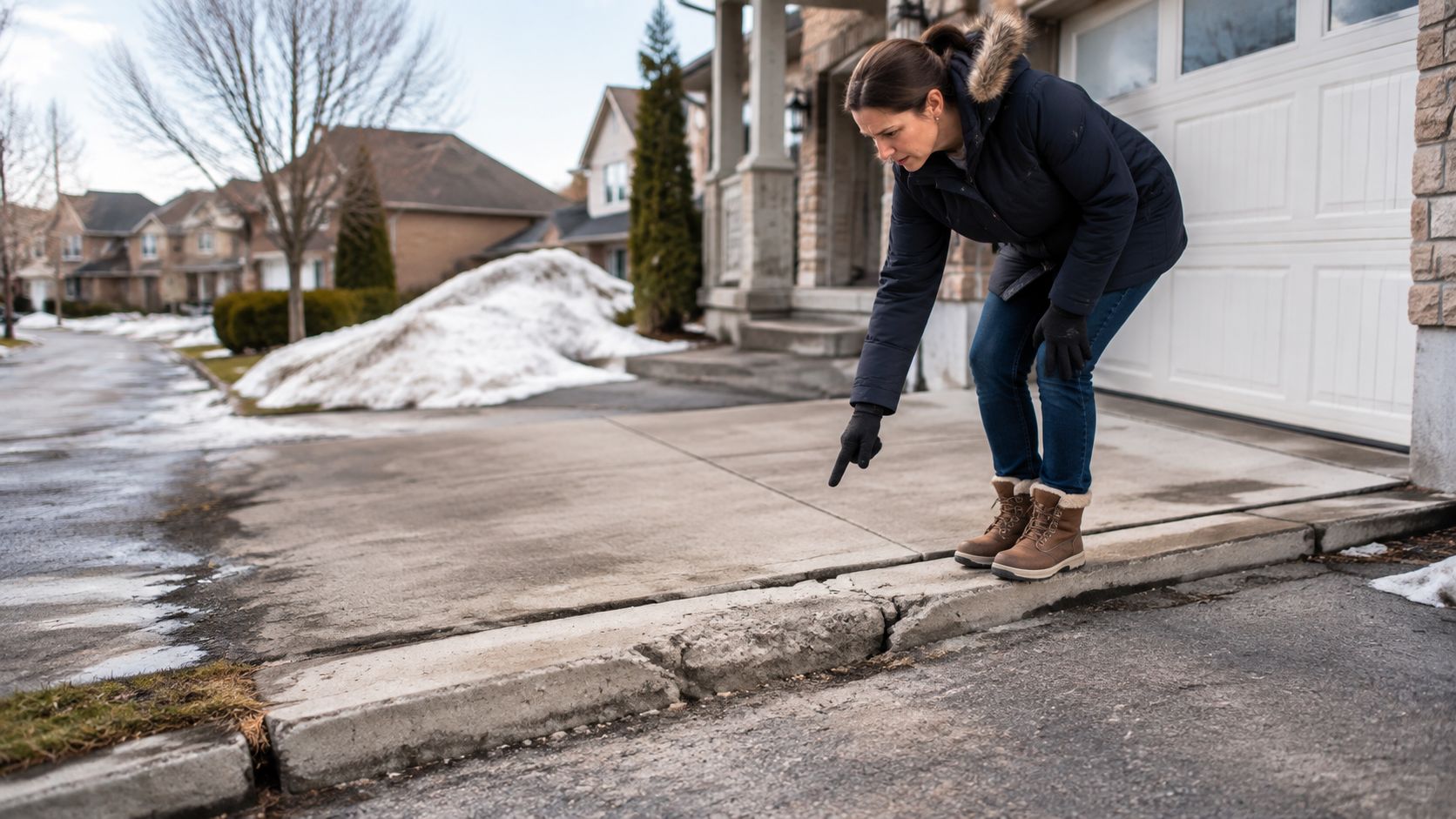
The border receives concentrated abuse. A snowplow blade can catch the outside edge, while salt laden slush collects where the driveway meets the curb or lawn. Water enters small surface imperfections, freezes, expands, and then creates more room for the next cycle. Canadian guidance warns that snow, standing water, and de icing chemicals can penetrate concrete and accelerate deterioration, while road apron areas and parking spots commonly receive damaging de icing residues. Travelers Canada's concrete driveway maintenance guidance recommends prompt snow removal, avoiding salt and chemical de icers, and using sand instead.
The border is a working edge
Across Ottawa neighbourhoods, recurring failure patterns include edge chipping, separation at joints, surface scaling, and washout beneath the outside strip. A border can't correct a poorly compacted base, but a properly formed and reinforced border can give the perimeter a defined load path and a more controlled transition between the driveway and surrounding grade.
That distinction matters. A decorative band poured over unstable soil may look excellent on installation day and still fail at the first vulnerable edge. A border integrated with the driveway layout, joints, drainage, reinforcement, and exposure appropriate concrete mix is more likely to remain useful as well as attractive.
Practical rule: Choose the pattern after the contractor has explained how the border will carry vehicles, shed water, and meet the curb.
A border can also make maintenance problems easier to see. If the band has a contrasting colour or texture, early joint movement and salt residue stand out before the entire driveway deteriorates. For broader edge planning, homeowners can also review this guide to concrete landscape border design, but driveway borders need vehicle rated detailing rather than pedestrian only construction.
Choosing the Right Border Design for Your Driveway
Pattern choice should follow the driveway's proportions and exposure, not lead the conversation. A soldier course brick pattern gives a crisp architectural edge, while cobblestone creates a busier, more traditional appearance. Slate tile edging tends to look broader and quieter, and custom stamped banding allows the contractor to coordinate a border with the house, walkway, porch, or existing patio.
Ottawa homes vary considerably. A narrow driveway in Nepean can be overwhelmed by a broad, heavily textured band, while a wide approach in Kanata may make a thin border disappear. The right width is the one that reads clearly from the street without reducing the usable access corridor or making the driveway feel visually crowded.
Comparing the main patterns
Border Pattern | Freeze Thaw Durability | Visual Impact | Installation Complexity | Best For |
|---|---|---|---|---|
Soldier course brick | Strong when the concrete, joints, and curing are correct | Clean, formal, and easy to coordinate with brick homes | Moderate, with careful alignment required | Traditional Ottawa homes and straight driveways |
Cobblestone medallion border | Good, but many pattern impressions require disciplined finishing | High visual interest and a more established appearance | Higher, especially around corners and transitions | Curved approaches and homes with stone detailing |
Slate tile edging | Strong when texture does not trap water and the surface is properly sealed | Broad, contemporary, and less busy | Moderate to high, depending on the stamp and layout | Modern homes and wider driveways |
Custom stamped banding with contrasting colours | Depends heavily on mix, finishing, joint layout, and sealer | Most adaptable, with strong contrast available | High, because colour and stamp alignment must be controlled | Coordinated driveway, walkway, and patio designs |
Pattern depth deserves more attention than most design galleries give it. Deep texture can provide a convincing stone effect, but it also creates recesses where water and residue collect. A poor application or uneven finishing can create ponding. Windsor's standard states that ponding caused by pattern depth, improper application, or finishing errors isn't acceptable, and driveway approaches normally use broom finish unless stamped or patterned concrete receives specific approval. The City of Windsor's concrete standard illustrates why the finish must be judged as drainage work, not merely decoration.
Colour affects maintenance as well. Light and medium earth tones generally make salt residue, tyre marks, and oil spots less conspicuous than very dark colours. A warm grey, muted sandstone, or restrained brick tone usually ages more gracefully than a dramatic near black band. The border should complement the field, not compete with the front facade.
For homeowners comparing textures and finishes, this overview of concrete finish types is useful. The practical choice still comes down to three questions: will the pattern drain properly, can the crew align its joints with the driveway, and will the colour remain convincing after winter maintenance?
Structural Specifications That Survive Ottawa Winters
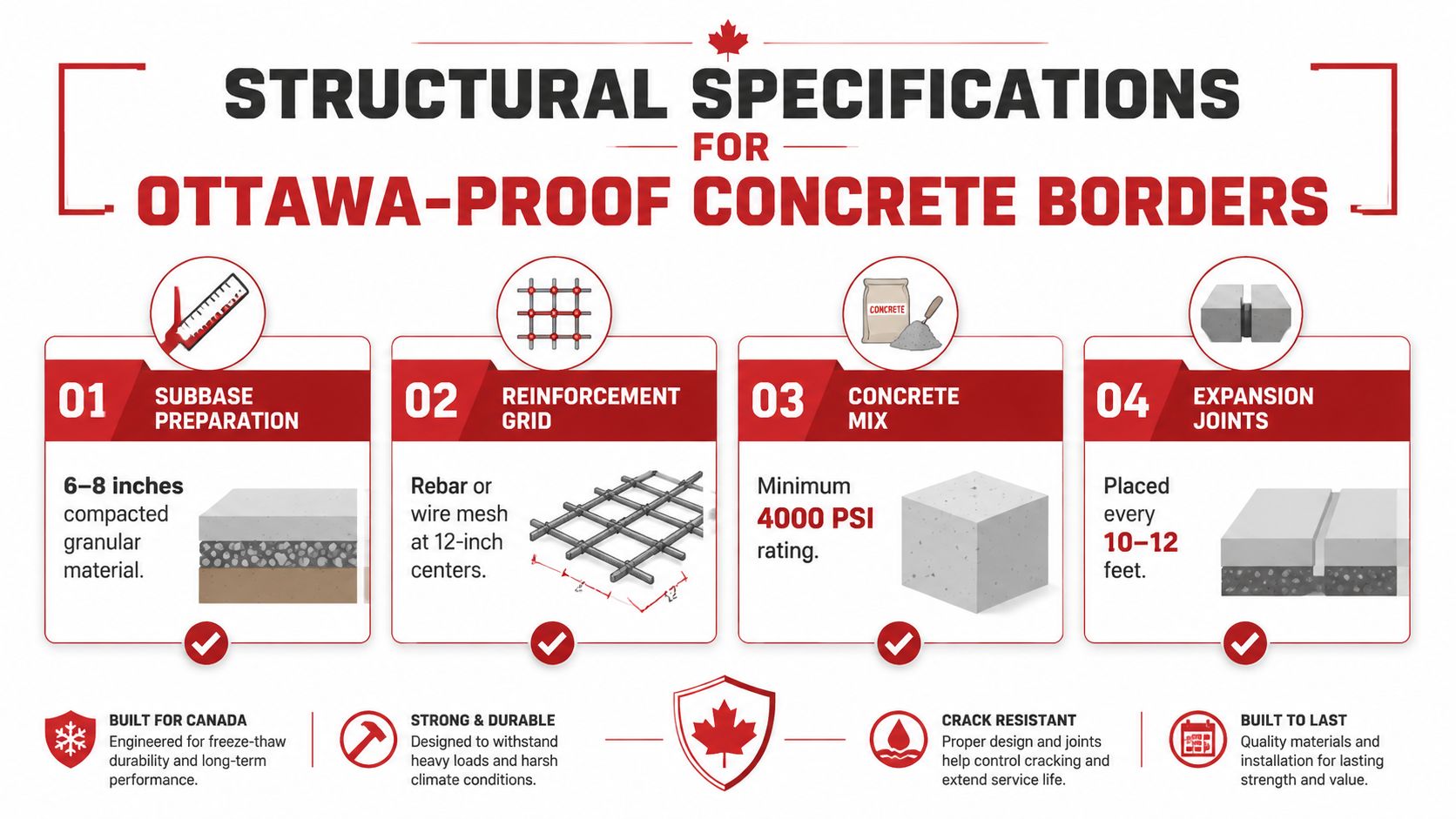
Decoration can't rescue a driveway that lacks a durable base. Ottawa area guidance recommends excavating a driveway about 18 inches, placing 8 to 12 inches of compacted granular aggregate, and pouring a 6 inch slab with welded wire mesh or upgraded rebar. Another local recommendation specifies 30 MPa concrete with 8 percent entrained air and a 6 inch driveway thickness. Ottawa masonry guidance for stamped concrete places stamped borders inside that same vehicle bearing system.
For Ontario exterior flatwork exposed to freeze thaw and de icing salts, the stronger benchmark is 32 MPa concrete with 5 to 8 percent air content and a maximum water to cementing materials ratio of 0.45. The Residential Concrete guide from the Ready Mixed Concrete Association of Ontario provides that baseline. The border should receive the same exterior exposure consideration as the main slab because its edge often sees the most salt and runoff.
Build the edge into the slab
A reliable installation follows a sequence that protects the perimeter:
Excavate and remove soft or disturbed material. Use compacted granular aggregate to create a stable drainage and load bearing base.
Set the border forms so the band has a consistent line, correct slope, and adequate support at the outside edge.
Install reinforcement so it remains in the concrete rather than sitting on the soil. The exact reinforcement layout should be designed for the driveway and site conditions.
Place the specified air entrained concrete without adding uncontrolled water on site.
Stamp only after the concrete reaches the correct working condition. Overworking the surface can weaken the finish and distort pattern depth.
Cut control joints promptly and align them with the driveway layout.
Ontario guidance identifies 100 to 125 millimetre driveway slabs, control joints, a separate visual border band, and keeping vehicles off the slab for at least 48 hours while it cures. Canadian guidance also identifies CSA A23.1 and A438 requirements for C 2 exposure where freeze thaw and de icing salts apply. Concrete Manitoba's driveway specification recommends cutting joints as soon as possible, usually within 4 to 12 hours, to one quarter of slab thickness. For 100 millimetre slabs, joints should be no more than 3 metres apart. For 125 millimetre slabs, the spacing should be no more than 4 metres, and for slabs 150 millimetres or thicker, no more than 4.5 metres.
Tree roots can also lift and distort a driveway edge. Before approving a border layout near mature trees, review practical arborist advice for lifted driveways and address the source of movement rather than filling the resulting crack.
Permits and Zoning Rules for Ottawa Driveway Borders
A border can change more than the appearance of a driveway. If it widens the hard surface, alters the slope, reaches into the boulevard, or changes the curb interface, the work may move beyond a straightforward private surface improvement.
Ottawa's zoning by law requires a driveway to have a minimum width of 2.6 metres, and the City's land guide recognises stable, dust free materials such as asphalt, cement, permeable pavement, cobblestones, or similar materials. Ottawa's zoning by law also identifies the broader framework in which a concrete driveway sits. The border must fit the regulated access corridor and remain compatible with the approved driveway surface and dimensions.
What can trigger review
The City of Ottawa says resurfacing or changing driveway material doesn't require an access permit or road cut permit when the driveway's size and slope remain unchanged. Modifications outside that narrow resurfacing case require both an access permit and a road cut permit. The City's building permit frequently asked questions should be checked before work begins in Barrhaven, Nepean, Kanata, Stittsville, or Orleans.
Project Scenario | Permit Required | Key Constraint |
|---|---|---|
Surface refresh with no change to size or slope | Usually no access or road cut permit under the City's stated exception | Footprint and grade must remain unchanged |
Border that widens the driveway | Check access and road cut requirements | The access corridor and zoning dimensions still apply |
Border that changes the curb interface | Permit review may apply | The curb and public approach are controlled areas |
Work touching boulevard, sidewalk, or public right of way | Right of way permit may apply | Excavation outside private property is regulated |
Border that changes drainage or slope | Confirm requirements before forming | Water must not be redirected onto public or neighbouring areas |
Ottawa requires a permit for excavation in the public right of way. The City specifically includes sidewalk or driveway installation or replacement and creation of a depressed curb for driveway access among its examples. The application may require a sketch and a 10,000 dollar bond before approval. Ottawa's street and right of way permit information explains why a border touching the curb, boulevard, or sidewalk cannot be treated as ordinary private landscaping.
The safest approach is to measure the existing driveway, mark the proposed outside edge, and confirm the curb and grade implications before demolition. A contractor who talks only about colour and pattern but ignores the public interface is missing a major part of the job.
Installation Process From Excavation to Final Cure
A stamped border can look correct on pour day and still fail after its first Ottawa winter. The crew must control excavation, base stability, drainage, form alignment, reinforcement, joints, placement, and curing in that order.
Prepare the ground and forms
Based on the specifications outlined above, proper excavation begins with removing unsuitable material and establishing a firm, evenly graded formation. Test the exposed subgrade for soft areas before placing aggregate. Loose or wet pockets allow movement beneath the border, concentrating stress where the narrow strip meets the driveway field.
Forms set the border's width, elevation, and drainage line. They should direct water away from the garage and foundation, while the outside form needs solid stakes and backing. A poorly supported edge can spread during placement, leaving a low section that holds meltwater and receives repeated freeze thaw pressure.
Reinforcement must remain at its designed elevation rather than resting on the base. Confirm its position before concrete arrives, and coordinate control joints with the border layout so planned cracking follows less visible lines.
Place, stamp, and protect
For exterior exposure, the concrete specification should address the Ontario benchmark of 32 MPa, 5 to 8 percent air content, and a maximum water to cementing materials ratio of 0.45. The crew places the slab and border as one coordinated pour, then waits for the correct stamping window. Adding water at the surface to extend finishing time can weaken the finish and increase scaling risk.
Stamp alignment deserves careful attention at the border to field transition. A drifting pattern makes the edge look improvised, while uneven texture can create shallow depressions that retain water. Keep the joint plan consistent with the pattern instead of cutting randomly through the most visible section.
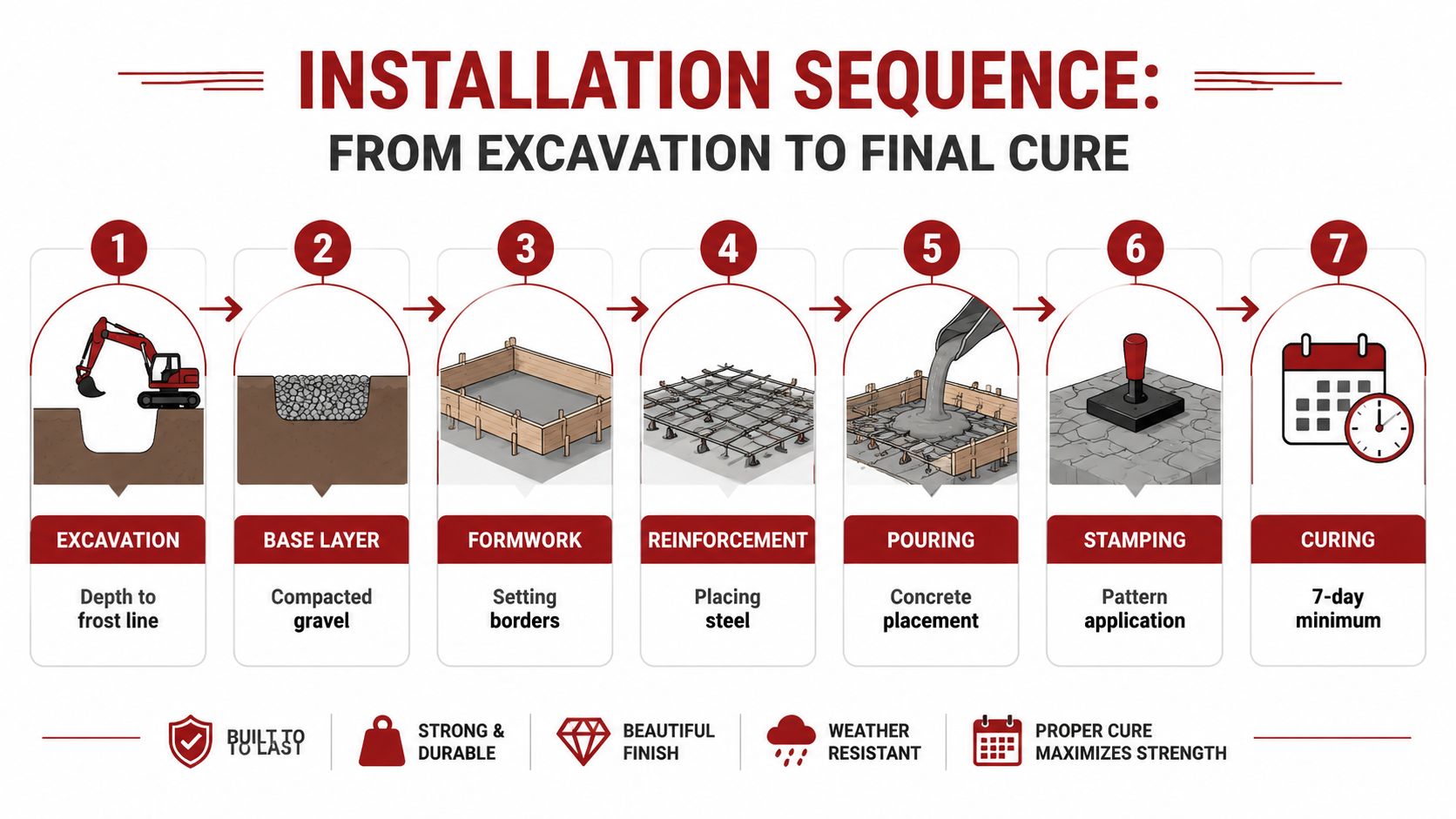
Use a curing method that protects moisture and temperature while the concrete gains strength. Keep vehicles off the slab for at least 48 hours during early curing, then follow the contractor's protection plan before exposing the surface to traffic, salt, or winter weather.
For another visual explanation of concrete driveway work, review the following installation video.
Winter Maintenance and Sealing for Long Lasting Borders
The border needs its own winter routine because it sits where snow, salt, slush, and plow contact concentrate. Treating the entire driveway identically is convenient, but it overlooks the part most likely to suffer edge damage.
Independent Canadian guidance recommends immediate snow removal, avoiding chemical de icers, and using sand for traction. That advice is especially important beside the curb, where road residue and meltwater can remain against the stamped band. A plastic shovel or snowblower with plastic skids is less aggressive than a metal edged tool, and a careful operator keeps the blade from riding directly on the concrete edge.
Seal for exposure, not appearance alone
Southern Ontario decorative concrete guidance uses 2 to 3 years as a practical resealing interval, with more frequent attention for borders exposed to road salt. This guide to concrete sealing and staining can help homeowners understand the maintenance conversation, but the product and timing should be selected for the driveway's exposure and existing sealer condition.
A sealer can't repair a weak slab or conceal active movement. It can, however, reduce the amount of water and residue entering a sound surface when the concrete has been properly cured and prepared. Ask the contractor to assess the border separately from the main field, especially where the colour has dulled or the edge receives direct plow contact.
Watch for these early signs:
Joint cracks: Hairline cracks extending from control joints can indicate movement that needs assessment.
Surface scaling: Flaking that exposes aggregate points to exposure or finishing trouble, not a simple colour issue.
Edge chipping: Repeated impact at the outside line can worsen quickly if water reaches the damaged area.
Persistent residue: White deposits or dark wet areas can show where runoff is pooling.
Rinse salt residue from the border when conditions allow in spring, keep drainage paths clear, and address small cracks before water can occupy them. DIY caulking may suit a stable, minor crack, but spalling, separation, or subgrade washout calls for a concrete professional. Ottawa Stamped Concrete designs and installs patterned concrete driveways, borders, walkways, porches, patios, and pool decks across the Ottawa area, including Barrhaven, Nepean, Kanata, Stittsville, and Orleans. Visit Ottawa Stamped Concrete to discuss a border design that accounts for structure, permits, drainage, and winter maintenance.
Comments