
7 Textured Concrete Pool Deck Styles for Ottawa

An Ottawa homeowner comparing a pool deck in Centretown, the Glebe, Kanata, Nepean, Barrhaven, Orléans, or Stittsville can easily start with colour. That's usually the wrong first decision. A wet, weather exposed surface needs a texture that supports grip, suits bare feet, sheds debris, and remains practical through seasonal changes. The finish also affects how the deck looks, how it's cleaned, how often it's sealed, and whether it fits the home.
A textured concrete pool deck is therefore more than a decorative upgrade. Ottawa Stamped Concrete serves the Ottawa region, including these communities, and specializes in patterned and stamped concrete for pool decks. The seven examples below compare finishes according to safety, appearance, maintenance, and installation choices. For broader preparation and surface work, homeowners can also review these concrete finishing techniques.
Table of Contents
1. Brushed Concrete Finish for Centretown Pool Decks - Installation and care
2. Stamped Stone Pattern Finish in Glebe Properties - Where the trade off appears
3. Salt Finish Textured Concrete in Kanata Modern Homes - Details that determine the result
4. Exposed Aggregate Finish for Nepean Suburban Pool Decks - Choose the aggregate before the pour
5. Ashlar Slate Pattern for Barrhaven Premium Pool Installations - Review the pattern before installation
6. Broom Finish with Traction Additives for Orléans Family Pool Decks - Specify grip without creating a harsh surface
7. Combination Stamped and Brushed Texture for Stittsville Contemporary Designs - Demand full scale samples
1. Brushed Concrete Finish for Centretown Pool Decks
Brushed concrete is a sensible choice for an established Centretown property where the pool deck needs to look finished without competing with the house. A contractor drags a stiff broom or brush across concrete while it's firm but not fully cured, leaving fine linear grooves across the surface. The result is understated, uniform, and more practical around water than a smooth decorative slab.
The direction and depth of the brushing matter. Consistent strokes create a calmer appearance, while a deeper brush texture can provide more interruption to the water film around a busy pool. Ontario guidance treats pool decks as freeze thaw exposure applications, specifically placing them in the F 1 category for concrete exposed to freezing and thawing in a saturated condition. The guidance also groups pool decks with freshwater pools and tennis courts, reinforcing that this is a durability application, not merely a visual finish. Ontario exposure guidance for pool decks
Installation and care
A finisher needs to brush at the right stage, often after the surface has reached a leather hard condition. The exact timing changes with weather, mix, slab thickness, and site conditions, so a contractor should judge the concrete rather than rely on a rigid clock.
For a Centretown backyard, specify:
Uniform brush direction: Consistent strokes give the deck a deliberate appearance.
Texture matched to traffic: A stiffer brush can create deeper texture where children and frequent wet foot traffic are expected.
Compatible sealer: The sealer should protect the surface without creating a glossy, slippery film.
Routine inspection: Look for worn sealer, dirt in the grooves, and areas where splash water remains.
Brushed concrete won't provide the visual variation of exposed aggregate or stamped stone. Its strength is balance. It offers a recognisable texture, straightforward cleaning, and a restrained appearance suited to compact urban yards.
2. Stamped Stone Pattern Finish in Glebe Properties
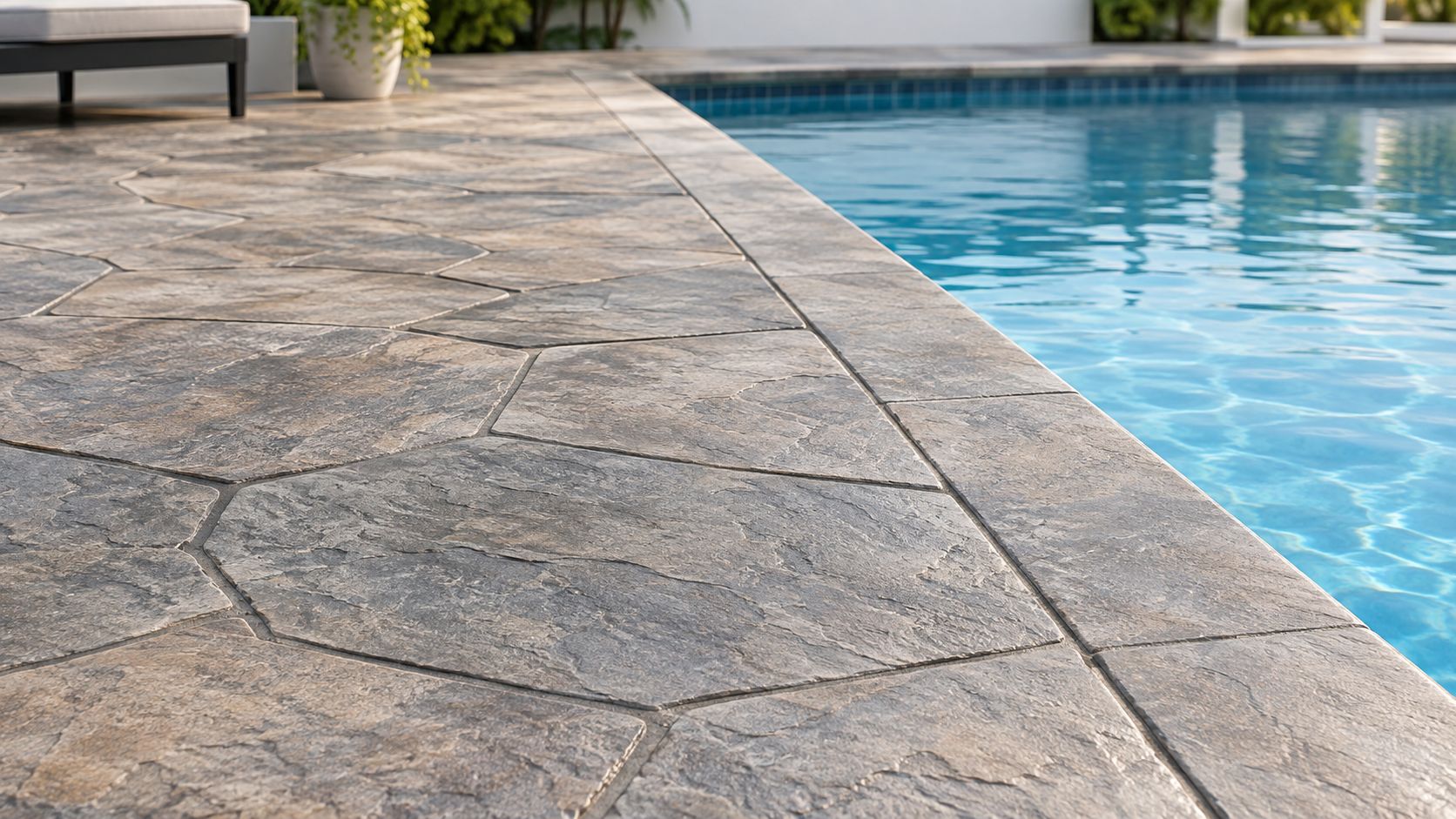
A Glebe pool deck often has to connect several design languages at once. The home may have traditional brick, mature landscaping, and a carefully planned outdoor living area. A stamped stone or slate pattern can give the deck the appearance of cut natural stone while retaining the continuity of a concrete slab.
The contractor presses patterned mats into freshly placed concrete, then uses colour and joint definition to reproduce flagstone, slate, or granite. The strongest results don't try to make every detail dramatic. A restrained pattern that echoes the home's brick or masonry usually looks more convincing than an overly busy layout.
For larger residential properties near the Parliament Hill area, a stamped stone pattern can define the pool zone without making it feel disconnected from the rest of the yard. It also gives the owner more control over border bands, field patterns, and colour relationships than standard paving units.
Where the trade off appears
Stamped concrete can look excellent, but pattern depth and sealer choice must be planned around wet traction. Smooth sealed areas can become slick, particularly if the finish is highly polished or heavily coated. Canadian wet area guidance commonly uses a dynamic coefficient of friction of 0.42 as a practical benchmark for exterior walking areas, while pool edge recommendations often target 0.50 or higher. Wet traction guidance for exterior surfaces
Ask the installer to show a full scale sample, not only a small colour chip. Confirm how the selected sealer will perform when wet, how borders will be cleaned, and when resealing will be required. Guidance for this finish is available in this detailed resource on stamped concrete pool deck planning.
3. Salt Finish Textured Concrete in Kanata Modern Homes
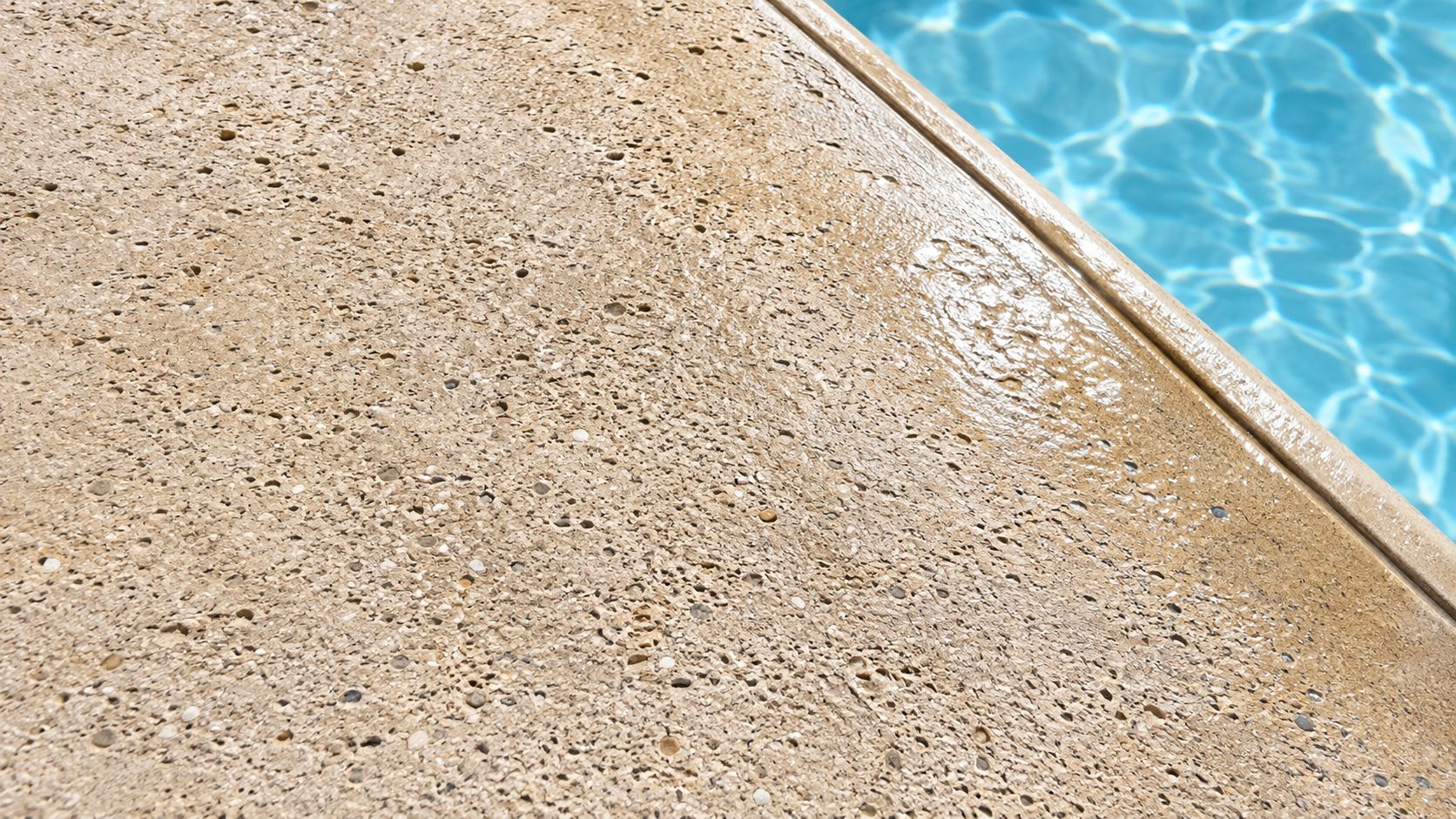
A contemporary Kanata backyard often needs a pool deck that adds grip and texture without competing with the home's clean lines. Salt finish concrete meets that brief through a simple installation process. Non iodized rock salt is pressed into fresh concrete, then removed after the surface is treated. The resulting small crater like impressions create a quiet, pebbled texture.
The irregular pattern feels natural while remaining controlled enough for modern architecture. It suits simple rectangular pools, dark window frames, clean planting beds, and outdoor furniture. Under wet feet, the textured surface provides more variation than a plain, hard trowelled slab.
Salt finish offers a quieter visual field than detailed stone stamping and a more relaxed character than ashlar slate. That balance helps the concrete support the architecture instead of becoming the pool area's main feature.
Details that determine the result
Salt selection, embedment, and timing control the consistency of the impressions. Contractors generally choose non iodized rock salt for a cleaner, more predictable pattern. The amount pressed into the concrete also affects texture depth, while thorough removal after treatment prevents loose salt from leaving an uneven finish.
Practical rule: Salt finish looks simple after completion, but surface preparation and washing determine whether the texture appears even.
The small recesses can collect leaves, soil, and other debris more readily than a lightly brushed surface. Rinse the deck carefully and choose cleaning tools that reach the texture without damaging the concrete or sealer. A compatible protective sealer also matters because moisture, winter cycling, and poolside contaminants place repeated demands on the surface.
For a Kanata homeowner, this finish suits priorities centred on contemporary appearance and tactile grip rather than the quickest sweeping routine. Review it beside exposed aggregate samples before installation. The two finishes may look similar from a distance, yet their texture and feel underfoot differ noticeably.
4. Exposed Aggregate Finish for Nepean Suburban Pool Decks
A Nepean backyard with natural stone walls, planting beds, timber details, or informal landscaping can suit exposed aggregate well. The finishing process removes the upper cement paste and reveals decorative stone within the concrete. The result combines visible pebbles, colour variation, and a naturally uneven texture.
Exposed aggregate reveals the concrete's natural stone without joints or individual pavers. Its appearance depends on aggregate selection and exposure depth. Pale stone keeps the deck visually light, while warmer or darker aggregate can connect the pool area with brick, garden edging, and exterior cladding.
Ontario contractors use exposed aggregate around pools because its microtexture can improve wet grip. Broom, exposed aggregate, and salt finishes are all used to create traction, and Ontario pool deck finish guidance describes exposed aggregate as suitable for Ontario winter cycling when it is properly installed and maintained.
Choose the aggregate before the pour
The stone determines the character of the whole deck. Request samples showing both colour and exposure depth, then review them beside the home, coping, and surrounding materials.
Aggregate colour: Coordinate the stone with the home, coping, and planting rather than choosing it in isolation.
Exposure depth: Limited exposure can leave the surface looking flat. Excessive exposure may feel unnecessarily rough under bare feet.
Edge treatment: Detail pool coping and transitions carefully so changes in texture remain comfortable and do not create trip points.
Sealer appearance: A penetrating or low-sheen sealer can retain a natural appearance, while other sealers deepen the stone's colour more noticeably.
Cleaning takes more attention than it does on a lightly brushed deck because leaves, soil, and other debris can settle between the stones. Regular rinsing and suitable cleaning tools help clear those recesses without harming the concrete or sealer. Review other concrete finish options before selecting the aggregate and sealer combination. For Nepean homeowners, the trade-off is clear: a stronger natural-stone appearance and tactile texture in exchange for more involved seasonal cleaning.
5. Ashlar Slate Pattern for Barrhaven Premium Pool Installations
Ashlar slate gives a Barrhaven pool deck a formal, architectural character. Its rectangular stamped shapes suggest cut slate tiles and defined joints, while the concrete remains a continuous surface. That combination suits properties with structured landscaping, masonry accents, and pool areas planned for entertaining.
Use the pattern across the full deck, or confine it to a central field with a contrasting border. Choose colour in relation to the home's brick, stone, coping, and furnishings. A tone that connects those materials usually integrates better than one selected from a sample board alone.
Review the pattern before installation
Ashlar slate demands more design control than a basic broom finish because its layout remains visually prominent. Request several sample impressions and inspect them beside the exterior, coping, and planned furniture. Small samples may not show repeated shapes, joint scale, or how colour settles into the stamped texture.
The surface specification must address wet traction as well as appearance. A grit additive in the sealer can improve grip around the pool, but the result depends on the additive, texture, sealer, drainage, and application quality. Review the Pool deck safety comparison with the contractor, then confirm the proposed system on a representative sample before the complete installation.
A premium pattern still needs a practical walking surface. Approve texture, sealer, drainage, and cleaning access together.
Ashlar slate can make later repairs more noticeable when new work fails to align with the original pattern. Keep the stamped layout, colour formula, sealer details, and installation photographs in the project records. Those details help a contractor match the existing work if a section requires replacement.
For a Barrhaven homeowner prioritizing visual impact, this finish works best when the pattern, border, colour, and traction strategy are decided before the pour. The trade-off is a stronger architectural statement with less tolerance for inconsistent stamping or poorly planned repairs.
6. Broom Finish with Traction Additives for Orléans Family Pool Decks
A wet child runs from the pool, drops a toy, and changes direction near the steps. An Orléans family deck must handle that daily combination of quick movement, bare feet, furniture, splash water, and frequent cleaning. A broom finish with a traction additive suits this setting by combining linear texture with grit in the sealer or surface system.
The practical benefit is straightforward maintenance. A broom finish has fewer decorative joints and recesses than a detailed stamped pattern, so sweeping and rinsing usually require less effort. Dirt and small marks also tend to be less prominent than on a strongly patterned surface.
Specify grip without creating a harsh surface
Grip depends on the complete surface system, not the additive alone. The contractor should explain the broom texture, additive type, sealer, drainage, and application method, then test them together on a representative sample. Uneven distribution can leave weak spots, while an overly aggressive finish may feel uncomfortable under bare feet and trap more debris.
Discuss the desired wet traction with the contractor and assess the actual sample underfoot when wet. A benchmark can guide the conversation, but it does not replace proper slope, drainage, curing, surface preparation, and consistent installation.
Family-use decision: Choose enough texture for wet circulation, then confirm that bare feet can tolerate it and routine cleaning remains manageable.
Use softer brushes when cleaning so the grit and protective coating are not stripped unnecessarily. Rinse splash zones regularly, remove leaves and other organic debris before they become embedded, and inspect the sealer as wear develops. Reapplication timing should follow the sealer system, exposure, and observed condition rather than a fixed assumption. Guidance on sealing a stamped concrete pool deck reinforces the need to choose the sealer and maintenance plan together.
For Orléans homeowners, this finish prioritizes dependable footing and practical upkeep over a highly decorative appearance. That trade-off makes it a strong fit for active family decks, provided the texture is approved before the full pour.
7. Combination Stamped and Brushed Texture for Stittsville Contemporary Designs
Stittsville's contemporary and transitional homes can benefit from two coordinated textures instead of one finish across the entire deck. Stamped sections establish pattern and visual zones, while brushed areas provide a simpler walking surface around the pool.
A subtle stamped stone field can frame the seating area, with brushed bands marking circulation routes and pool edges. Another layout keeps the stamped pattern near outdoor furniture and uses brushing where wet traffic is heavier. This arrangement can feel more custom than a single finish applied everywhere, but it requires careful coordination between the stamp pattern and brushed zones.
Demand full scale samples
A small stamp impression cannot show how pattern, brush marks, colour, and sealer will read across a large deck. Request a representative sample containing both finishes, then inspect it dry and wet. Check the transition lines, pattern breaks, colour consistency, and recessed areas where dirt could collect.
Ask the contractor how each finish will be sealed, cleaned, and repaired. A high sheen on the stamped section may make the adjoining walking zone feel slick, while too much contrast can make the deck look patchy. Confirm that the proposed sealer suits both textures and that the layout can be reproduced if a section requires future repair.
Design decision: Use the stamped pattern to define spaces, then place the more pronounced texture where wet foot traffic is most likely.
This hybrid approach suits Stittsville owners prepared to coordinate the design before the pour. It offers greater visual flexibility than a single finish, but repairs and later matching can be more difficult. Keep the approved sample, colour notes, sealer details, and layout drawings with the project records.
Textured Concrete Pool Decks, 7-Finish Comparison
Finish | Implementation complexity | Resource requirements | Expected outcomes | Ideal use cases | Key advantages |
|---|---|---|---|---|---|
Brushed Concrete (Centretown) | Low, timing-sensitive during cure | Basic broom/brush tools, standard concrete, annual sealant | Subtle linear texture; consistent slip resistance; low maintenance | Small–medium residential Centretown pool decks | Cost-effective; easy maintenance; good winter performance when sealed |
Stamped Stone Pattern (Glebe) | High, pattern alignment and stamping skill required | Pattern mats, colour stains, experienced crew, sealant | Realistic stone appearance; upscale look; durable; periodic reseal | High-end Glebe properties seeking stone aesthetic | Luxurious appearance; more affordable than real stone; seamless surface |
Salt Finish Textured (Kanata) | Medium, careful salt placement and timing | Rock salt, sealant, precise installation | Pebbled, cratered texture; exceptional grip; contemporary look; higher cleaning needs | Modern Kanata homes and contemporary pool decks | Superior slip resistance; textured look at moderate cost; modern aesthetic |
Exposed Aggregate (Nepean) | High, controlled exposure, professional installation | Decorative aggregates, exposure tools, skilled crew, sealer | Exposed stones/pebbles; very slip resistant; durable and customizable | Suburban Nepean properties with larger decks and landscaping | Natural aesthetic; long-lasting grip; customizable aggregate options |
Ashlar Slate Pattern (Barrhaven) | High, precise stamping and colour work | Pattern mats, colour systems, skilled contractors, sealant | Formal slate-tile appearance; elegant curb appeal; periodic maintenance | Premium Barrhaven homes with formal architecture | Elegant slate look; cost-effective vs real slate; monolithic stability |
Broom Finish with Traction Additives (Orleans) | Low–Medium, additive mixing and uniform distribution | Traction additives, brooms, standard concrete, periodic sealing | Enhanced slip resistance; functional, family-friendly surface; easy cleaning | Family-oriented Orleans neighbourhoods and community pools | Exceptional safety for children/elderly; affordable; durable traction elements |
Combination Stamped + Brushed (Stittsville) | Very high, coordinates multiple techniques and design elements | Pattern mats, brushes, skilled artisans, design planning, sealant | Layered visual depth; decorative and high slip resistance; custom appearance | Contemporary Stittsville homes seeking unique, design-forward decks | Unique customized designs; decorative appeal plus safety; flexible styling options |
Match the Finish to the Way You Live
The best textured concrete pool deck isn't necessarily the most decorative one. It's the finish that matches how your household moves through the space, how often you clean it, how much visual variation you want, and how the surface will respond to Ottawa's wet and freezing conditions.
For straightforward maintenance and practical safety, start with brushed concrete or a broom finish with traction additives. Brushed concrete keeps the appearance restrained, while the additive enhanced broom finish gives families a more deliberate grip strategy. These are strong options for compact yards, active households, and homeowners who don't want a complex pattern to dominate the pool area.
Choose exposed aggregate or salt finish when natural texture matters most. Exposed aggregate provides visible stone and a connection to the outdoors. Salt finish offers a subtler, more contemporary surface with small impressions that add tactile interest. Both require thoughtful cleaning because textured recesses can hold debris.
For stronger visual impact, consider stamped stone or ashlar slate. Stamped stone can echo natural masonry in a Glebe setting, while ashlar slate can give a Barrhaven property a more formal appearance. In both cases, don't approve colour alone. Review the wet texture, sealer sheen, border layout, and cleaning access.
A combination stamped and brushed finish suits a Stittsville homeowner who wants defined zones and a custom contemporary look. It offers the most design control, but it also demands the clearest sample work and installation planning.
Before signing off, compare samples with wet bare feet, ask how the surface will be cleaned, and confirm the sealing and resealing plan. Ottawa homeowners should also check local requirements. A deck attached or adjacent to a building generally needs a permit when its walking surface is more than 24 inches, or 600 millimetres, above adjacent grade. A freestanding deck also needs a permit when it exceeds 10 square metres and is above that height threshold. Ottawa building permit requirements
Pool enclosure planning can affect the layout too. Ottawa requires an enclosure permit for a pool, pond, or hot tub that can hold water 600 millimetres deep or more at any point. The enclosure must be at least 1.5 metres high, gates must self close and self latch, and the latch must sit at least 1.35 metres above the gate bottom. Openings must be too small for a 100 millimetre sphere, and the enclosure must be at least 1 metre from the nearest wetted surface. Ottawa pool enclosure planning information
Discuss the finish, drainage, sealer, enclosure relationship, and maintenance routine with an experienced Ottawa contractor before construction begins. Ottawa Stamped Concrete is one local option for patterned and stamped concrete pool deck installations across the region.
Ottawa Stamped Concrete offers custom patterned and stamped concrete for pool decks, patios, driveways, walkways, and porches across Ottawa, including Barrhaven, Nepean, Kanata, Stittsville, and Orléans. Visit Ottawa Stamped Concrete to compare textured finish options and discuss a pool deck suited to your home, traffic, and seasonal maintenance needs.
Comments