
What Is Concrete Spalling Ottawa Homeowner Guide

Concrete spalling is the loss of the outer layer of concrete, often beginning as cracking and progressing when water and salts reach steel and push the surface away. Shallow spalls up to 25 mm deep can commonly be rebuilt with a two part epoxy mortar, while deeper damage may point to corrosion, drainage problems, or deterioration beneath the surface.
After a thaw, an Ottawa homeowner may notice pale flakes beside the garage apron in Orleans, small pits across a porch in Barrhaven, or a rough strip along a walkway in Kanata. The concrete may have looked sound before winter, yet the first warm days reveal that the surface has started to break apart.
That discovery raises a practical question. Is the damage only cosmetic, or is it evidence that moisture and de icing salt have found a path into the slab? In Ottawa, that distinction matters because concrete faces repeated wetting, freezing, thawing, and chloride exposure through fall, winter, and early spring.
Table of Contents
Introduction Why Ottawa Homeowners Notice Spalling in Winter
What Concrete Spalling Really Means for Your Slab - Surface loss versus deeper separation - Why the surface layer matters
Why Spalling Happens in Ottawa From Freeze Thaw to Salt and Mix Issues - Freeze thaw starts with water - Salt carries chlorides into the slab - Mix and construction quality influence durability
How to Spot Early and Advanced Signs on Driveways Patios and Porches - Look for surface changes first - Watch for signs that the damage is deeper
What Happens If Spalling Is Left Unaddressed Through Another Winter - Why a patch can fail again - Practical consequences around the home
Repair and Mitigation Options That Address the Cause Not Just the Patch - Compare the visible condition with the next action - Treat the water and salt pathway
Conclusion Protecting Your Ottawa Concrete for the Long Term
Introduction Why Ottawa Homeowners Notice Spalling in Winter
Spalling describes concrete that flakes, chips, peels, or breaks away from its surface. The visible loss may be shallow, affecting the surface paste, or deeper, exposing coarse aggregate and eventually reinforcing steel. A few loose flakes don't automatically mean a driveway is unsafe, but they do show that the surface has lost some of its protection.
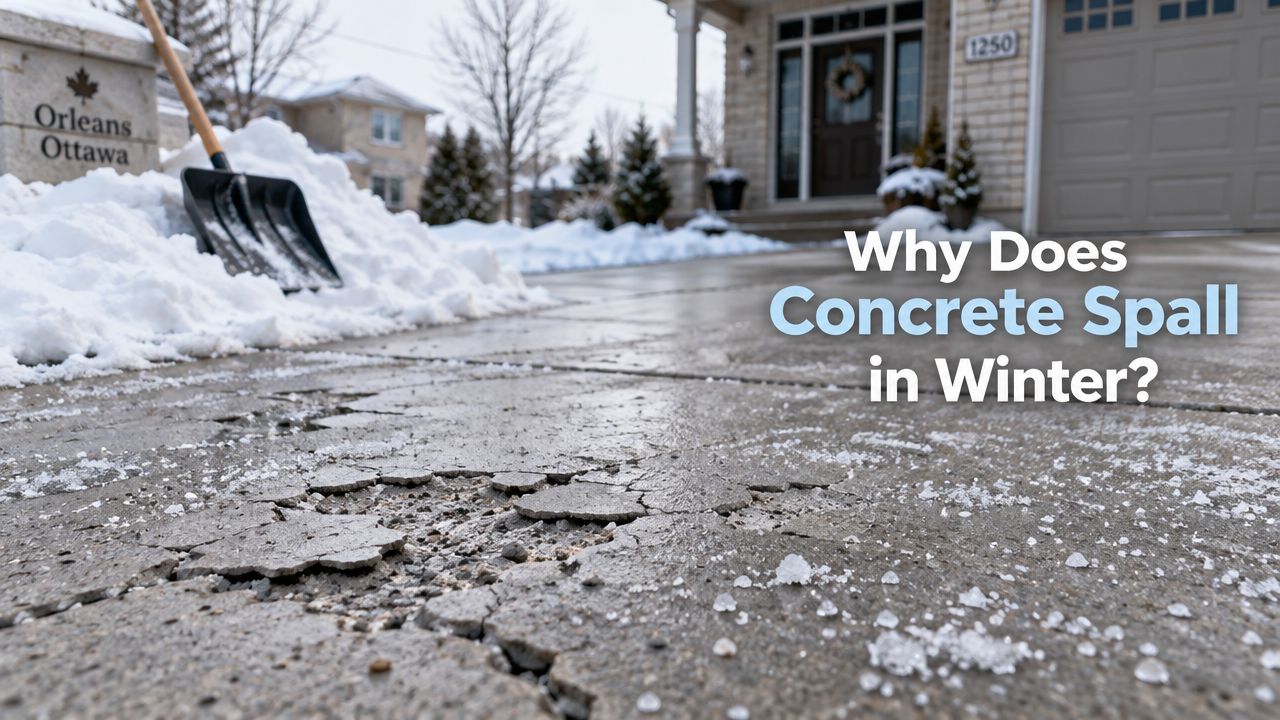
Ottawa's weather creates a demanding environment for exterior concrete. Water enters pores and cracks, freezes during cold periods, then moves farther into the material when temperatures rise. De icing salts add chlorides to that moisture, especially around driveway edges, garage entrances, steps, and areas where snow is piled.
A University of Waterloo study of Ontario bridge girders identifies heavy use of de icing salts as a major contributor to severe girder soffit spalling in certain cases. The study of Ontario bridge girder deterioration is focused on bridge infrastructure, but its central lesson applies to residential slabs too. Water and salt exposure can turn a surface problem into a deeper concrete durability problem.
Local perspective: A driveway in Orleans, a porch in Barrhaven, and a pool deck in Nepean don't need to look severely damaged before moisture control becomes important.
The useful response isn't panic or an automatic replacement. First, identify whether the concrete has lost only its surface paste, whether the damage has reached aggregate, or whether cracks, rust staining, hollow areas, or exposed steel point to a more advanced condition. The sections below follow that progression so you can make a sensible repair decision.
What Concrete Spalling Really Means for Your Slab
Think of a concrete slab as a layered protective system rather than a solid block with an identical texture throughout. The top contains cement paste that binds the aggregate and creates the finished surface. Deeper inside, the coarse stone provides body, while reinforcing steel, when present, sits below a layer of concrete cover designed to protect it from moisture and chlorides.
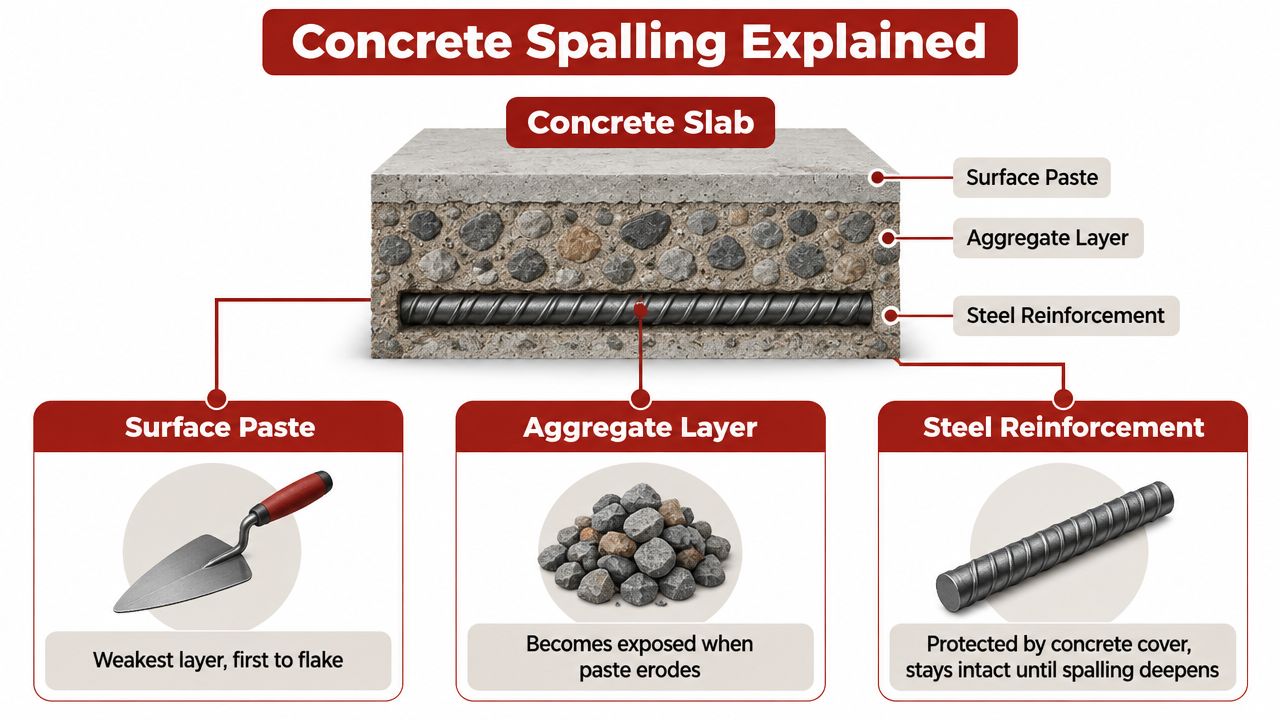
A useful analogy is paint over damp wood. If moisture gets behind the paint, the outer film may lift, blister, and peel even though the first visible defect appears small. Concrete behaves differently, but the homeowner's view is similar. Moisture enters a weak point, pressure and cracking develop, and the surface layer eventually separates.
Surface loss versus deeper separation
Shallow scaling usually removes thin flakes of paste from the exposed surface. You may feel a gritty texture underfoot or see small pale chips after a thaw. The aggregate remains mostly embedded, and no steel is visible.
Deeper spalling removes more of the cover concrete. Coarse aggregate becomes exposed, larger pieces detach, and the damaged area may sound hollow when tapped because a near surface layer has separated from the slab below. If reinforcing steel appears, the issue has moved beyond a simple appearance concern.
Spalling often starts with cracking, but cracking alone isn't proof of spalling. A crack is a break in the concrete. Spalling means material has broken away or separated. The two conditions can develop together when water uses the crack as an entry route.
Why the surface layer matters
The cover above reinforcing steel acts as a barrier. As long as that cover remains sound and relatively dry, it slows the movement of water and chlorides toward the steel. Once the cover cracks, delaminates, or falls away, the slab loses part of that protection.
The right question isn't only, “How much concrete has fallen away?” Ask what allowed water to reach that location and whether the remaining cover is still sound.
This distinction prepares you for the main diagnostic step. A rough surface beside a salt exposed garage entrance may need maintenance. Rust staining, hollow sections, or widespread loss require a closer assessment because the visible defect may be the final stage of a problem that began inside the slab.
Why Spalling Happens in Ottawa From Freeze Thaw to Salt and Mix Issues
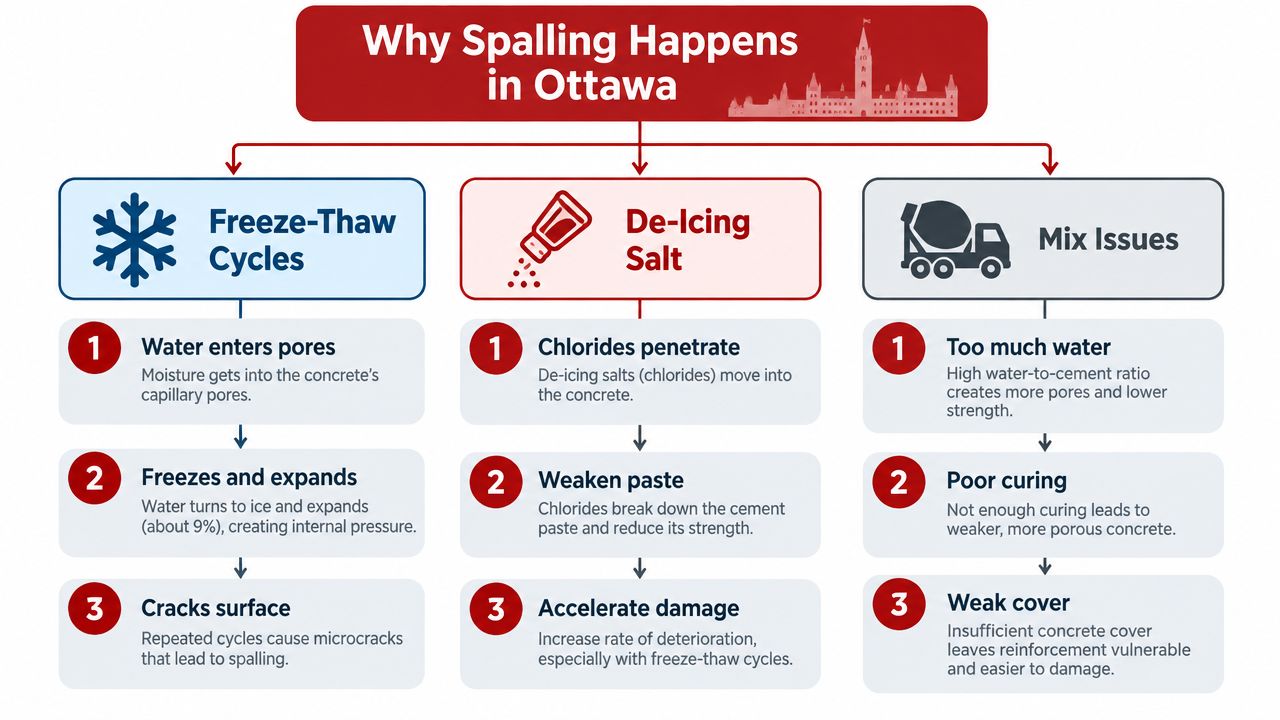
A Barrhaven driveway may look sound in autumn, then shed pale flakes after a winter thaw. In Kanata, one walkway can deteriorate while a nearby section remains intact. The difference is often a moisture and salt pathway, not an old or unattractive surface. Water enters pores, cracks, joints, and weak areas, then freezing, thawing, and chloride exposure repeat the stress.
Freeze thaw starts with water
The NRC explanation of freeze thaw deterioration explains how water in small concrete pores creates internal stress as it freezes and thaws. Repeated cycles can turn shallow scaling into deeper spalling.
Ottawa conditions make that pathway easy to see. A low spot beside a downspout, a poorly drained joint, or snow stored against a porch keeps one area wet longer than the rest. Patching may hold when the surrounding concrete is sound and the water route has been corrected. A patch alone will fail sooner if drainage continues feeding the same area.
Salt carries chlorides into the slab
De icing salt dissolves in meltwater. Chloride laden water can enter pores and cracks, weaken surface paste, and move toward reinforcing steel. The Edmonton municipal report on salt related concrete surface damage describes surface paste loss that exposes coarse aggregate. That progression explains why concrete may become gritty before larger pieces detach.
Salt exposure is common at garage aprons, driveway edges, steps, and areas where vehicles carry brine home. Homeowners can review options for concrete sealers for patios, but sealer cannot correct standing water, poor grading, or ongoing chloride entry. Those conditions require drainage changes and better salt control.
Mix and construction quality influence durability
Excess water in the mix, inadequate curing, weak cover, and poor finishing can leave a vulnerable surface. High strength does not automatically mean better freeze thaw performance. NRC guidance notes that concrete above 55 MPa can be more susceptible to spalling and may offer lower fire resistance. In residential work, that fire finding concerns how dense, strong concrete behaves under intense heat. It does not mean every high strength driveway will spall, but it shows that strength alone cannot replace air entrainment, suitable materials, and proper construction. The NRC publication on concrete spalling and fire resistance identifies polypropylene fibres, steel fibres, normal weight aggregate, and carbonate aggregate as mitigation measures.
The video illustrates how internal moisture and concrete conditions can produce surface loss, helping connect the visible defect with the process beneath it.
Concrete age also matters. Earlier service life modelling indicates that chloride driven deterioration develops over time, including periods of 16 to 20 years at a 75 mm bar depth and at least 25 years under a 1.9 kg/m3 chloride threshold. The Canadian bridge service life research provides infrastructure context. For homeowners, the practical lesson is simple: a small defect may record years of moisture and salt exposure, so the repair should address the pathway as well as the damaged concrete.
How to Spot Early and Advanced Signs on Driveways Patios and Porches
Start the inspection after a thaw, when loose material and damp areas are easier to see. Walk slowly across the driveway, porch, patio, and walkway rather than judging the slab from the street. Compare damaged areas with nearby concrete that receives less salt or drains more effectively.
Look for surface changes first
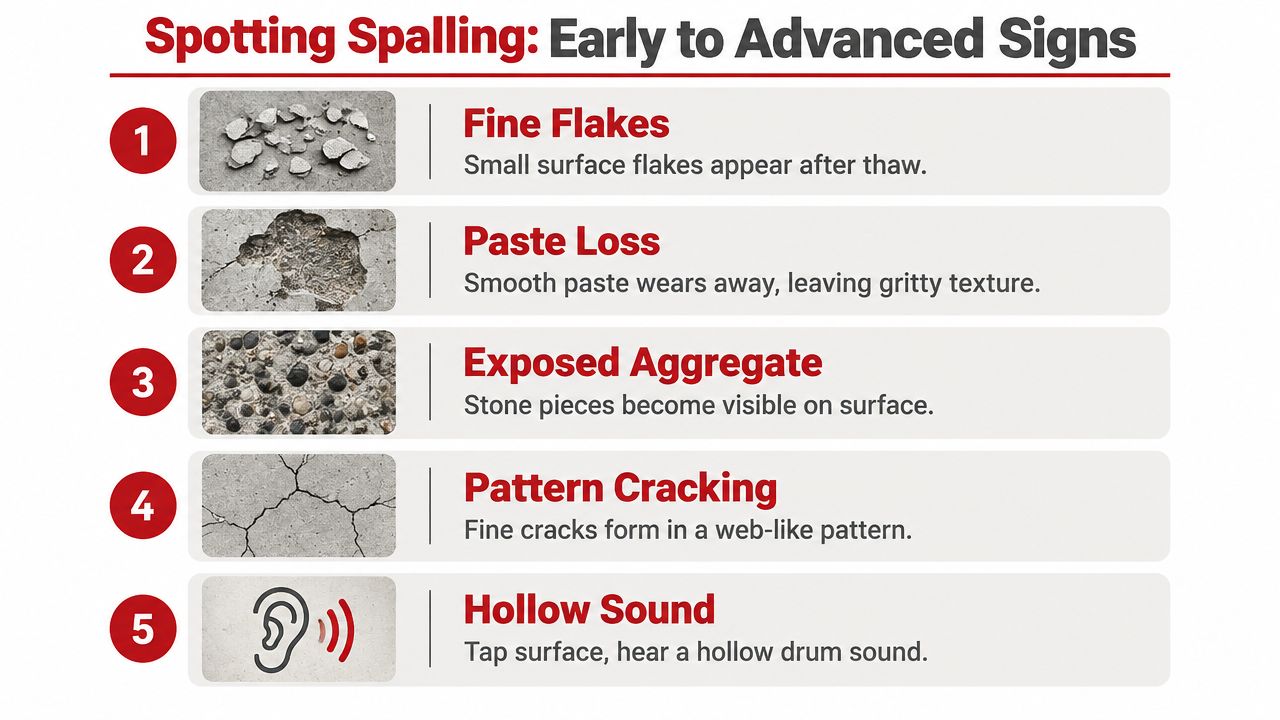
Fine flakes may appear along the garage apron or porch edge after snow and ice melt. Next, the smooth paste wears away and leaves a gritty texture. These signs can remain shallow, especially where the aggregate is still firmly held.
Use a phone to photograph the area from above and from a low angle. Record whether the patch is dry, whether water collects nearby, and whether the damage sits beside a joint, edge, downspout, or snow storage area.
Watch for signs that the damage is deeper
Exposed aggregate means the surface paste has already eroded. Web like pattern cracking can show that the concrete is under internal stress, although the pattern alone can't identify the exact cause. Small pop outs near edges and joints deserve attention when they recur or expand.
A careful tap with a suitable hand tool may reveal a hollow drum sound over delaminated concrete. Rust coloured staining is more concerning because it can indicate corrosion near reinforcing steel. Exposed steel, loose concrete around the steel, or a damaged porch edge should receive professional attention.
Inspection note: Don't judge severity by colour alone. Map the location, depth, hollow areas, rust marks, and drainage conditions together.
Homeowners researching related surface problems can review common imprinted concrete driveway problems, but avoid treating every crack or colour change as spalling. Normal weathering tends to remain stable. Progressive spalling produces continuing flakes, widening loss, deeper pits, or areas that separate from the slab.
What Happens If Spalling Is Left Unaddressed Through Another Winter
A spalled patch may look unchanged through a dry summer in Barrhaven or Kanata. Once snow, meltwater, and freezing temperatures return, the same weak area can open again. Water enters small cracks and porous edges, freezes, expands, and pushes against the surrounding concrete. Repeated cycles can loosen more surface paste and extend the damage beyond the original patch.
The missing concrete is only the visible part. The larger concern is the moisture and salt pathway behind it. Water can move through cracks, exposed aggregate, failed joints, and porous repair edges. De-icing salts travel with that water, increasing chloride exposure near reinforcing steel. If the protective concrete cover is already damaged, corrosion becomes more likely.
Why a patch can fail again
A patch restores lost material, but it does not automatically correct a low spot, blocked drainage route, or repeated salt loading. If meltwater reaches the same boundary, the repair may separate, or the surrounding concrete may begin to spall. The result can look like a poor patch when the underlying problem is water management.
As noted in the causes section above, NRC modelling of bridge concrete shows that corrosion-related deterioration can develop over years in Canadian conditions. The model does not determine the exact service life of a residential driveway, patio, or porch. It does show why corrosion should be treated as an internal process rather than dismissed as a surface flaw.
Practical consequences around the home
A damaged edge beside a porch, walkway joint, or garage entrance can become a trip hazard. Deeper openings hold water and salt, giving each freeze-thaw cycle another route into the slab. Reinforcing steel can corrode and expand, placing pressure on the surrounding concrete. At a garage entrance, poor slope or drainage can also send meltwater toward the slab or foundation instead of away from it.
The right response depends on what is feeding the damage. A shallow, dry, stable area with firm surrounding concrete may be suitable for planned patching. A repair is less likely to last if water continues to collect there or salt-laden runoff repeatedly crosses the same joint.
Arrange an assessment before another freeze-thaw season when you see exposed steel, widespread hollow-sounding areas, rapidly expanding loss, or spalling on a load-bearing element. These signs suggest that surface patching alone may not address the moisture pathway or corrosion beneath the concrete.
Repair and Mitigation Options That Address the Cause Not Just the Patch
A repair should match the depth, spread, movement, and moisture conditions. In a Barrhaven driveway, Kanata porch, or Ottawa garage entrance, a small stable spall may need local rebuilding. Damage that stays wet, spreads along a joint, or shows corrosion requires attention to the pathway feeding it.
Compare the visible condition with the next action
Severity Level | What You See | Sensible Next Action |
|---|---|---|
Shallow surface loss | Fine flakes, gritty texture, firm edges, no visible steel | Remove unsound material, rebuild the stable area with a compatible repair material, then address moisture |
Moderate surface deterioration | Exposed aggregate, recurring pits, cracks near wet locations | Review grading, joints, drainage, salt exposure, and sealing before selecting a larger repair |
Deep or localised spalling | Loose concrete below the surface, rust staining, hollow sound, or exposed steel | Arrange a professional assessment of the cover concrete and reinforcement before patching |
Widespread or moving damage | Broad delamination, repeated repair failure, settlement, or unreliable slab areas | Consider system level repair, resurfacing, section replacement, or drainage correction |
The table separates appearance from cause. Fine flakes on dry, firm concrete can often be repaired locally. A hollow sound suggests separation beneath the visible surface, while rust staining or exposed steel points to corrosion and pressure inside the slab. Patching over those conditions can hide the pathway without stopping it.
Repair costs vary with access, preparation depth, affected area, drainage work, and finish requirements. The Ottawa concrete repair cost guidance offers general budgeting context, but it should not be treated as support for a fixed price. Ask what preparation is included, how far unsound concrete will be removed, and whether the quoted work addresses water entry.
Treat the water and salt pathway
Water management often determines whether a patch lasts. Check whether grading sends runoff toward the slab, whether downspouts discharge beside vulnerable edges, and whether a joint allows meltwater to collect. Snow stored against a porch or garage entrance can create the same wetting and refreezing cycle each winter.
De-icing salt adds chlorides to that water. Reduce salt-laden runoff where practical, while keeping walkways safe. A contractor may recommend sealing after the concrete is sound and dry. Sealer can limit water and chloride entry, but it cannot replace missing concrete, correct settlement, or repair an active drainage problem.
For broader repair and resurfacing decisions, homeowners can review concrete slab repair options. Property owners managing several projects or running a contracting company may also find this guide to grow your concrete business useful for organising customer education and service planning.
For a homeowner, the sequence is straightforward: identify the depth, remove unsound material, rebuild compatible concrete, and correct the moisture and salt conditions around it. When steel is visible, hollow areas are widespread, or the same patch fails again, arrange an assessment before another freeze-thaw season.
Conclusion Protecting Your Ottawa Concrete for the Long Term
The clearest answer to what is concrete spalling is also the most useful one for homeowners. Spalling is concrete surface loss, but the lasting concern is the pathway that allows water, freeze thaw stress, and chlorides to keep reaching the slab. A patch can restore a stable shallow defect, yet it won't protect the repair if drainage leaves the area wet or salt continues to enter through cracks and joints.
Use a simple seasonal routine in Orleans, Barrhaven, Kanata, Stittsville, and Nepean:
After winter: Photograph new flakes, pits, cracks, rust marks, and hollow areas once snow and surface water have cleared.
During warmer months: Check whether downspouts, grading, joints, and low areas send water toward the damaged concrete.
Before the next freeze: Remove loose material through a qualified repair process, select a compatible repair mortar, and discuss sealing only after the slab is sound and dry.
When damage is deep: Seek professional advice if steel is visible, hollow areas are widespread, edges are unsafe, or the same patch fails repeatedly.
Early attention gives you more choices. You may be able to maintain a stable surface, rebuild a shallow spall, or correct drainage before the slab requires broader resurfacing or section replacement. The right goal isn't a smoother appearance. It is a concrete surface that sheds water, limits chloride entry, and remains suitable for Ottawa's demanding seasons.
Ottawa Stamped Concrete provides concrete repair and resurfacing services for damaged driveways, patios, walkways, porches, and pool decks, including work that considers surface condition and drainage. If you're seeing spalling in your Ottawa property, document the affected areas and visit Ottawa Stamped Concrete to discuss a practical assessment and repair path.
Comments