
8 Stamped Concrete Walkway Ideas for Ottawa Homes

You're standing at the front of an Ottawa home, comparing colours on a phone while trying to picture how each walkway will look beside the brick, siding, porch steps, planting beds, and winter snow. The path needs to suit the house and the yard's scale, provide safe footing, shed water, and tolerate repeated freeze thaw movement. It also needs a pattern that won't look dated or become difficult to maintain.
These stamped concrete walkway ideas connect visual character with practical choices. Borders, colour blends, texture, width, slope, drainage, sealing, and installation timing all affect the finished result. The examples are especially relevant to homes in The Glebe, Westboro, Kanata, Orleans, and Barrhaven, and Ottawa Stamped Concrete serves Barrhaven, Nepean, Kanata, Stittsville, and Orleans.
Ottawa's conditions deserve careful planning. The city experiences about 79 freeze thaw cycles in a typical winter, while roughly 6,000 kilometres of roadway face those changes each year, as reported by CBC's coverage of Ottawa potholes and climate conditions. The same seasonal movement affects exterior concrete through cracking, water infiltration, and surface breakdown.
The best walkway design balances appearance, drainage, traction, and maintenance.
Table of Contents
1. Ashlar Slate Pattern Walkways for The Glebe's Historic Properties - Make the surface work through winter
2. Cobblestone Pattern Walkways for Westboro's Contemporary Aesthetic - Prioritise traction over shine
3. Brick Pattern Walkways for Kanata's Family Oriented Communities - Build for family use
4. Slate Tile Pattern Walkways for Orleans' Modern Residential Properties - Keep geometry aligned
5. Flagstone Pattern Walkways for Mixed Neighbourhood Compatibility - Let the landscape guide the shape
6. Granite Finish Walkways for Premium Kanata and Barrhaven Properties - Keep luxury from becoming slippery
7. Random Stone Pattern Walkways for Established Westboro Charm - Plan the transitions carefully
8. Herringbone and Chevron Pattern Walkways for Design Forward Orleans Developments - Align the pattern with movement
1. Ashlar Slate Pattern Walkways for The Glebe's Historic Properties
Ashlar slate is a strong choice when the walkway should feel established rather than newly manufactured. Its irregular rectangular shapes resemble cut slate or flagstone, which suits the Victorian and Edwardian homes found around Clemow Avenue, Lansdowne Park, and the older streets of The Glebe. Charcoal, slate grey, and muted blue grey tones can echo existing masonry without competing with ornate brickwork or heritage trim.
The pattern works particularly well on a straight front entrance route leading to porch steps. A narrow contrasting border can make the path feel finished, but an oversized border may consume valuable walking width or make a small front yard appear crowded. On a curved route, keep the stamp orientation visually consistent so the walkway reads as deliberate rather than pieced together.
Make the surface work through winter
The pattern alone won't protect the concrete. Water needs a clear path away from the house, steps, and low points. Proper slope, well planned joints, and a suitable base matter more than how closely the finish resembles natural slate.
Canadian concrete guidance highlights the importance of air drying after curing when concrete faces de icing salt exposure, and it identifies a low water cement ratio as beneficial for winter resistance. That makes curing and sealing decisions central to a Glebe walkway, particularly where salt from the public sidewalk can be tracked toward the entrance.
Practical rule: Choose the slate colour for the house, but choose the slope, joints, and sealer for Ottawa weather.
Schedule sealing before winter conditions arrive, using a product appropriate for exterior stamped concrete and expected salt exposure. Heritage properties also deserve a contractor who can work around mature landscaping, narrow access points, existing masonry, and older steps without making the new path look disconnected.
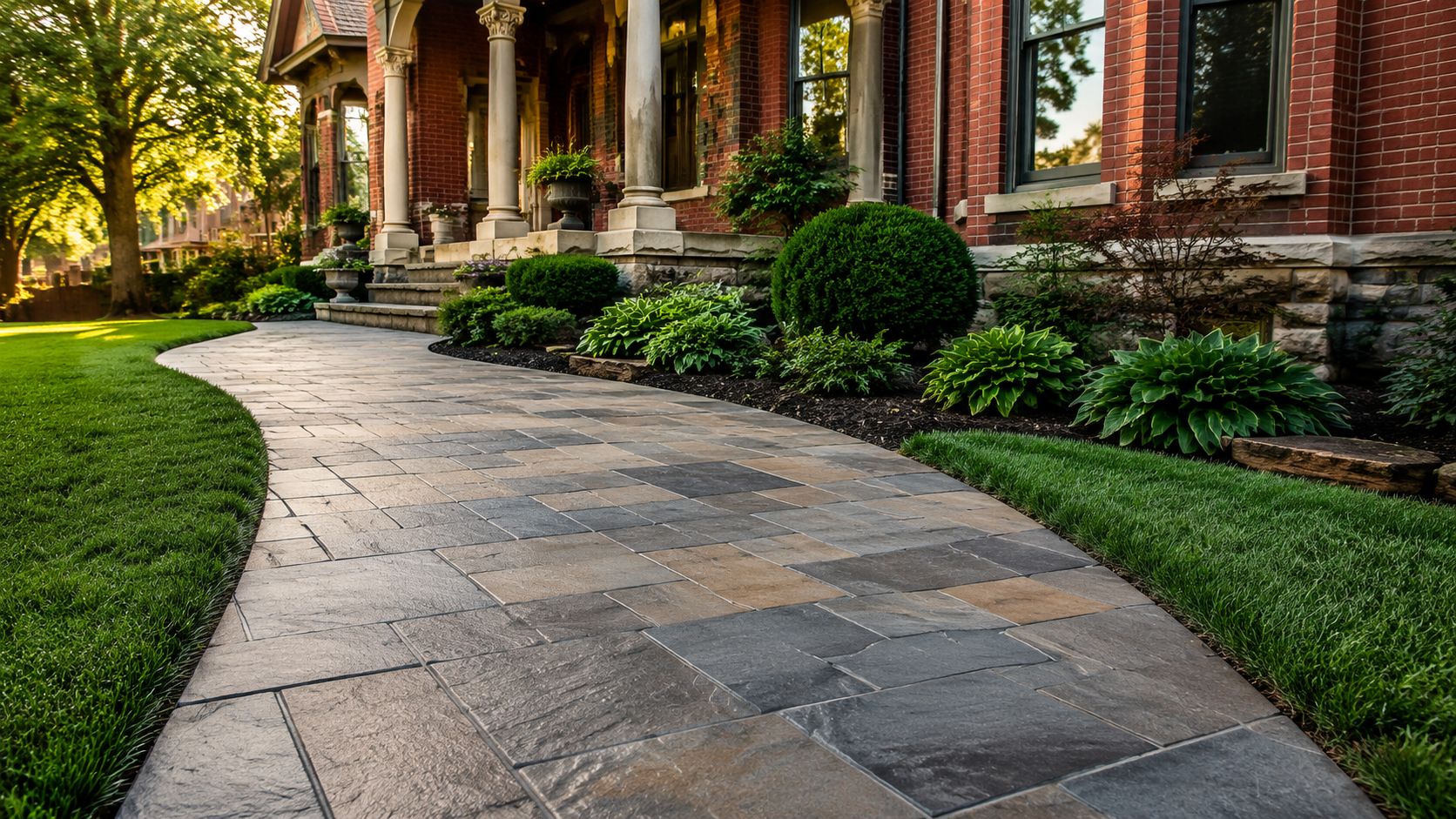
For homeowners comparing surface materials and architectural finishes, compare parking marble designs can provide another visual reference, although a walkway still needs to be assessed for outdoor traction, drainage, and winter exposure.
2. Cobblestone Pattern Walkways for Westboro's Contemporary Aesthetic
Cobblestone stamping gives a walkway a lively rhythm without requiring individually laid stones. The small, rounded forms recall European streetscapes and work well in Westboro, where contemporary homes sit alongside established houses, mature trees, Richmond Road shops, and café streetscapes. Warm grey, soft tan, and restrained brown tones can connect modern siding with traditional brick.
This pattern suits a busy front entrance because the repeated shapes create visual interest across a relatively simple layout. It can also soften a straight path beside a modern façade. A narrow dark border helps define the edges, while a lighter centre can make the route easier to read in changing light.
Prioritise traction over shine
Cobblestone texture can improve visual depth, but a glossy sealer may make the surface look artificial and can create an uncomfortable walking experience when wet. Use a sealer designed for exterior stamped concrete and discuss an anti slip approach for a route that receives frequent foot traffic, winter salt, or runoff from steps.
Installation timing also affects the finish. Dry summer conditions generally make it easier to manage placement, stamping, curing, and early sealing, but the contractor still needs to follow the product and concrete requirements rather than relying on the calendar alone.
For a Westboro property near shops or restaurants, align the walkway with the natural approach from the sidewalk. Don't force a decorative curve where visitors already walk in a straight line. The most successful cobblestone designs support the route people use.
Warm palette: Use tan or warm grey when the home has red brick, cedar, or natural wood.
Defined edge: Add a contrasting edge where lawn or planting beds could blur the boundary.
Low glare finish: Select a protective sealer that preserves colour without an overly wet appearance.
Clear approach: Keep the entrance connection direct, especially on compact lots.
A cobblestone pattern is decorative, but it should still feel comfortable underfoot and remain easy to clear after snow.
3. Brick Pattern Walkways for Kanata's Family Oriented Communities
Brick stamping brings warmth and familiarity to family homes across Kanata, including newer subdivisions, Bridlewood, the Eagleson area, and properties near Kanata Avenue. The pattern can connect the front door to the driveway, side gate, or backyard without making the walkway feel too formal. Terracotta, muted red, tan, and warm brown tones suit traditional brick façades, while a quieter tan and charcoal combination can work with newer stone and siding.
The key advantage is flexibility. A running bond can make a long path feel orderly, while a basketweave arrangement can add a more traditional note near the porch. A border gives the entrance a clear frame, though it shouldn't be so busy that it competes with the brick pattern.
Build for family use
Children, pets, deliveries, bicycles, and muddy footwear all put practical demands on a walkway. A surface with visible texture and a moderate colour variation can hide minor dirt better than a perfectly uniform finish, but deep relief can make snow clearing less convenient. Keep the walking surface consistent around corners and avoid abrupt changes where the route meets the driveway.
Expansion joints need deliberate placement. The supplied design guidance recommends joints every 8 to 10 feet, so the installer can divide a longer walkway into controlled sections and reduce the risk of random cracking. That interval must still be adapted to the actual layout, dimensions, base conditions, and concrete plan.
Spring installation can provide time for curing through the warmer season, but the work still needs suitable weather and proper protection while the surface develops strength. A permeable or breathable sealer can help protect the finish while avoiding an excessively slick appearance.
A family walkway should look welcoming from the street and remain predictable under a child's feet, a dog's paws, and a winter boot.
Use a gentle slope away from the house, connect the path cleanly to the driveway, and keep the edges stable where lawn maintenance equipment will pass.
4. Slate Tile Pattern Walkways for Orleans' Modern Residential Properties
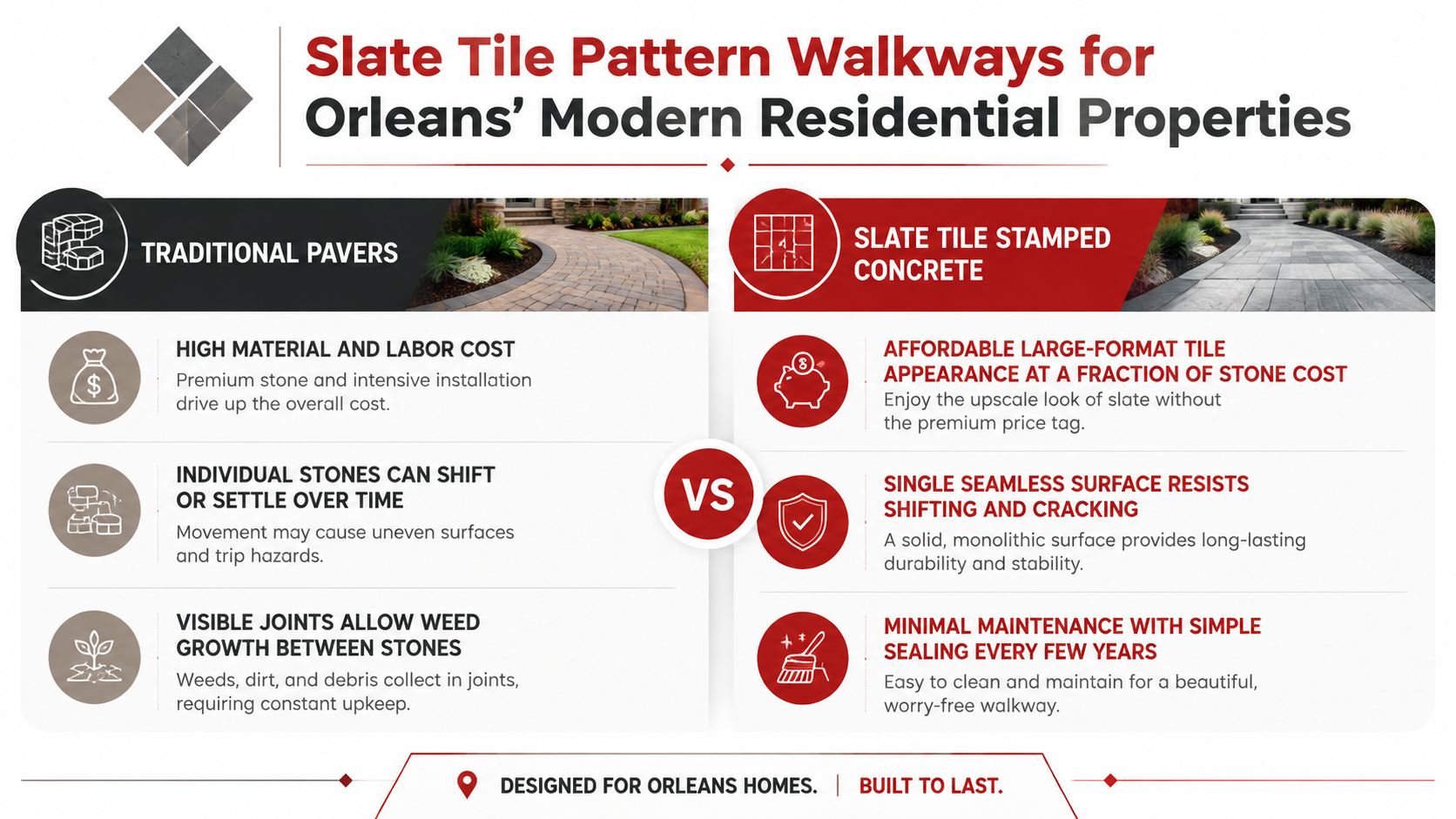
Slate tile stamping takes the natural stone idea in a more controlled direction. Clean geometric joints and larger, regular shapes suit modern homes in Orleans, especially newer residential developments with simple rooflines, broad façades, and minimal planting schemes. The same approach can work beside contemporary properties in Barrhaven or on entries near Orleans Boulevard.
Large format shapes make a modest route feel calmer because there are fewer visual joints. They also pair well with a straight walkway, a square landing at the front steps, or a broad approach that turns at a right angle toward the driveway. Charcoal and grey are practical colour families for this setting because they coordinate with dark window frames, grey siding, and contemporary stone.
Keep geometry aligned
A tile pattern looks best when its lines relate to the house. Align the dominant direction with the front door, porch edge, or main wall rather than allowing the stamp to drift across the route. A contrasting border can sharpen the design, but it needs accurate placement around corners and landings.
Ottawa's freeze thaw conditions make joint layout especially important. The supplied guidance recommends wider expansion joints for this type of design, allowing the installer to plan for seasonal movement instead of treating the geometric appearance as the only priority. A professional grade sealer designed for tile mimicking patterns can protect colour and reduce moisture entry, but it can't compensate for poor drainage or an inadequate base.
For a family route, choose a texture that provides grip without deep cavities that trap grit. The safest modern walkway usually has enough relief to distinguish the pattern and support traction, but not so much that snow shovels catch on the surface.
A slate tile pattern is a good fit when the home has a crisp architectural language. It's less successful beside a heavily ornamental façade or a garden designed around loose, informal shapes.
5. Flagstone Pattern Walkways for Mixed Neighbourhood Compatibility
Flagstone stamping uses irregular shapes and varied sizes to create a natural stone appearance. It's one of the most adaptable choices for Ottawa properties because it can sit comfortably beside a heritage home in The Glebe, a renovated house in Westboro, a family property in Kanata, or a contemporary entrance in Orleans. The surrounding yard determines whether the result feels rustic, traditional, or refined.
Use a restrained palette when the house already has strong brick or stone. A warmer base with a darker accent can bring out the joints, while a grey blend may suit modern siding and evergreen planting. Multiple colour stamps add depth, but too many competing tones can make a small front yard look visually restless.
Let the landscape guide the shape
Flagstone works naturally along a gently curving route through established planting. It also suits a direct path when the installer uses a narrow border to bring order to the irregular pattern. The walkway should slope away from the home and avoid creating a low point beside steps, downspouts, or basement windows.
Established trees and mature garden beds add character, but they can also complicate excavation and access. Before finalising the shape, identify roots, utilities, irrigation lines, drainage outlets, and the route needed to move materials. A pattern that looks attractive on a plan may need to change once the installer sees the actual site.
For a broader overview of surface options, stamped concrete finishes can help homeowners compare pattern and colour directions before choosing a specific flagstone blend.
The finish should support the setting rather than imitate stone too aggressively. In a mixed neighbourhood, a calm flagstone layout with carefully selected colour variation often ages better than a dramatic pattern that dominates the entire frontage.
6. Granite Finish Walkways for Premium Kanata and Barrhaven Properties
A granite finish creates a more polished, premium impression through speckled colour and a stone inspired surface. It suits executive properties in Kanata and upscale homes in Barrhaven, particularly where the walkway forms part of a coordinated entrance with architectural stone, structured planting, outdoor lighting, and a substantial porch.
Black, charcoal, deep grey, and restrained silver blends can reinforce a luxury palette. These colours work best when the house has enough contrast to prevent the walkway from disappearing into the façade. A charcoal field with a slightly lighter border can frame a wide entrance, while a darker finish beside pale stone can create a deliberate architectural contrast.
Keep luxury from becoming slippery
A premium look doesn't require a high gloss. A controlled satin finish can preserve the colour variation while reducing glare and keeping the walking surface visually grounded. Ask how the sealer will respond to ultraviolet exposure, salt, wet conditions, and future maintenance. The sealer should protect the finish without turning the walkway into a slick decorative slab.
Granite effects depend heavily on colour placement and finishing skill. Inconsistent release colour, weak borders, or poorly aligned transitions can make the surface look more like ordinary mottled concrete than granite. Professional installation matters because the visual effect is created through coordinated base colour, accent colour, stamp texture, joint definition, and sealing.
The coloured stamped concrete process offers useful context for homeowners evaluating how colour decisions affect the finished surface.
Pair this pattern with landscaping that has a clear structure. Repeated evergreen forms, clipped shrubs, natural stone retaining details, or simple planting bands can support the premium character. Avoid surrounding a highly refined granite finish with random edging and overcrowded plants, since the competing lines weaken the entrance.
7. Random Stone Pattern Walkways for Established Westboro Charm
Random stone suits the organic character of established Westboro streets. Its asymmetrical shapes avoid the formal repetition of brick and the strict geometry of tile, making it a natural choice for older homes, mature trees, informal gardens, and routes that connect the front entrance with a side gate or nearby shops and restaurants.
Warm earth tones usually work best. Soft brown, tan, muted sandstone, and warm grey can sit comfortably beside mature plantings and older brick. A subtle accent in the joints gives the pattern definition without making every irregular shape stand out.
Plan the transitions carefully
An irregular pattern can become confusing where it meets the public sidewalk, driveway, porch landing, or property edge. Use a defined border or a straight transition at those points, even if the centre of the walkway remains random. This gives visitors a clear place to step and helps snow clearing follow the route.
Westboro properties often have mature landscaping and established grades, so drainage deserves early attention. Check where roof water, surface runoff, and winter melt currently travel. A new path shouldn't redirect water toward the foundation or create a shallow basin beside the lawn.
Ottawa Stamped Concrete's technicians can assess the relationship between the pattern and existing property conditions in the service areas of Westboro and the wider Ottawa region. The important point is local familiarity, not just choosing an attractive stamp from a catalogue.
A random stone walkway can also accommodate a gentle curve more naturally than a strict geometric pattern. Use that flexibility to preserve a mature tree, follow a planting bed, or create a more comfortable approach from the sidewalk. The design should look organic, but the walking route still needs consistent traction, stable edges, and a clear connection to the entrance.
8. Herringbone and Chevron Pattern Walkways for Design Forward Orleans Developments
Herringbone and chevron patterns give a walkway a strong directional quality. They suit design forward homes in Orleans, as well as contemporary entries in Barrhaven, where the path can become an architectural feature rather than a background surface. The repeated diagonal lines guide the eye toward the front door and add energy to an otherwise simple frontage.
Herringbone is usually more forgiving when the walkway changes direction, while chevron creates a sharper, more continuous arrow effect. Choose the pattern according to the property's geometry. A chevron route looks strongest when the point aligns with the entrance, while herringbone can support a longer, more practical approach from the driveway.
Align the pattern with movement
Pattern direction should follow natural foot traffic. If residents approach from the driveway, orient the visual flow toward the porch rather than across it. At a turn, use a landing or carefully planned transition so the diagonal lines don't create an awkward visual break.
Contrasting colours can emphasise the geometry, but strong contrast also makes installation errors easier to see. Use a charcoal accent with a mid grey field for a restrained contemporary effect, or a warm tan field with a darker edge when the home has beige stone or wood details. A border can frame the design, but it should reinforce the entry rather than create a separate visual track.
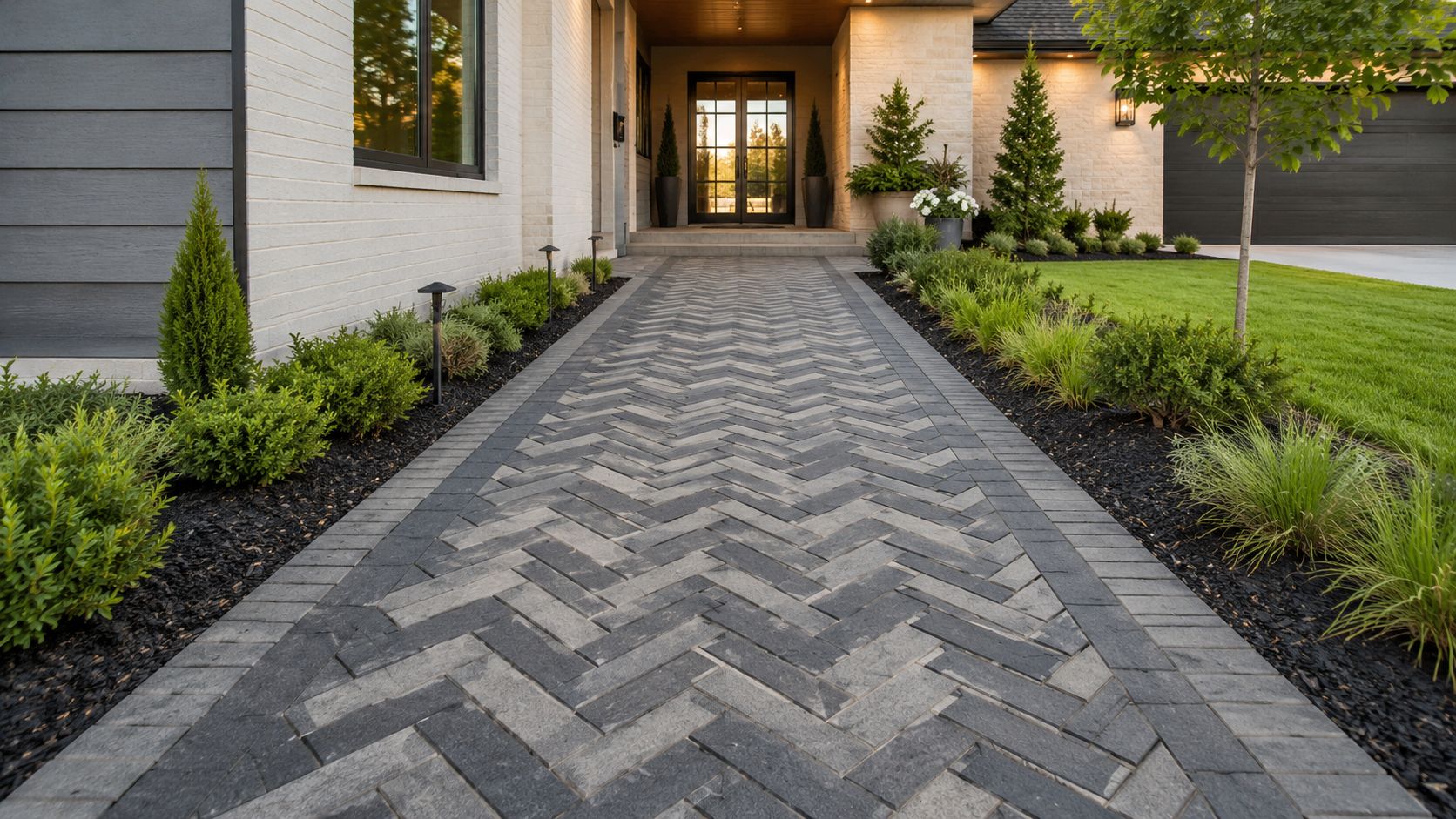
Installation needs accurate layout, consistent stamping, and suitable curing weather. Geometric patterns expose small alignment problems, so experienced contractors should establish the route, border, joints, and entry landing before concrete placement.
For a coordinated route that includes steps, stamped concrete walkway and steps provides a relevant design direction. The walkway and steps should read as one system, with compatible colour, texture, edge treatment, and traction.
8-Point Stamped Concrete Walkway Pattern Comparison
Pattern (Location) | Implementation complexity | Resource requirements | Expected outcomes | Ideal use cases | Key advantages |
|---|---|---|---|---|---|
Ashlar Slate (The Glebe) | Moderate–High, professional, precision stamping | Skilled contractor, color pigments, sealant; regular resealing | Upscale, slate-like curb appeal; durable in freeze–thaw | Historic Victorian/Edwardian front walkways | Complements heritage architecture; good winter traction |
Cobblestone (Westboro) | Moderate–High, specialized stamping depth options | Stamping equipment, anti-slip sealer, color blends | Charming, pedestrian-friendly surface with texture | High-foot-traffic streets, shopfronts, pedestrian paths | Inviting European look; cost-effective vs real stone |
Brick (Kanata) | Moderate, common pattern, straightforward layout | Standard stamping tools, annual sealer, expansion joints | Timeless, safe surface with easy maintenance | Suburban family walkways, entry paths in Kanata | Classic aesthetic; excellent traction; low upkeep |
Slate Tile (Orleans) | High, precision stamping and alignment required | Large-format stamps, professional sealer, careful installation | Clean, modern geometric appearance; slip resistant | Newer residential developments and contemporary entries | Modern, organized look; simple maintenance routine |
Flagstone (Mixed neighbourhoods) | High, skilled randomization for natural look | Multiple stamps/colors, complex sealing, skilled tech | Natural, organic appearance that hides settling | Versatile, works across The Glebe, Westboro, Kanata, Orleans | Highly adaptable; hides imperfections; strong traction |
Granite Finish (Kanata, Barrhaven) | High, specialized stamping and finishing | Premium pigments, high-end sealers, expert installers | Luxury granite-like appearance with strong durability | Upscale properties, executive neighbourhood walkways | Luxury curb appeal; excellent weather resistance |
Random Stone (Westboro) | Very High, authentic irregularization is demanding | Expert technicians, varied stamps, careful grading | Charming, character-filled surfaces; hides defects | Established Westboro streets and heritage properties | Organic aesthetic; integrates with mature landscaping |
Herringbone/Chevron (Orleans/Barrhaven) | Very High, precise alignment and pattern accuracy | Skilled crew, contrasting colors, meticulous layout | Dynamic directional design that guides foot traffic | Design-forward modern developments and entries | Distinctive, eye-catching patterns; increases perceived value |
Turn Your Favourite Pattern Into a Workable Plan
The right pattern depends first on the house and yard, then on the visual effect you want. Ashlar slate and flagstone suit heritage homes, mature gardens, and properties where natural stone character matters. Cobblestone bridges traditional and contemporary styles, making it useful in Westboro. Brick fits family oriented Kanata properties, while slate tile and herringbone or chevron support the cleaner lines of modern Orleans and Barrhaven homes. Granite makes the strongest premium statement when the landscaping and façade can support it. Random stone works best where the property already has informal planting and established character.
Scale matters as much as the stamp. A narrow front yard may need a simple pattern and restrained border, while a broad executive frontage can carry a larger design with stronger colour variation. Think about how the walkway connects to the driveway, sidewalk, porch, side gate, and backyard. The route should follow everyday movement, not only the most attractive line on a sketch.
Ottawa's access rules can affect the layout before pattern selection begins. City guidance allows one walkway without a permit only when it meets conditions including a maximum width of 1.8 metres, compliance with the frontage hard surface cap, separation from trees and utilities, a minimum distance of 0.6 metres from a fire hydrant, and an endpoint at the sidewalk rather than a crossing over it, as outlined in the City's landscaping and land guide. The City's proposed access guidance also refers to a maximum width of 1.8 metres for a separate pedestrian access and restrictions involving municipal tree root zones, City infrastructure, vehicular access, and ditches, according to the private approach review.
Frontage limits can change the design as well. Ottawa's 2026 access guidance states that the combined width of walkways and driveways must not exceed 50 percent of the front yard lot width, with the remaining area kept as soft landscaping. It also says that lots with frontage of 12.0 metres or less and a driveway won't allow pedestrian access, as reported in CTV News Ottawa's coverage of the access changes. Confirm current requirements through the City's Access Design Requirements, which identifies the applicable access, zoning, and road activity by laws.
The walkway also needs to serve pedestrians safely. Ottawa's Pedestrian Plan calls for pedestrian facilities on existing, new, and reconstructed roads and says pedestrian zones should remain accessible and unimpeded. That means keeping the path clear, maintaining a sensible width, and avoiding decorative elements that interrupt movement.
Budget expectations should be realistic. Industry history sources place stamped concrete's origins in the 1950s, with broader popularity in the 1970s, and commonly estimate a properly installed and maintained surface at about 25 years of service life. Canadian pricing guidance places installed stamped concrete at about $8 to $19 per square foot, so a 4 by 50 foot walkway, equal to 200 square feet, works out to roughly $1,600 to $3,800 before excavation or site upgrades, based on Ottawa stamped concrete walkway pricing guidance. Ontario's wider construction environment is substantial, with Statistics Canada reporting $49.3 billion in building construction revenue in 2022, as shown in the agency's construction data.
Before requesting an assessment, settle four decisions: one pattern, one colour family, one border treatment, and one installation season. Then review slope, drainage, joint placement, traction, curing conditions, salt exposure, and winter sealing with Ottawa Stamped Concrete. A design that looks right in a photograph still needs to work at the property line, beside the foundation, under a snow shovel, and through Ottawa's freeze thaw cycles.
If you're comparing visual options with digital planning tools, an AI landscape design tool can help organise early ideas, but the final plan should be checked against the actual grade, access rules, utilities, trees, and concrete installation requirements.
Ottawa Stamped Concrete offers custom patterned and stamped concrete walkways for homeowners in Barrhaven, Nepean, Kanata, Stittsville, and Orleans, with related patio, driveway, porch, and pool deck services. Visit Ottawa Stamped Concrete to discuss your preferred pattern, colour family, border treatment, and installation season, then request a project assessment for your property.
Comments