
Colored Stamped Concrete Process: Ottawa Guide

Colored stamped concrete in Ottawa needs specialised colouring methods, tight temperature control, and careful timing, because local projects have to hold up through 40 plus freeze thaw cycles and long periods of seasonal moisture. If the slab goes in at the wrong time or the colour work is rushed, the finish can look good for a few days and then start showing problems that should've been avoided.
A homeowner in Barrhaven usually starts with a simple picture, a cleaner driveway, a patio that looks like stone, maybe a pool deck that feels finished instead of plain grey. The hard part is that Ottawa doesn't give you a forgiving install window. Between precipitation, shoulder season dampness, and sudden cold snaps, the colored stamped concrete process has to be built around weather, not just design.
Table of Contents
Understanding the Colored Stamped Concrete Process - What makes it different from plain concrete - The four colouring approaches at a glance
Four Coloring Methods Compared - Where each method fits - How the methods compare in practice
Ottawa Climate Timing Requirements - Why Ottawa weather changes the job - Cold weather and hot weather both matter
Step by Step Application Process - Site work and concrete placement - Colour hardener and release agent - Stamping, curing, and sealing
Common Quality Issues and Mistakes - What goes wrong when moisture is ignored - Warning signs to watch for
Maintenance and Long Term Care Guide - Seasonal care that actually helps - Where maintenance usually varies
Understanding the Colored Stamped Concrete Process
A patio in Kanata or a driveway in Stittsville usually starts the same way. The homeowner wants the texture of stone or slate, but they don't want the upkeep that comes with individual pavers or the plain look of standard concrete. The colored stamped concrete process solves that by combining structure, colour, and texture in one slab, so the finish isn't an afterthought, it's part of the concrete itself.
What makes it different from plain concrete
Regular concrete is poured to perform. Coloured stamped concrete is poured to perform and to look finished. That means the mix, the colouring method, the release material, the stamping window, and the curing plan all have to work together.
Ontario specifications treat this as a standardised system, not a decorative shortcut. Archived Toronto construction specifications for coloured impressed concrete reference ASTM C979 for pigments, while common Ontario patterned concrete specs also call for ASTM C33 aggregates, ASTM C150 Portland cement, and ASTM C260 air entrainment, which shows the process is built around durability as much as appearance Toronto construction specs. In Ottawa, that matters because the surface has to survive long winters, moisture, and repeated freeze thaw stress.
The other thing homeowners notice quickly is that the look changes depending on how colour is introduced. Some systems colour the whole mix. Others colour the surface. Some add contrast with release powder, and some use stains or dyes later for visual adjustment.
Practical rule: if the surface colour is doing all the work while the concrete underneath is ignored, the finish usually ages poorly in Ottawa weather.
The four colouring approaches at a glance
The four main approaches are integral colour, colour hardener, acid stain, and liquid dye. Each one creates a different final look, and each one behaves differently once it faces Ottawa seasons. Integral colour gives a more consistent base tone. Colour hardener adds a denser, more wear resistant coloured surface. Acid stain is more variable and organic looking. Liquid dyes offer flexibility, especially for adjustment and enhancement work.
For a pool deck in Orléans, a contractor may lean toward a surface colour system that handles wear and gives a defined stamped texture. For a walkway in Nepean, the decision might be driven more by slip resistance, maintenance, and how the finish will look after a few freeze thaw cycles. The method matters because the same stamp pattern can look completely different depending on how the colour is built into the slab.
Four Coloring Methods Compared
Every Ottawa homeowner eventually asks the same question, which colouring method lasts. The honest answer is that the right choice depends on the job. A front walkway in Barrhaven doesn't need the same colour strategy as a pool surround in Orléans, and a driveway in Nepean takes more abuse than a sheltered backyard pad in Kanata.
Where each method fits
Integral colour goes into the concrete before or during placement, so the colour is carried through the mix. It's a good fit when you want a uniform base tone and fewer visible wear issues at the surface. The downside is that it doesn't create as much surface depth on its own, so a release agent or additional texture work is often used to make the stamp pattern read better.
Colour hardener is the method most Ontario municipal impressed concrete specifications lean on. In municipal guidance, it's commonly specified at about 60 lb per 100 square feet, and it has to be floated into moist concrete after bleed water has dissipated to avoid mottling and uneven absorption Ontario impressed concrete specifications. That's a strong clue about why contractors use it so often on driveways and pool decks. It gives a harder wearing coloured surface and it helps the stamp pattern hold up under traffic.
Acid stain creates a more variegated finish. It can look rich on the right surface, but it's not the first choice when a homeowner wants exact colour consistency across a large exterior slab. It's better for enhancement than for a brand new high traffic decorative slab.
Liquid dye is usually the most flexible visually. It's useful for colour adjustment, accenting, or restoration work, but it doesn't replace a proper base system in exterior Ottawa work where durability is the priority.
How the methods compare in practice
Coloring Method Comparison Guide | Best For | Durability | Cost Range |
|---|---|---|---|
Integral colour | Uniform base tone, simpler residential work | Good when paired with proper mix design | Moderate |
Colour hardener | Driveways, patios, pool decks, municipal style finishes | Strong surface wear resistance | Moderate to higher |
Acid stain | Accent work, artistic variation, selective enhancement | Variable, surface dependent | Moderate |
Liquid dye | Colour correction, restoration, design accents | Depends on sealer and substrate | Lower to moderate |
The reason colour hardener shows up so often in Ontario specs is simple, it gives practical surface performance, not just visual colour. That matters in Ottawa where damp seasons, snow load, and traffic all punish weak finishes.
For homeowners comparing options, this stamped concrete colour guide helps show why a no colour approach is rarely the right answer for an exterior project here. The surface has to look good, but it also has to survive use.
Ottawa Climate Timing Requirements
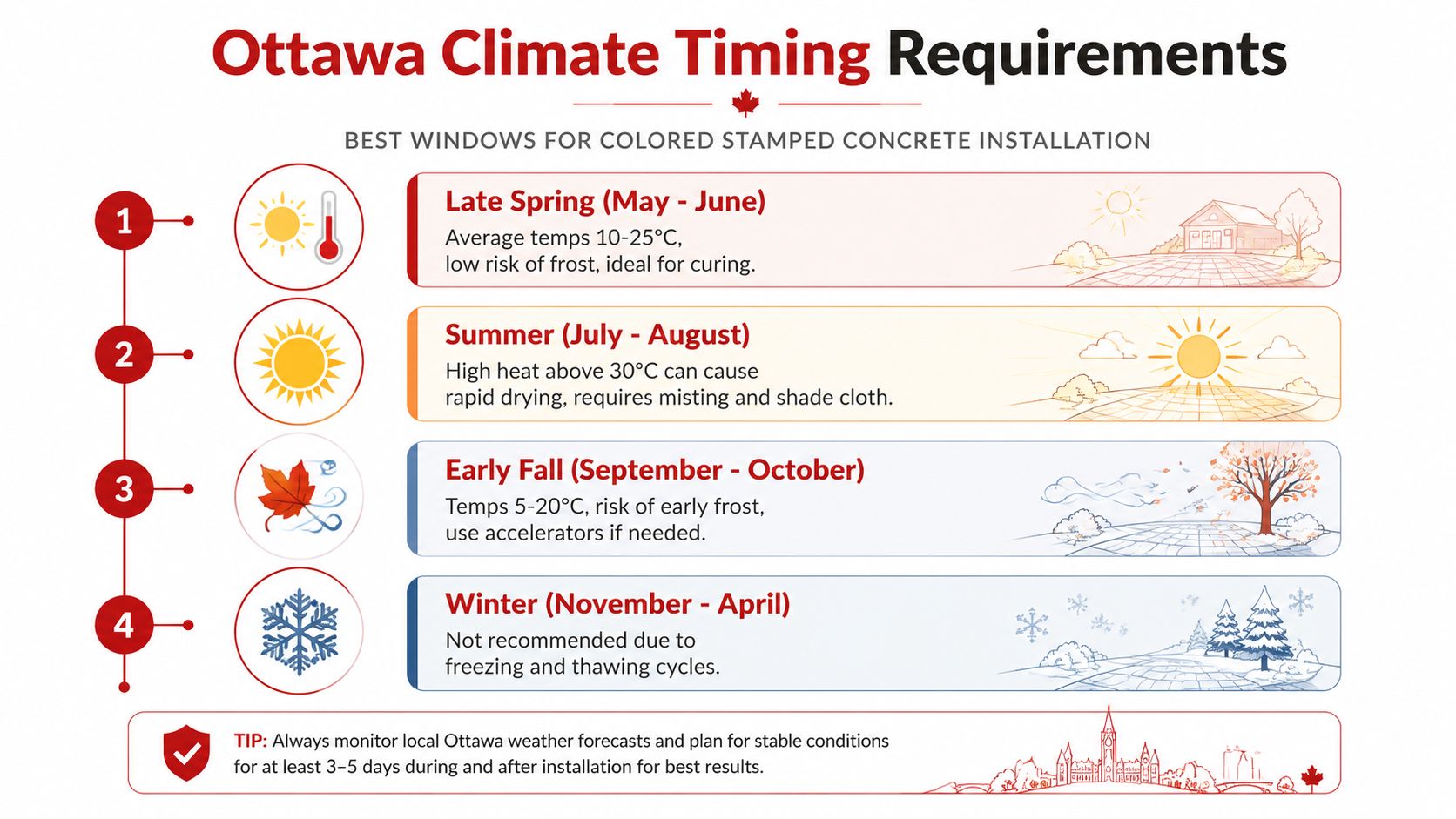
Ottawa weather doesn't just influence the schedule, it decides whether the job goes well at all. Ontario regional specifications require coloured and impressed concrete to be placed only within a 10°C to 30°C window, with a minimum 120 hour curing period, and cold weather guidance says the concrete must be protected so its temperature stays at or above 10°C through curing Ontario impressed concrete specifications. That's not a casual suggestion. It's the difference between crisp stamp definition and a surface that never really sets up right.
Why Ottawa weather changes the job
Environment and Climate Change Canada's historical database lists 27 Ottawa named stations with records spanning 1840 to 2024, and Government of Canada climate assessments report an annual observed baseline precipitation of 713.98 mm for Ottawa Ottawa historical climate stations. That combination tells you exactly why moisture management matters so much here. There's plenty of wet weather, and wet weather narrows the safe finishing window.
In the world, that means late spring and early summer often give the most forgiving conditions, while shoulder season work in April or October needs much tighter judgement. I've seen homeowners push for a date because the calendar looked free, only to find the slab was fighting temperature swings and surface moisture all day. That's when colour inconsistency starts creeping in.
Cold weather and hot weather both matter
Canadian cold weather guidance defines cold weather as a forecast probability that air temperature will fall below 5°C within 24 hours of placing, and it requires the concrete to be kept at or above 10°C during curing RMCAO cold weather guidance. The same guidance gives a benchmark of 3 days at 10°C to reach 40 percent of specified strength, or 7 days at 10°C to reach 70 percent. That directly affects when a decorative slab can be stamped, sealed, or opened to traffic.
Hot weather has its own limits. RMCAO hot weather guidance lists maximum placement temperatures of 32°C, 30°C, 25°C, or 20°C depending on section thickness RMCAO hot weather guidance. On a hot July day in Nepean or Orléans, that affects set rate, working time, and how quickly the colour needs to be handled.
The contractor who watches the thermometer and the forecast usually gets the better finish, not the one who rushes the calendar.
Step by Step Application Process
A good stamped surface starts long before the stamping mats show up. The base has to be ready, the forms have to hold, and the slab has to be mixed and placed with enough control that the colour and texture can be finished while the concrete is still in the right working state. In Ottawa, the process is as much about timing as it is about technique.
Site work and concrete placement
First comes excavation, grading, and compaction. A stable base matters because decorative concrete is still structural concrete, and if the slab moves, the finish goes with it. After that, the forms are set and the reinforcement is placed, then the concrete is poured and levelled.
At this point, the crew has to read the surface, not just the clock. If the slab is too wet, the surface won't hold detail cleanly. If it stiffens too fast, the stamps leave shallow texture and the finish looks rushed. That's why experienced crews work in sequence and keep their tools ready before the truck arrives.
Colour hardener and release agent
Ontario impressed concrete specifications commonly call for the colour hardener to be floated into moist concrete at approximately 60 lb per 100 square feet, but only after bleed water has dissipated Ontario impressed concrete specifications. That timing matters because residual bleed water can weaken the bond and create mottling or uneven colour uptake.
The release agent comes next. It prevents the stamp mats from sticking, but it also creates contrast in the recessed pattern. Used well, it makes a stamped surface look deeper and more natural. Used badly, it can look dusty or patchy.
Stamping, curing, and sealing
Stamping starts while the slab is still workable enough to take a clean impression. The mats need to be aligned, pressed consistently, and moved in a rhythm that avoids obvious overlap lines. Once the texture is in, the slab has to cure under the right conditions before any sealant goes on.
Cold weather guidance says concrete must stay at or above 10°C through curing, and regional impressed concrete guidance calls for at least 120 hours of curing RMCAO cold weather guidance Ontario impressed concrete specifications. That curing window is why sealing too early is such a mistake.
Field note: if a contractor talks about sealing before the slab has actually dried out, that's a warning sign, not a convenience.
Common Quality Issues and Mistakes
The most expensive stamped concrete problems usually start with bad timing, not bad taste. A lot of homeowners assume the pattern is the hard part, but in Ottawa the hidden risk is moisture. That's especially true on jobs in Barrhaven and Nepean, where a surface can look ready while the slab still holds too much water to finish properly.
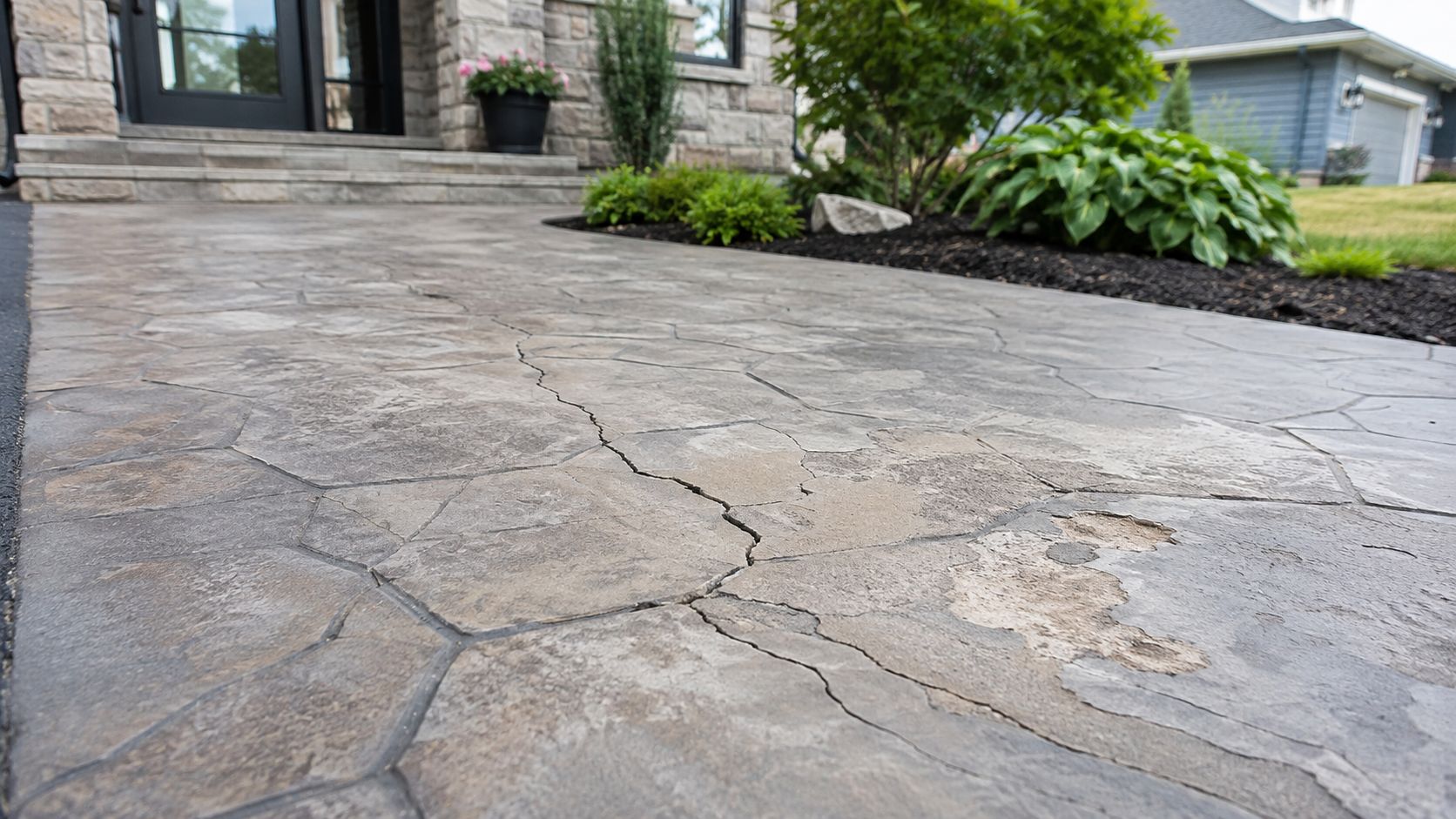
Colour mottling is one of the first issues people notice. It usually shows up when colour hardener is handled before bleed water has dissipated, or when the surface is finished unevenly. The result isn't just cosmetic inconsistency, it can make the entire slab read as patchy or unfinished.
What goes wrong when moisture is ignored
Sealer problems are just as common. Regional guidance says sealers should go on only when the concrete is dry and above 4°C, and new slabs should generally cure about 28 days before sealing because trapped moisture can cause clouding, whitening, bubbling, or peeling Ottawa sealer guidance. That's one of the biggest mistakes I see when homeowners get told the surface can be finished quickly.
Freeze thaw stress makes the problem worse. Ottawa research on winter conditions reports average December to March freeze thaw cycles rising from 34.4 days historically to 40.8 days during 1984 to 2004 and 41.6 days over the last decade in that study Ottawa freeze thaw research. More cycles mean more stress on a surface that wasn't cured or air entrained correctly.
Warning signs to watch for
If you're checking a contractor's work, look for these problems early.
Patchy colour: This often points to poor hardener timing or inconsistent floating.
Soft stamp definition: Usually means the slab lost workability before the mats were applied.
Cloudy sealer: Often tied to residual moisture trapped under the finish.
Scaling in winter: Often linked to weak cold weather protection or poor air entrainment.
For a practical look at how failures show up in real projects, this problem guide for stamped concrete driveways is worth reading before you sign off on a job.
The biggest misconception is that sealing is just a final decorative step. In Ottawa, it's a moisture management decision, and if the slab isn't ready, the sealer can trap the problem instead of protecting the surface.
Maintenance and Long Term Care Guide
A stamped slab doesn't need complicated care, but it does need regular attention that matches Ottawa's seasons. In Kanata, a patio may need spring cleaning after snowmelt leaves grit behind. In Orléans, a pool deck may see more sun, more water, and more sealer wear. The care plan changes a bit by neighbourhood, but the goal stays the same, keep moisture moving, keep the surface clean, and don't let small damage sit through another winter.
Seasonal care that actually helps
Spring is the time to inspect for flaking, surface wear, and joint movement after freeze thaw cycles. Summer is the right time to think about resealing if the surface has dulled or started shedding water less effectively. Winter is where most damage happens from scraping, so use snow removal tools that won't gouge the finish and avoid aggressive metal edges.
If the colour starts looking tired, touch ups may be enough on some surfaces, especially where the pattern detail is still sound. That's one reason a well built colour system matters from day one. It gives you room to maintain the finish instead of replacing it.
For sealer selection and application, this sealer application guide is a useful companion to the installation advice above. If you're also caring for adjacent wood features, AlliedFenceAndGate.com cedar tips are helpful for keeping the whole outdoor space coordinated without creating maintenance conflicts between materials.
Where maintenance usually varies
Ottawa census data documents 314 Ottawa Gatineau neighbourhood profiles, including Barrhaven, Nepean, Kanata, Stittsville, and Orléans Ottawa neighbourhood profiles. Those areas don't all see the same traffic patterns or exposure, so maintenance needs can vary by how the surface is used. A driveway with daily vehicle loads needs different monitoring than a sheltered front walk or a decorative back patio.
When a surface starts showing peeling sealer, scaling, or colour loss, call a pro instead of trying to bury the problem under another coat. A good maintenance routine protects the investment, but only if the original finish was built to handle Ottawa weather in the first place.
If you're planning a patio, driveway, walkway, porch, or pool deck in Ottawa, talk with Ottawa Stamped Concrete about a finish that's built around our climate, not just our curb appeal. Visit Ottawa Stamped Concrete to discuss your project, compare colour options, and get practical guidance for a stamped surface that can handle local freeze thaw conditions.
Comments