
Stamped Concrete Repair Guide for Ottawa Homeowners

A fine crack beside the garage apron can look harmless in June. In a Barrhaven driveway, though, that line may be the first visible sign that water is entering the stamped surface, moving through a weak joint, or reaching a damaged base. Ottawa's winters don't give small defects much room to remain small.
Stamped concrete repair is therefore more than filling a crack and applying a fresh coat of sealer. The repair must account for moisture, slab movement, surface bond, pattern texture, colour, curing, and the narrow outdoor work season in Ottawa, Ontario. A patch that looks acceptable on installation day can separate after the next hard winter if the underlying cause remains.
Table of Contents
Why Stamped Concrete Repair Is a Real Ottawa Problem - Small defects need a cause, not just a filler - Repair timing matters
The Three Failure Modes You Will Actually See - Cracks reveal movement and moisture routes - Delamination and spalling affect the bond - Colour fade is usually a finish problem
Choosing Between Patch, Resurface, and Partial Replacement - Use a patch for isolated, shallow damage - Resurface a sound slab with broad finish damage - Choose partial replacement for concentrated deep failure
Matching Pattern Texture and Colour on a Real Repair - Start with the original surface - Recreate texture while the material is workable - Build colour in layers
DIY Versus Hiring an Ottawa Contractor - Call a contractor when the damage signals movement - Compare the risk, not just the method
Sealing and the Two to Three Year Maintenance Rhythm - Prepare the surface before applying anything - Avoid the flood coat
Your Ottawa Repair Action Plan - Start with evidence - Ask for a repair description - Put maintenance on the calendar
Why Stamped Concrete Repair Is a Real Ottawa Problem
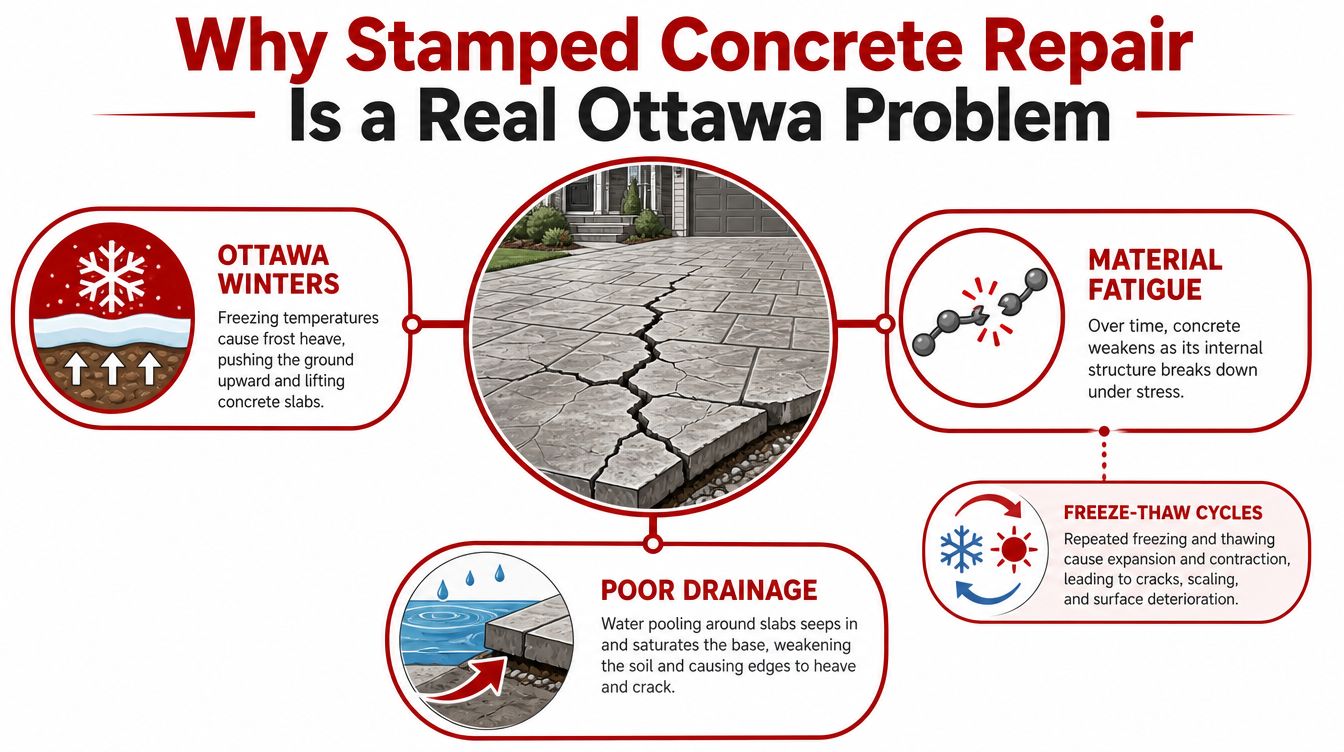
Ottawa's freeze-thaw cycle is the technical reason stamped concrete damage can escalate. Water enters joints, hairline cracks, porous patches, and thin surface layers. When that water freezes, it expands and presses against the surrounding concrete. Ottawa-focused guidance describes roughly 80 to 100 freeze thaw cycles each year, with trapped water expanding by about 9% when it freezes (Ottawa concrete and parging repair guidance).
The process repeats as temperatures rise and fall. Thawing creates another opportunity for water to enter, while road salt and spring runoff keep the surface wet. On a patio edge, walkway joint, or driveway transition in Nepean, Kanata, Stittsville, or Orléans, poor drainage can accelerate deterioration. Snow piled against the slab and water collecting near an exposed edge create added pressure.
Small defects need a cause, not just a filler
Stamped surfaces often fail first around joints, thin overlays, and small cracks because these areas give moisture a direct route into the slab. The visible result may be scaling, spalling, delamination, or a patch that loses its bond after one Ottawa winter.
Practical rule: Stop water entry and address movement before restoring the pattern.
Sealing every two to three years can reduce moisture and road salt exposure (Ottawa concrete and parging repair guidance). Sealer cannot stabilise a moving slab or correct poor drainage. It can, however, limit the wetting that turns manageable surface wear into deeper deterioration.
Repair timing matters
Ottawa's outdoor repair season is short. Exterior work needs a stable, dry period in late spring, summer, or early fall, with enough warmth for the repair material to cure before hard frost. Resurfacing guidance recommends completing this work during the warmer seasonal window (Ottawa concrete resurfacing guidance).
Inspection should cover cracks, hollow areas, slab movement, drainage, joints, and salt residue. A stable surface defect may suit sealing or a local patch. A hollow, lifted, or repeatedly wet section may require partial replacement. Pattern texture and colour also affect the recommendation, because a structurally sound repair can still remain visibly obvious if the finish cannot be matched. Waiting rarely improves the appearance or expands the repair options before winter returns.
The Three Failure Modes You Will Actually See
Stamped concrete damage usually falls into three visible groups, although one area can show more than one problem. The first step is to identify the failure mode before choosing a product.
Cracks reveal movement and moisture routes
A hairline shrinkage crack is different from a fracture that continues through the slab. Location matters. A line over a control joint may reflect expected movement, while a crack with vertical displacement, heaving, or widening edges points to a more serious base or drainage condition.
Clean the area and inspect it in different weather. If the crack repeatedly opens, holds water, or connects to a lifted section, a surface filler won't solve the cause. A contractor should assess the slab's movement and the condition below the decorative face.
Delamination and spalling affect the bond
Delamination occurs when the upper layer loses its bond with the concrete beneath. You may hear a hollow sound when the surface is tapped, or see bubbling, shallow chips, flaking, and areas that peel after salt exposure. A weak top layer can also trap moisture beneath a sealer, making the damage more visible and harder to stabilise.
Spalling removes the finished surface itself. If the damaged concrete reaches deeper material or the base, the repair needs more preparation than a skim coat. Ontario's repair specifications distinguish between partial depth and full depth work, with OPSS 366 covering conventional, high early strength, and fast track repair materials (Ontario OPSS 366 repair specification).
Colour fade is usually a finish problem
Colour loss doesn't automatically mean the slab has failed. Sun exposure, traffic, de icing products, and worn sealer can mute the original colour or create uneven tone. A newer patch can also look darker because it retains moisture differently from the older concrete.
Use the problem's appearance to guide the diagnosis:
Failure mode | What you see | Likely cause |
|---|---|---|
Crack | Hairline, widening, displaced, or joint related line | Shrinkage, movement, drainage, or moisture entry |
Delamination or spalling | Hollow spots, bubbling, flakes, shallow chips | Weak surface bond, salt exposure, trapped moisture, or freeze thaw damage |
Colour fade | Dull, uneven, or washed out appearance | UV exposure, traffic, de icing products, or worn sealer |
For a useful visual reference on how patterns and surfaces deteriorate, review this guide to common imprinted concrete driveway problems. The key distinction is simple. A moving crack needs stabilisation, a detached surface needs sound material and proper bonding, and a faded finish needs cleaning, recolouring, or resealing.
Choosing Between Patch, Resurface, and Partial Replacement
The right repair is the least aggressive method that restores a sound and stable surface. That doesn't always mean the cheapest method. A quick patch saves time only when the surrounding concrete can support it.
Use a patch for isolated, shallow damage
A localised patch can suit one small crack, chip, or shallow void. The contractor should remove loose material, clean and profile the edges, confirm that the surrounding concrete isn't hollow, and apply a compatible repair compound. The surface then needs shaping or texturing to suit the existing pattern.
Patching is efficient, but colour and texture differences are normal. It works best when the damaged area is limited and the slab isn't moving.
Resurface a sound slab with broad finish damage
Resurfacing is more suitable when the slab remains stable but the stamped face has faded, scaled, or lightly delaminated across a wider area. A bonded overlay can create a new decorative skin, provided the original surface has been mechanically prepared and the overlay has adequate bond and thickness.
A thin skim coat over an unstable slab is appearance work, not durable stamped concrete repair. Active structural cracks, widespread hollow areas, and slab movement must be resolved first.
Choose partial replacement for concentrated deep failure
Partial depth replacement suits a defined section with severe edge breakup, deep spalling, or damage around a drain, while the rest of the slab remains sound. Removing the failed concrete exposes solid material and gives the new repair a cleaner bond surface.
Ontario specifications treat repair performance as more than cosmetic appearance. One provincial draft requires repaired concrete to reach 20 MPa minimum compressive strength before opening to traffic (Ontario concrete repair performance guidance). That threshold reflects a broader principle for residential work. The repair material and curing process need to match the depth and use of the damaged section.
Method | Best trigger | Key limitation |
|---|---|---|
Patch | One isolated crack, chip, or shallow void | Visible colour and pattern mismatch can remain |
Resurface | Stable slab with broad fading, scaling, or light surface wear | Won't correct movement, hollow areas, or deep failure |
Partial replacement | Defined section with deep damage and sound concrete around it | Requires careful removal, bonding, curing, and matching |
Surface flatness matters as well. Ontario's draft surface specification allows a 3 mm maximum gap under a 3 m straightedge and identifies diamond grinding as the acceptable method for correcting surface tolerance and local roughness before traffic (Ontario OPSS 350 draft specification). A sound patch still needs controlled elevation and transitions.
Matching Pattern Texture and Colour on a Real Repair
A repair can be structurally successful and still disappoint the homeowner if the patch stands out. Pattern and colour matching aren't decorative afterthoughts. They require a contractor to read the existing slab before mixing material.
Start with the original surface
Look for installation records, old photographs, leftover material, or an undisturbed edge. The contractor should identify the stamp layout, joint direction, relief depth, and original release agent colour. A spare slab cutout can serve as a reference tile, while the driveway edge may show the original tone more clearly than the traffic path.
Mechanical profiling comes before colour. Cleaning salt residue, removing weak concrete, and preparing the bond surface determine whether the repair can accept the new material evenly.
Recreate texture while the material is workable
A polymer modified repair compound can be pressed with flexible polyurethane stamps while it remains plastic. The stamp must line up with the existing pattern, not reproduce a similar stone or brick impression.
Texture comes from stamp depth and controlled pressure. Trowelling the surface flat and trying to imitate the pattern afterward usually creates shallow relief and obvious edges. Over stamping can crush the raised detail, while insufficient pressure leaves a weak or incomplete impression.
Build colour in layers
Colour matching usually takes more than one product. A contractor may use:
Base tint, mixed close to the cured slab's underlying tone.
Dry shake colour hardener, used to strengthen the visual contrast on raised areas.
Antiquing wash or tinted sealer, used to soften transitions and deepen recesses.
The process described in this coloured stamped concrete process guide illustrates why colour develops through preparation, material choice, texturing, and finishing rather than a single coat.
The realistic target is a close blend at conversational distance, not an invisible repair under close inspection.
New and old concrete absorb moisture differently, so a patch may look darker during wet weather and change again as it cures. Ask for a test area when the colour is important, and ask the contractor to explain where the pattern will start and stop. A straight repair line across several stones is usually more noticeable than a repair that follows existing joints or pattern boundaries.
DIY Versus Hiring an Ottawa Contractor
A homeowner can handle some minor stamped concrete repair, but the decision should depend on depth, movement, area, and finish expectations, not confidence with a trowel alone.
A shallow chip at an isolated edge may be manageable with a polymer patch kit, colour hardener, and a rented stamp. The match will probably be approximate, and the homeowner will manage the curing, sealing, and any future failure. That can be a reasonable trade off when appearance isn't critical.
Call a contractor when the damage signals movement
A crack wider than a credit card, spalling larger than about one square metre, or damage exposing rebar or base material should receive professional assessment. These thresholds are practical warning signs, not a substitute for inspection. A lifted edge, hollow section, recurring separation, or drainage problem indicates that filling the surface may only postpone the next failure.
The same decision applies in Barrhaven and Orléans, where access, demolition, disposal, and the condition of the existing base can change the scope. A professional quote should explain whether the failed material will be removed, how the substrate will be prepared, and what curing and sealing conditions are required.
Compare the risk, not just the method
DIY work avoids contractor mobilisation and may suit a small repair. It also leaves the homeowner responsible for colour matching, stamp alignment, weather timing, and the risk of sealing before the material has cured properly. A contractor brings equipment and repair experience, but the quote may include demolition, disposal, surface profiling, and more extensive preparation.
Canadian concrete work is tied to recognised CSA requirements for mix design, transport, placement, curing, sampling, and testing, including CSA S6, CSA A23.1, CSA A23.2, and CSA A283 (Canadian government concrete standards document). CSA S448.1:10 also provides a dedicated repair standard for reinforced concrete in buildings and parking structures (CSA repair standard notice).
For a practical visual comparison of severity and recommended action, use the video below.
Sealing and the Two to Three Year Maintenance Rhythm
Sealer helps limit water absorption, UV driven fading, and de icing salt exposure. It isn't a structural repair product, but scheduled resealing can reduce the moisture load that drives repeat surface damage in Ottawa.
Ottawa area guidance commonly recommends resealing every two to three years (Ottawa concrete and parging repair guidance). The interval depends on exposure, traffic, drainage, and the existing finish. A south facing driveway or busy walkway may wear sooner than a protected patio.
Prepare the surface before applying anything
A reliable maintenance sequence is straightforward:
Dry sweep: Remove sand, leaves, and loose grit.
Gentle degrease: Treat oil and traffic residue without aggressive abrasion.
Rinse carefully: Remove cleaner and salt residue.
Allow proper drying: Plan for at least 24 hours of dry weather above 10 degrees Celsius.
Apply two thin coats: Use a roller or sprayer and add a compatible non slip additive where needed.
For homeowners who want a detailed cleaning routine before resealing, this resource explains the best way to clean a concrete driveway. Cleaning is part of the bond preparation. Sealer applied over dirt, salt, or damp concrete can trap contamination and create uneven whitening.
Avoid the flood coat
Applying too much sealer at once is a common mistake. A heavy film can turn cloudy, peel, or remain soft, particularly when moisture is still present below the surface. Thin, even coats give the sealer a better chance to cure without creating a brittle surface layer.
The stamped concrete sealer application guide offers additional practical direction on application. If the slab has active cracks, hollow areas, or delamination, repair those conditions first. Sealer preserves a prepared surface, it doesn't make unstable concrete stable.
Your Ottawa Repair Action Plan
A driveway in Barrhaven can look unchanged in dry weather, then reveal new ponding or a widening crack after thaw. Use that first week to establish what changed, where moisture remains, and which conditions a contractor must address. The goal is useful evidence, not a remote diagnosis.
Start with evidence
Photograph each crack, spall, faded patch, lifted edge, and puddle. Include one wider image showing the driveway and one close image showing the stamped pattern. Date the photographs, then compare them after rain, thawing, and the next season.
Run a hose and marker check in late morning. Wet the surface evenly and mark places that hold water longer than nearby concrete. Persistent ponding keeps the damaged area wet through Ottawa's freeze-thaw cycle, which can turn a small surface defect into a deeper repair.
Ask for a repair description
Contact two local contractors during the practical exterior repair window from mid May to early October. Request written quotes that state the proposed repair method, pattern stamp number, preparation, colour approach, and sealer type. A lump sum does not show whether the contractor plans to patch, resurface, or remove unstable concrete.
Ask each contractor these questions:
What condition requires repair first? The quote should identify active cracking, hollow concrete, delamination, drainage, or another cause.
How will the new work meet the existing surface? Pattern depth, release colour, and finish texture affect both appearance and water shedding.
What happens if the match is imperfect? A test area or defined transition may be more realistic than promising an invisible repair.
Which areas remain outside the repair? Confirm whether adjacent edges, joints, and low spots are included or left for later work.
What weather limits apply? The contractor should explain curing and sealing requirements for the available Ottawa repair window.

Put maintenance on the calendar
Record the completion and sealing date when the repair is finished. Set a reseal reminder for month 24, then inspect for whitening, renewed water absorption, edge wear, and salt-related deterioration before another winter arrives.
Ottawa's neighbourhoods, from Barrhaven and Nepean to Kanata, Stittsville, and Orléans, face the same seasonal constraint (Ottawa neighbourhood communities). Address the cause during the narrow repair season, verify drainage with the hose check, and make the pattern and colour decision before work begins.
Ottawa Stamped Concrete offers concrete restoration and resurfacing for worn stamped surfaces, including damaged driveway sections and broader decorative areas. Visit Ottawa Stamped Concrete to discuss the surface condition and arrange a repair assessment for your Ottawa property.
Comments