
Stamped Concrete vs Regular Concrete: Ottawa Guide 2026

You're standing on the driveway or out back, looking at a worn slab and trying to decide if you want something practical or something that lifts the property. In Ottawa, that choice usually comes down to regular concrete or stamped concrete, and the wrong pick shows up fast once winter starts chewing on the surface. If you want the straight answer from someone who's poured both across Barrhaven, Nepean, Kanata, Stittsville, and Orleans, here it is, both start with the same concrete base, but they solve very different problems.
Option | What it is | Best for | Typical trade off |
|---|---|---|---|
Regular concrete | A standard poured slab with a simple finish | Utility, durability, lower upfront spend | Plain appearance |
Stamped concrete | Standard concrete with a decorative finish applied after placement | Patios, walkways, pool decks, visible drive areas | Higher cost and more maintenance |
Table of Contents
What Is Stamped Concrete and Regular Concrete - The structural base is the same
Appearance and Aesthetic Differences - Where the visual payoff is strongest
Maintenance and Lifespan in Ottawa Climate - What Ottawa weather changes
Installation Complexity and Process Differences - Why timing drives cost - What gets added on a stamped job
Ideal Applications for Each Concrete Type - Driveways need a tougher question - Match the finish to the use
What Is Stamped Concrete and Regular Concrete
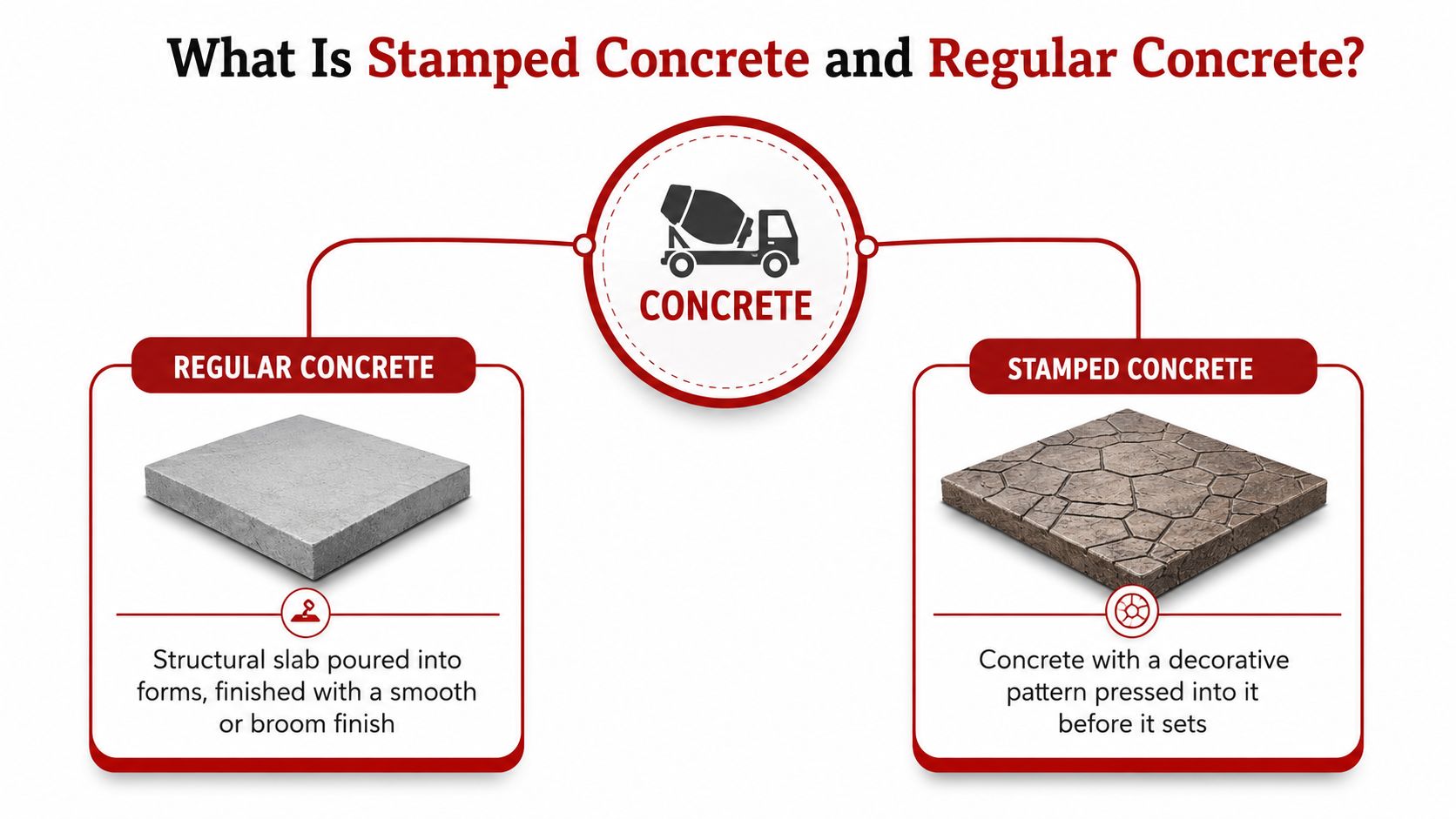
A lot of homeowners think stamped concrete is some special, stronger material. It isn't. Stamped concrete is standard concrete with a decorative surface system applied after placement, while regular concrete is the same structural slab left with a simple finish, often a broom texture for traction. The slab underneath is doing the structural work in both cases, and Ontario's building requirements set the baseline thickness for that slab, not the decorative treatment on top.
That matters because the structure is not where the decision lives. The decision is about finish, visual impact, upkeep, and how much you want to spend on labour and detailing. In practical terms, stamped concrete is usually the finish homeowners choose for patios, walkways, and pool decks where appearance carries weight, while regular concrete makes more sense when the surface has to work hard and look clean without extra fuss. For Ontario context and slab baseline details, see the local comparison in this Ottawa stamped concrete guide.
Practical rule: if the slab's job is mainly to carry traffic, regular concrete is usually enough. If the surface is part of the home's visual first impression, stamped concrete earns its keep.
The structural base is the same
The big misconception is that stamped concrete somehow changes the slab itself. It doesn't. It uses the same poured concrete base, then gets its pattern, colour, and finish while the surface is still workable. That means homeowners in Barrhaven, Nepean, Kanata, Stittsville, and Orleans are not comparing two different structural systems. They're comparing a plain slab and a decorative finish system.
If you want a technical ceiling for the slab itself, the Ontario baseline is what governs the pour, not the decorative finish. That's why the conversation should stay focused on the surface outcome, not on whether stamped concrete is “stronger” in some magical way.
Appearance and Aesthetic Differences
Regular concrete gives you a clean, utilitarian look. You can keep it simple with a broom finish or move to exposed aggregate, but the visual language stays restrained and mostly grey. That works fine for plenty of homes, especially where the goal is a neat surface, decent traction, and no visual drama.
Stamped concrete takes that same base and turns it into something that reads like stone, slate, brick, or timber. Colour hardeners and release agents create depth that plain concrete can't fake with a broom finish. For homeowners in Orleans with heritage character, a stamped patio can sit comfortably beside brick façades, mature landscaping, and more traditional streetscapes. In Kanata, a broom finish driveway often makes more sense because the house and lot are asking for function first, not ornament.
The point isn't that one looks “better” in a vacuum. It's that they solve different design problems. If your front walk is the first thing guests see, stamped concrete changes the whole approach to the property. If it's a side access path or a back utility slab, regular concrete usually looks perfectly right.
A local finish gallery can help you see how surface choices read on different homes, and these stamped concrete finishes are a good reference point when you're deciding how far you want to push the design.
Where the visual payoff is strongest
Stamped concrete has the most impact where the surface is visible from the street or from major living spaces. Patios off the kitchen, pool surrounds, front walkways, and entry pads are the obvious wins. Those are the spaces where colour variation and pattern depth pull real weight.
Regular concrete, by contrast, is honest. It doesn't pretend to be stone. It gives you a flat, reliable surface that stays out of the way and doesn't compete with the rest of the property.
If the space is meant to impress, stamped concrete does the job. If the space is meant to disappear into the background, regular concrete is the cleaner choice.
Cost Comparison for Ottawa Homeowners
Ottawa homeowners notice the price gap first, and they should. Installed pricing from North American concrete sources puts regular concrete at about $4.50 to $8.50 per square foot and stamped concrete at about $8.50 to $18.50 per square foot (cost comparison reference). Another published range puts standard broom finish concrete at $7 to $12 per square foot installed and stamped concrete at $15 to $20 per square foot installed, with custom borders or multiple colours reaching $20 to $28 per square foot installed (regional pricing reference). A third installed-price comparison shows the same pattern, with stamped work sitting well above plain concrete and custom detailing pushing the price even higher (installed-price reference).
The premium comes from labour, tools, colouring, sealing, and detailing, not from a thicker slab. You are paying for finish complexity. Anyone comparing quotes against a broader concrete floor cost by Newline Painting reference will see the same pattern, more finish work drives the installed price up.
Project Type | Regular Concrete Cost | Stamped Concrete Cost |
|---|---|---|
Small patio or walk | Lower installed range from the sources above | Higher installed range from the sources above |
Standard decorative patio | Cost stays near the plain slab baseline | Cost rises with pattern, colour, and sealer work |
Larger visible driveway | Better value if surface area matters most | Premium grows fast as square footage increases |
A 400 square foot patio shows the gap clearly. Using the published local cost guide from this stamped concrete cost guide and the regional pricing ranges above, standard concrete lands around $2,800 to $4,800, while stamped concrete lands around $6,000 to $8,000. That spread is enough to change the project from a practical upgrade into a real design investment.
Bottom line: if the budget is tight, stamped concrete is the first feature to cut, not the slab itself.
For Ottawa homeowners comparing quotes, start with the local cost breakdown at this stamped concrete cost guide. It helps separate real scope from sales talk.
Maintenance and Lifespan in Ottawa Climate
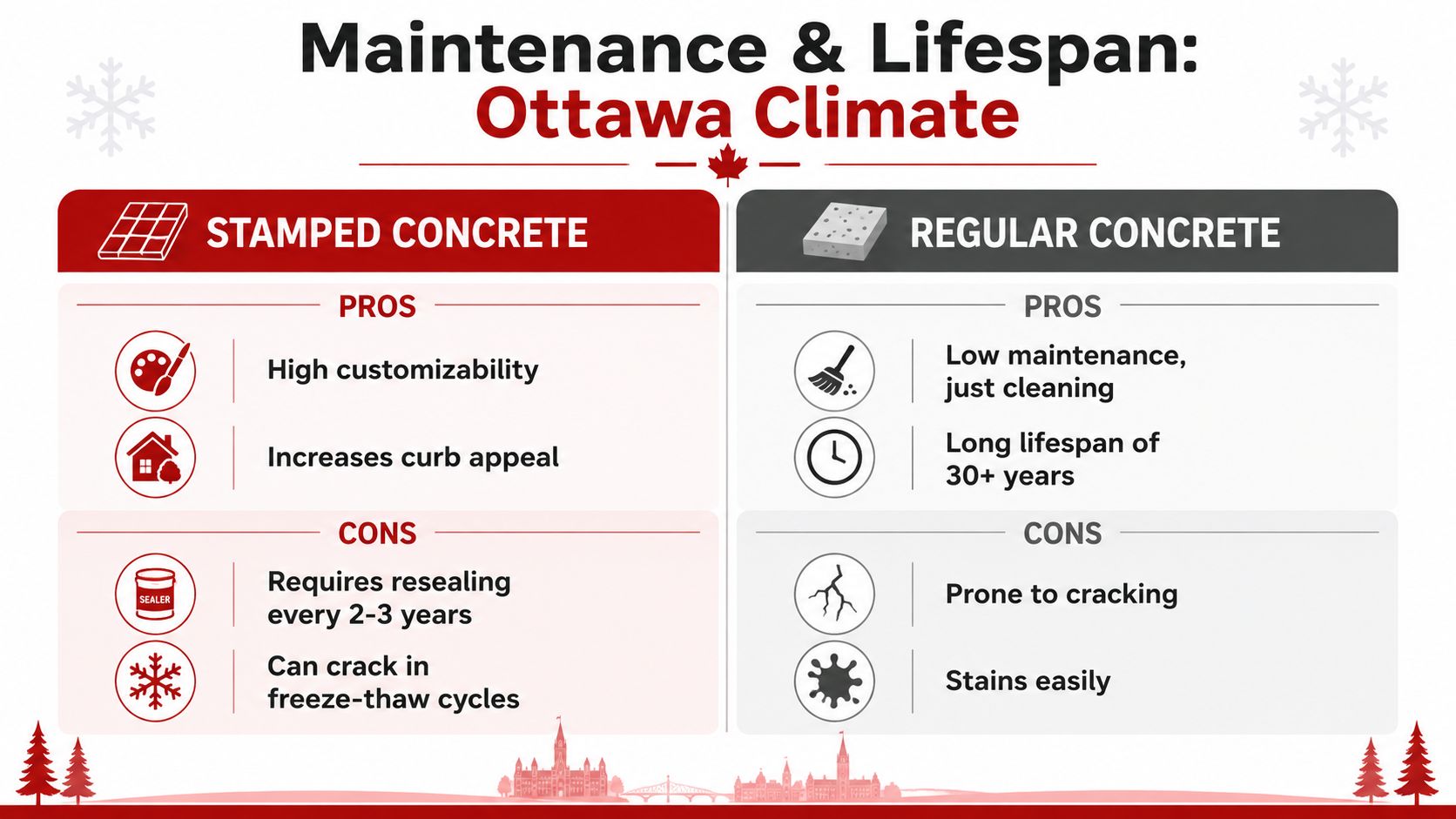
Ottawa beats up exterior concrete faster than a mild climate ever will. Freeze-thaw cycles, snow clearing, de-icing salts, and standing water all put pressure on surface finishes, and stamped concrete feels that pressure sooner because the decorative layer has more to protect than plain slab concrete. Independent contractor guidance says stamped concrete should be resealed every 2 to 3 years to protect colour, texture definition, and surface wear, while regular concrete generally needs only occasional cleaning and crack repair (maintenance reference).
That difference matters more here than in many other markets. A stamped patio in Barrhaven or a front walk in Orleans can look sharp right after install, but it only keeps that look if the sealer stays ahead of wear. Once the sealer breaks down, the surface loses colour depth and the crisp pattern definition homeowners paid for.
The same contractor guidance points to a typical lifespan of 25 to 30 years for stamped concrete versus 30 to 50 years for regular concrete. Those are not abstract numbers. They show the decorative system gives up some service life to get the finish homeowners want. That trade works on a front entry or patio where curb appeal matters. It makes less sense on a wide driveway that takes winter abuse every day.
If you are already dealing with surface stress on another concrete area, the crack repair approach outlined in Peoria homeowners deck crack help is a useful reminder that visible damage starts as a maintenance issue before it turns into a replacement issue.
What Ottawa weather changes
Cold weather does not care how nice the pattern is. If water gets into weak points, freezes, and expands, the finish pays first. That is why resealing is required on stamped surfaces in this climate, and why regular concrete often looks like the safer ownership choice for people who do not want to stay on a maintenance cycle.
Regular concrete is not maintenance free. It still needs cleaning, and cracks still need attention. But it is a simpler surface, so there is less to preserve and fewer finish layers to protect.
Installation Complexity and Process Differences
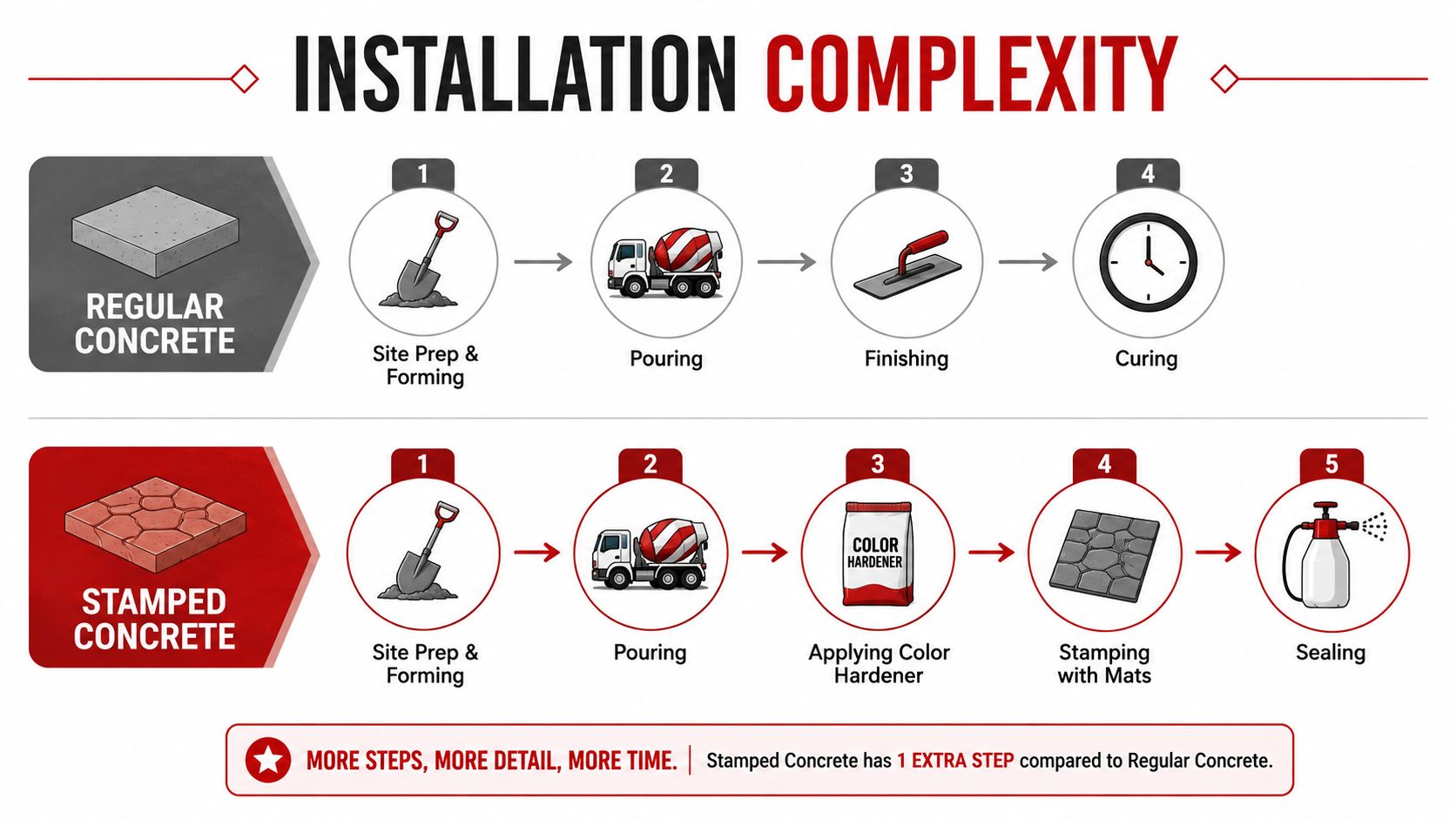
Regular concrete is straightforward. The crew prepares the base, sets forms, pours the slab, then finishes the surface with simple tools. If the job is a driveway or utility pad, the process is built around speed, correct slope, and a clean finish that will hold up without extra decoration.
Stamped concrete adds a lot more moving parts. The same structural pour still happens, but the finish crew has to apply colour hardener, work release agents into the surface, and stamp pattern mats while the concrete is at the right consistency. If the timing is off, the pattern won't seat cleanly and the finish loses sharpness. That's why skilled crews matter so much on stamped jobs in Stittsville and Nepean, where homeowners often expect a polished decorative result rather than an almost decorative result.
Why timing drives cost
Stamped work is labour heavy because there's no pause button once the surface reaches the workable stage. The crew has to move in sequence, keep pattern alignment tight, and manage edges, joints, and transitions without leaving obvious mistakes. That's the part many homeowners never see when they compare quotes.
A clean plain slab gives you fewer places to mess up. A stamped slab gives you more surface expression, but it also gives the crew more opportunities to make a bad impression if the timing slips.
Good stamped work looks easy after the fact. During the pour, it's controlled chaos, and that's exactly why experienced crews charge more.
What gets added on a stamped job
The extra steps are the whole reason stamped work costs more. You're not paying for some exotic concrete mix. You're paying for pattern mats, colouring, release agents, sealing, and more detailed labour. That extra work is also why the finish needs a crew that knows how to keep pattern consistency over the entire surface.
For homeowners trying to judge project scope, the honest comparison is simple. Regular concrete is a pour. Stamped concrete is a pour plus a finish system, and that finish system needs a trained team to get it right.
Ideal Applications for Each Concrete Type
Patios, pool decks, and front walkways are where stamped concrete usually makes the most sense. Those are the places where people see the finish up close, and that's where the decorative surface pays back some of its premium. In Barrhaven and Orleans, where backyard living spaces often carry real weight in the way a home feels, stamped concrete can turn a plain slab into part of the property's design language.
Regular concrete belongs in the tougher, less glamorous spots. Driveways, garage floors, utility paths, and high traffic commercial walkways are often better served by a simpler surface that stays cost conscious and easy to live with. On larger areas, the square foot premium for stamping compounds fast, and many homeowners would be smarter to spend that budget on more coverage, better drainage, or a stronger functional layout.
Driveways need a tougher question
Most homeowners get it wrong. A stamped driveway can look great from the street, but in Ottawa it also gets hit by snow, salt, ploughing, and repeated freeze thaw stress. If visibility is low and the driveway is mostly a working surface, regular concrete usually offers the better value.
If you're comparing a decorative finish against a heated surface strategy, the guide on how to bid heated concrete systems is useful background because it shows how quickly the budget can shift when function has to take priority over appearance.
Match the finish to the use
Use stamped concrete when the surface is part of the home's presentation. Use regular concrete when the surface is there to perform. That's the cleanest rule, and it keeps buyers from overpaying for visual flair where nobody will notice it after the first week.
Ottawa Stamped Concrete also offers stamped and patterned installations for patios, driveways, walkways, porches, and pool decks across the region. That's relevant because the choice isn't just about material, it's about whether the space itself justifies the extra finish work.
Making the Right Choice for Your Ottawa Property
If you care most about durability, lower lifecycle cost, and simple upkeep, choose regular concrete. It's the right answer for driveways, garage floors, utility slabs, and any surface where function outweighs design. In Ottawa, that's the safer call when you want fewer maintenance touchpoints and a surface that doesn't ask much back.
If you care most about curb appeal, property character, and a more finished look, stamped concrete is the better pick. That's especially true for front entries, patios, and decorative walks in neighbourhoods like Stittsville and parts of Orleans, where the visual payoff can feel bigger because the property already has the setting for it. You're paying more, but you're also buying a surface that actively contributes to the look of the home.
My opinion is simple. For a space you see every day and use hard every winter, plain concrete is the smarter buy. For a space you show off, stamped concrete earns its place.
Choose the surface for the job, not for the sales pitch. In Ottawa, that rule saves money and avoids regret.
If you're weighing stamped concrete against regular concrete for a patio, driveway, or walkway in Ottawa, Ottawa Stamped Concrete can walk you through the trade offs and the right finish for your property. Visit Ottawa Stamped Concrete to get a project conversation started and compare options for your home in Barrhaven, Nepean, Kanata, Stittsville, or Orleans.
Comments