
Concrete Slab Lifting: What Ottawa Homeowners Need to Know

Concrete slab lifting in Ottawa usually lands in the low thousands for a 300 square foot section, while full replacement is commonly the much bigger bill. In practical terms, lifting often runs 50 to 70 percent less than replacement, so the savings are real when the slab is still worth saving.
If you're staring at a sunken driveway in Barrhaven after spring thaw, or a tilted back porch in Kanata that's started collecting water, the first question isn't how the foam goes in. It's whether lifting makes sense at all, or whether the best fix is drainage, grading, or full replacement.
Table of Contents
How Concrete Slab Lifting Works - What it is not - How the lift is controlled
Mudjacking Versus Polyurethane Foam Compared - Head to head in plain terms
The Diagnostic Step Most Homeowners Skip - What to check before anyone quotes a lift - When lifting is a warning sign, not a solution
What Concrete Slab Lifting Costs in Ottawa - Typical cost ranges by surface
What Happens on the Day of the Lift - The usual sequence - What to expect after the crew leaves
When Replacement Is the Smarter Move - Questions that separate honest advice from a sales pitch
Choosing an Ottawa Slab Lifting Contractor - What a proper quote should include
Why Ottawa Homeowners Are Calling About Sunken Slabs
A lot of calls start the same way. Someone in Barrhaven, Nepean, or Orleans steps out in early spring and notices a porch slab that's dropped at one corner, a garage edge that now sits below the driveway, or a walkway that's become a trip point. The concrete itself may still look intact, but the elevation has changed enough that water, footing, and access all feel off.
That's where concrete slab lifting enters the conversation. It's not a cosmetic trick, it's a repair method used to restore serviceability when the slab has settled because support underneath has been lost. In the transportation record, slab releveling was used after roadway slabs had settled by up to 10.5 mm (0.413 in), and the full injection and releveling work took about 10.5 hours at a cost of $42,260 in that field operation, which shows the method's structural purpose rather than a surface touch up (Transportation Research Record study on slab releveling).
Practical rule: if the slab is still structurally sound and only the elevation is wrong, lifting is worth a serious look. If the concrete is breaking down across the whole surface, lifting can be the wrong repair.
This guide helps you judge whether a lift is the right spend, whether another method fits better, and what Ottawa pricing usually looks like in real residential settings. It also helps you spot the common mistake, paying for a lift when drainage, frost movement, or subgrade problems are still active.
For a related example of how slab conditions show up around garage areas, this Ottawa garage pad reference is useful context.
How Concrete Slab Lifting Works
A settled slab does not need a new life story. It needs support back under the concrete so the surface can carry load again. Concrete slab lifting does that by filling the voids beneath the slab and bringing the slab back to its proper elevation.
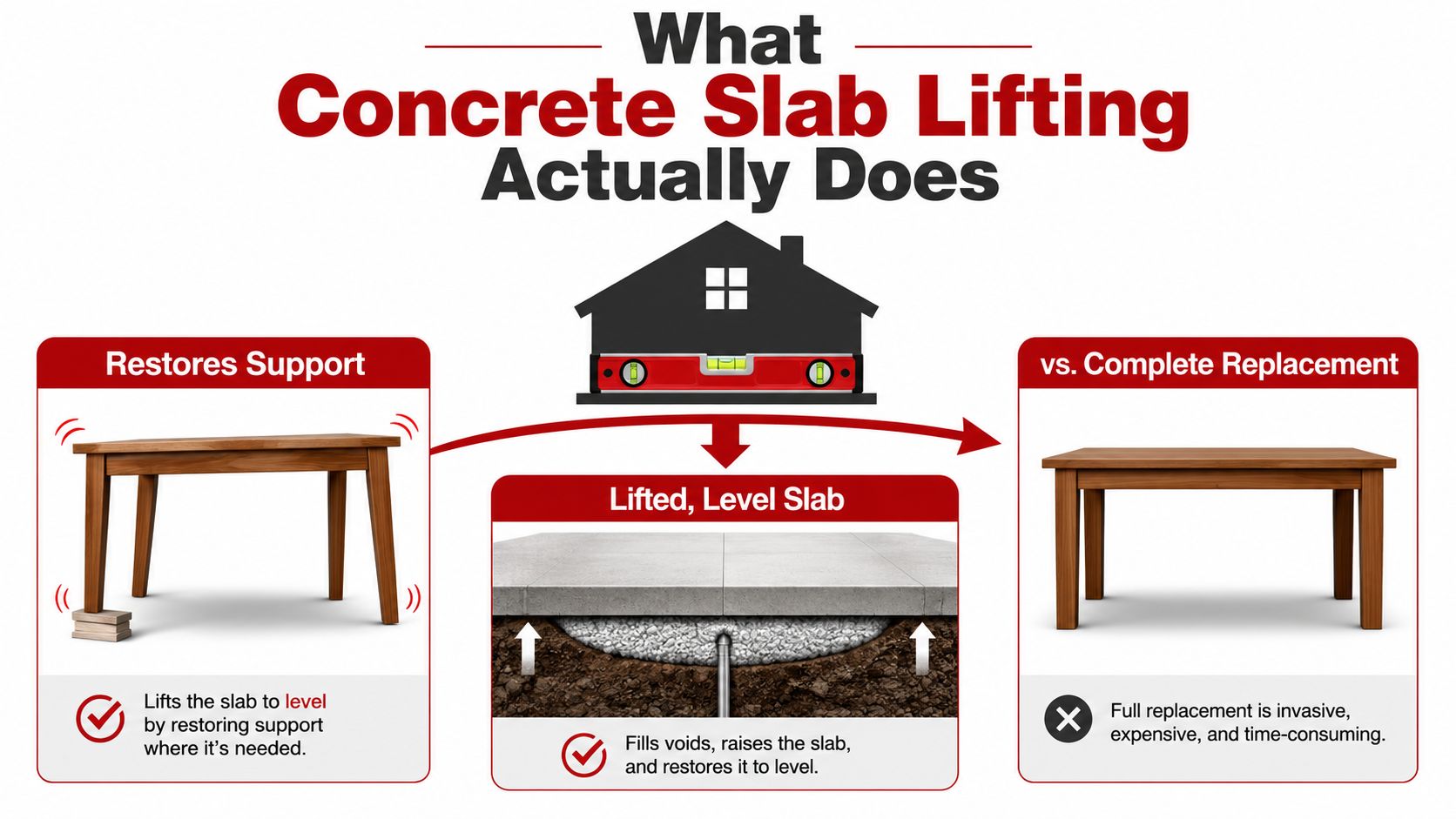
The repair starts with drilling access points and injecting material beneath the slab. The material spreads through the empty spaces, then the slab is raised in a controlled way until it reaches the target grade. Transportation guidance describes this process as pressure injection under the slab to fill voids and raise the concrete to the required elevation, with drilling included in the work scope, so the fix is about restoring bearing support rather than covering up a surface issue (Texas DOT special specification).
What it is not
It is not resurfacing. Resurfacing changes what you see on top, but it does not bring a settled slab back to grade. It is not crack filling either, because filling a crack does not restore the lost support beneath the concrete. It is not replacement, since the existing slab remains in place after the lift and patch work are done.
That difference matters on Ottawa driveways, porches, and walkways. If the concrete is still sound and only the height is wrong, lifting can preserve the slab you already have and avoid the mess of tear-out. If the slab is badly broken, lifting may only buy a little time before the larger repair still has to happen.
How the lift is controlled
The goal is a specific grade, not a higher slab. A transportation research report describes pavement slabs being raised by drilling 2 inch diameter holes and pumping grout underneath until the slabs matched the engineer established line grades (TRR pavement lifting report). That grade control is what separates a proper lift from a guess. A slab is not ready because it feels firmer underfoot, it is ready when it sits where it should and sheds water the way it should.
Repairing a settled slab works like shimming a wobbly table leg. You restore support instead of replacing the whole structure. That is the point for homeowners, it solves a slope problem, a ponding problem, or a trip edge without forcing a full replacement when the slab itself still has useful life. For the contractor, it means reading the slab and the ground beneath it, then raising only what the site can safely accept.
Mudjacking Versus Polyurethane Foam Compared
These two methods aim at the same result, but they behave differently on Ottawa properties. Mudjacking uses a cementitious slurry and larger injection holes. Polyurethane lifting uses a lighter foam, smaller holes, and a faster return to service, which is why the method matters more than most homeowners realise.
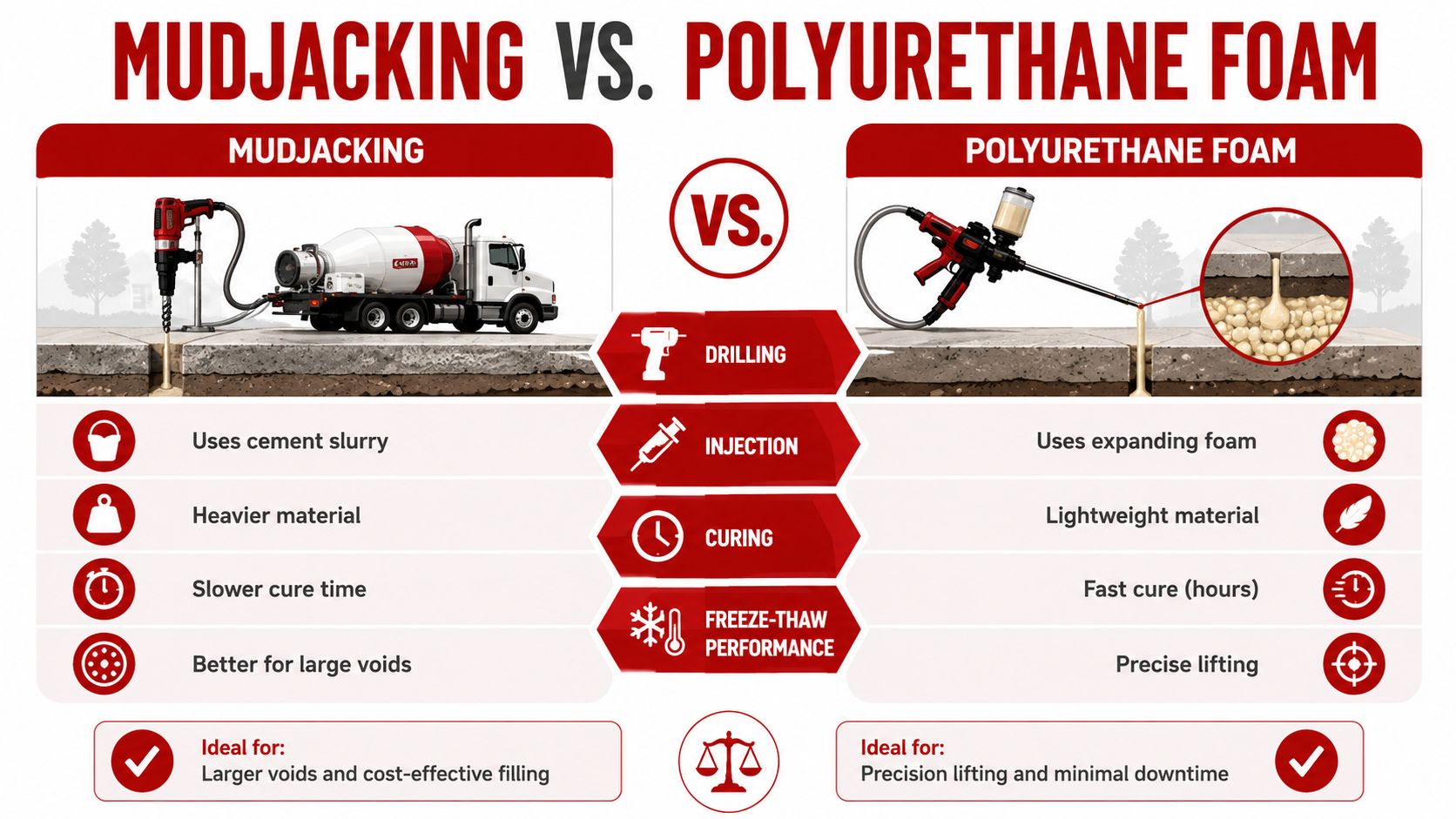
Mudjacking has a place when the site conditions suit it. It's often the more familiar option, and industry pricing guidance shows it can run around $3 to $8 per square foot when suitable (industry pricing guidance). Polyurethane methods are also commonly chosen because they're fast and precise, and the same pricing guidance puts small projects in a broader $5 to $25 per square foot range depending on location and method, with some slab foundation work at the high end (same industry pricing guidance).
Head to head in plain terms
Factor | Mudjacking | Polyurethane Foam |
|---|---|---|
Drilling | Larger holes | Smaller holes |
Injection | Cementitious slurry | Expanding foam |
Curing | Slower | Faster |
Added weight | Heavier | Lighter |
Best fit | Larger voids, some straightforward slabs | Precision lifts, faster turnaround, lighter support conditions |
The practical difference shows up on weak or moisture affected ground. A heavier fill can be fine on some slabs, but on Ottawa sites where drainage or soil movement is still active, lighter material is easier to justify. Polyurethane is also the better fit when you want a cleaner finish and less downtime.
Contractor's rule of thumb: ask what the slab needs, not what material the company prefers. The right material depends on void size, access, and how much support the subgrade can give back.
There's a reason many homeowners end up choosing foam for residential slabs, it allows fine control and quick use after the lift. Mudjacking remains useful, but it shouldn't be the default answer for every settled driveway or walkway.
The Diagnostic Step Most Homeowners Skip
A slab that's sunk once isn't automatically a lifting job. In Ottawa, especially in Nepean, Orleans, and Stittsville, the key question is whether the ground movement is finished or still active. If the cause is still there, you can lift the slab today and watch it move again after another freeze thaw cycle.
What to check before anyone quotes a lift
Start with the concrete itself. Long, through cracks, broken corners, and slabs that have multiple settlement points often tell a different story than a single dropped corner. Then look at water management. Downspouts that dump beside the slab, gutters that overflow, or grading that slopes toward the slab can keep washing away support.
The freeze thaw issue is the part many homeowners underestimate. When water gets trapped, freezes, and expands, the slab and subgrade keep cycling through movement. That means a repair without drainage correction can become a repeat bill rather than a lasting fix. A contractor who quotes a lift without asking about water, downspouts, or slope is skipping the most important diagnosis.
When lifting is a warning sign, not a solution
If the slab is settling because the soil was never properly compacted, a lift can still work, but only if the drainage and site conditions are addressed first. If tree roots have already heaved or fractured the slab, the problem may be bigger than elevation alone. And if the movement is active across a wider area, the honest answer might be to regrade the site before touching the concrete.
If the repair doesn't touch the cause, the slab can move again.
This is the part Ottawa homeowners usually need most before spending money. A straight, level slab is only useful if the ground under it is stable enough to keep it there. That's why the contractor should talk about runoff, soil, and frost, not just give a price on the spot.
What Concrete Slab Lifting Costs in Ottawa
A quote only makes sense once you know what it is replacing. In Ottawa, slab lifting usually costs less than full replacement, but the right comparison is not a neat per-square-foot number alone. It depends on whether the slab is a simple driveway panel, a narrow walk, or a larger section with access problems, finish work, or signs that the ground is still moving.
Replacement is the more expensive route, so lifting can be the better value when the concrete is still in decent shape. The trade-off is simple. If the slab is being pushed around by drainage, frost, or poor support, paying to raise it without fixing the cause can leave you with the same sunk edge again. For a homeowner, that is the cost conversation.
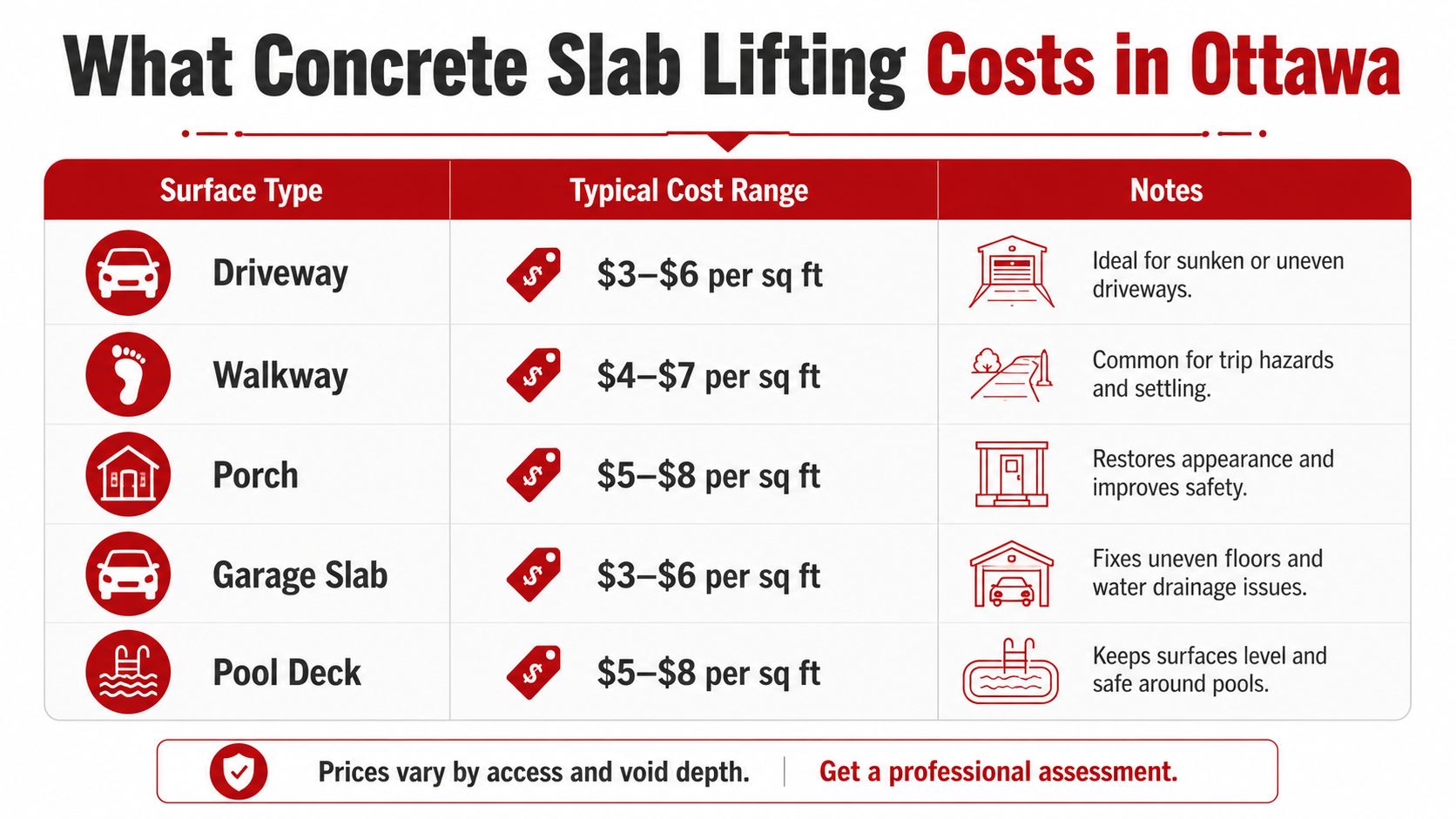
Typical cost ranges by surface
Surface Type | Typical Cost Range | Notes |
|---|---|---|
Driveway | $3 to $6 per sq ft | Common residential lift area |
Walkway | $5 per sq ft | Often small but highly visible |
Porch | $5 to $8 per sq ft | Access and finish matter |
Garage Slab | $3 to $6 per sq ft | Needs careful elevation matching |
Pool Deck | $10 per sq ft | Surface protection matters |
Those ranges line up with common industry pricing, and they show why two jobs that look similar from the street can land at very different totals. Sidewalks often sit around $5 per square foot, patios and pool decks often run closer to $10 per square foot, and slab foundations can climb much higher depending on site conditions and access. If you want a broader local comparison, the Ottawa stamped concrete cost reference helps show the gap between repairing a usable slab and paying to pour a new decorative one.
A small, easy-to-reach slab costs less. A larger lift, tight access, or a section that needs careful matching at the edges costs more. That is the part homeowners should press on when they review an estimate.
Budget check: a low quote that ignores drainage, patching, or finish work is usually not a bargain. A high quote should come with a plain explanation for access, complexity, or the amount of lift needed.
The best estimate breaks the job into clear pieces. Ask what is tied to material, what is tied to access, and what is tied to final patching. If the contractor cannot explain those parts in plain language, keep looking.
What Happens on the Day of the Lift
A good lift day in Ottawa starts with a diagnosis, not the foam gun. I want to know why the slab dropped, whether the concrete still has enough life left in it, and whether lifting is the right call at all. If drainage, soft fill, or frost movement are still active, the slab can end up in the same place again. Once that call is made, the crew sets up, checks the slab, and starts drilling injection points in a way that keeps the repair controlled and lets us watch the movement as it happens.
The usual sequence
The work usually follows a simple order. Drill, inject, patch. Industry guidance describes that process plainly, with the filler selected after the sub slab conditions are checked, then the holes patched flush once the slab reaches the target height (industry guidance on concrete lifting).
On site, the homeowner usually sees a few drilled holes, equipment running, and a crew that keeps talking through the lift as it progresses. Good operators do not guess at the final height and hope for the best. They watch the slab in real time, because too much lift creates a different problem just as fast as too little lift does.
What to expect after the crew leaves
The patched holes should end up flush with the slab surface. After that, the repaired area needs the cure time the contractor gives you before normal use resumes, especially if cars or heavier loads are going back over it. Most residential Ottawa jobs are much smaller than larger roadway releveling projects, so the disruption is usually limited, but the expected timing should still be written into the scope. For a plain example of how crews sequence a residential lift and finish the repair, this Ottawa restoration reference is a useful guide.
Noise is part of the day, but it is not demolition noise. The bigger nuisance is usually access around the slab, not the lift itself. If the contractor keeps the site tidy and explains the steps as they go, the work should feel like controlled maintenance, not a tear-out.
When Replacement Is the Smarter Move
There are times when lifting is the wrong answer, even if it looks cheaper on paper. If the slab has severe cracking, widespread spalling, weak remaining thickness, or obvious structural breakdown, raising it won't fix the underlying condition. A slab that's already failing across the surface can keep shedding money after a lift, because the surface itself is the problem.
Ottawa homeowners need to be blunt with themselves. If the slab is at the end of its useful life, or if tree roots have distorted it badly, replacement may be the more honest spend. A lift can restore elevation, but it can't rebuild concrete that's already too damaged to serve well.
Questions that separate honest advice from a sales pitch
Ask the contractor three things. First, does the slab still have enough sound concrete left to justify saving? Second, is the settlement localised or widespread? Third, what site issue caused the drop in the first place, and has it been corrected?
If the answers stay vague, that's a warning sign. You want someone who can tell the difference between a sound slab that needs support and a failing slab that needs to come out. The goal isn't to avoid replacement at all costs, it's to avoid paying for a lift on a slab that should have been rebuilt.
For homeowners comparing repair versus restoration in more detail, this Ottawa restoration reference is a useful reminder that not every surface should be saved the same way.
Choosing an Ottawa Slab Lifting Contractor
The best contractor is the one who asks better questions before giving you a number. In Barrhaven, Kanata, Nepean, Stittsville, and Orleans, I'd want a quote that explains the method offered, the write up on patching, and whether the crew is willing to talk about drainage and soil conditions before locking in a repair plan.
What a proper quote should include
Method choice: mudjacking, polyurethane, or both, with a clear reason for the recommendation.
Written scope: drilling, injection, patching, clean up, and any limit on lift height.
Site diagnosis: mention of downspouts, slope, drainage, and visible settlement causes.
Local references: previous work in Ottawa neighbourhoods, not just a general promise.
Warranty terms: what the company covers, and what it does not.
A contractor who can't explain the difference between support correction and surface patching probably shouldn't be touching your driveway. A contractor who only talks about price and never mentions why the slab sank is missing the core problem. And a contractor who won't say when replacement is better is prioritising the sale over the repair.
The core question to ask is simple. Will this lift hold, and if not, what has to change first? If you get a clear answer, you're talking to the right person.
Ottawa Stamped Concrete works on the kind of residential concrete projects where smart decisions matter, from driveways and walkways to porches and pool decks. If you're weighing whether a sunken slab should be lifted, repaired, or replaced, visit Ottawa Stamped Concrete to talk through the options with a local team that understands Ottawa properties and the freeze thaw conditions that affect them.
Comments