
Concrete Pool Deck Cost in Ottawa: A Practical Guide

In Ottawa, an installed stamped concrete pool deck typically runs about C$20 to C$40+ per square foot, with a 500 square foot project often landing between C$10,000 and C$20,000 before permits and site preparation. The spread comes from finish choice, winter protection, drainage, demolition, access, and the condition of the existing surface.
You may be standing beside the pool right now, looking at cracked interlock, a tired concrete slab, or a bare area that never drains properly. A neighbour's online estimate might suggest a simple per square foot price, but Ottawa projects rarely behave like a flat national average. Soil conditions, narrow side yards, frost movement, salt exposure, and city requirements can move the final invoice substantially.
A stamped deck can look like natural stone without the maintenance of individual pavers, but the pattern is only one part of the decision. The quote also needs to show what happens below the slab, how water leaves the pool edge, how the crew reaches the backyard, and whether the existing surface can be repaired or needs removal.
Table of Contents
How Pool Deck Pricing Is Built Per Square Foot - Materials are more than concrete - Labour changes with the site - Preparation controls the outcome - Finishing creates the visible difference
The Cost Drivers That Hit Pool Decks Hardest - Drainage comes before decoration - Joints and edges prevent expensive trouble - Access can change an otherwise simple quote
What Happens on Site From Base Prep to Sealer - The work starts below the finished surface - Forms and reinforcement set the shape - The pour has a narrow timing window - Curing and sealing protect the result
Three Ottawa Pool Deck Budget Scenarios - Scenario A - Scenario B - Scenario C
Why a Single Price Number Can Mislead Ottawa Homeowners - Overlay only works on the right slab - Replacement costs more because it resets the system - Repairs need a realistic place in the plan
Your Pre Quote Checklist for an Ottawa Pool Deck - Confirm the city requirements - Check the construction details
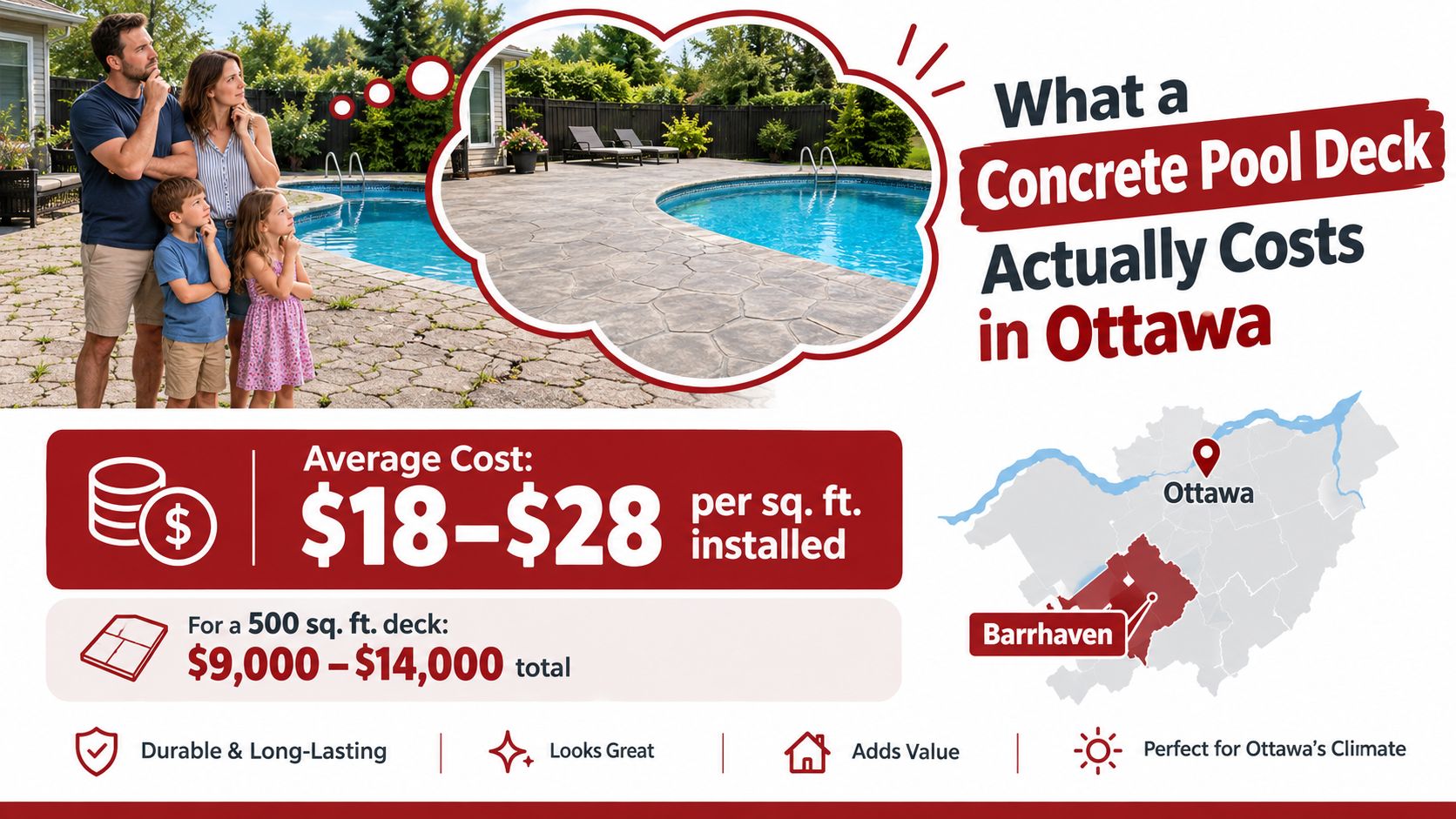
What a Concrete Pool Deck Actually Costs in Ottawa
A family in Barrhaven, Ottawa, Ontario might start with a straightforward renovation. Their interlock pool surround has shifted, the joints collect weeds, and several sections no longer fall away from the pool. They ask for warm grey stamped concrete with a subtle stone pattern. The first quote looks reasonable until they notice that one contractor includes demolition and granular base work while another prices only the finished slab.
For stamped concrete in the Ottawa market, plan around C$20 to C$40+ per square foot installed. A 500 square foot surround therefore commonly lands around C$10,000 to C$20,000 before permits, drainage upgrades, or difficult site access. Ottawa homeowners can compare that range with Ontario pricing references, including a poured concrete range of about C$5 to C$10 per square foot and a Sarnia area pool deck range of about C$6 to C$18+ per square foot, where broom finishes sit lower and stamped patterns with colour sit higher, as outlined by Ontario pool deck pricing guidance.
The Ottawa price is higher than a basic national headline when the project needs frost conscious construction. Crews may need stronger edge details, air entrainment, improved drainage, careful compaction, and a sealer suitable for a pool environment. A long winter and repeated freeze thaw movement punish shortcuts that might remain hidden in a milder climate.
Practical rule: Treat the square foot price as the starting point. Treat the base, drainage, access, finish, and permit scope as the real quote.
Every serious estimate should separate four numbers:
Surface and finish: The concrete type, colour, pattern, texture, and sealer.
Site preparation: Demolition, excavation, granular base, compaction, grading, and disposal.
Reinforcement and detailing: Rebar or mesh, control joints, coping transitions, edges, and forms.
Project administration: Permits, drawings, inspections, pump access, and any required grading documentation.
If those items are hidden inside one total, you can't compare contractors properly. Ask for an itemized estimate before you compare the apparent concrete pool deck cost.
How Pool Deck Pricing Is Built Per Square Foot
Contractors don't calculate a pool deck by multiplying a finish price against area and stopping there. They build the estimate from several cost buckets, each responding to a different site condition.
Materials are more than concrete
The material allowance may include an air entrained mix suited to outdoor exposure, fibremesh, reinforcement, colour hardener, release agent, and sealer. A quote might also include granular A, clear stone, forming lumber, joint material, and protective coverings around the pool.
For a planning example only, a quoted C$28 per square foot can be viewed as roughly C$6 to C$8 for materials, C$10 to C$14 for labour, C$4 to C$6 for base preparation, and C$6 to C$10 for finishing, based on the supplied Ottawa pricing model. Those figures are a way to read the quote, not a universal rate card.
Labour changes with the site
Labour includes layout, excavation, forming, reinforcement placement, the pour crew, stamping or brooming, joint work, curing, cleanup, and sealing. A simple rectangle beside a wide driveway is faster to organize than a deck with curved coping, equipment pads, stairs, several elevations, and a narrow access route.
Preparation controls the outcome
Ottawa soils can include heavy clay, fill, and areas disturbed by earlier landscaping. The contractor needs to determine whether the existing base is stable, whether water can drain away from the pool, and whether the sub base will compact evenly. A decorative finish can't correct a slab that moves because the supporting ground wasn't prepared properly.
Finishing creates the visible difference
Stamping, colour hardener, release powder, edge treatment, control joint cutting, and the first seal coat can represent a large part of the final price. Homeowners routinely ask about the pattern but forget to ask whether the quote includes rebar, joint layout, and initial sealing.
Two quotes at the same square foot price can still differ by thousands because one includes demolition, reinforcement, disposal, and sealer while the other excludes them. Ottawa homeowners comparing estimates should ask each contractor to identify inclusions and exclusions line by line.
The Cost Drivers That Hit Pool Decks Hardest
Pool surrounds carry more risk than ordinary flatwork because the deck must shed water, remain comfortable under bare feet, meet the pool edge cleanly, and tolerate repeated winter exposure. The largest price changes usually come from site conditions, not from the colour selected at the design stage.
Drainage comes before decoration
Water should move away from the pool rather than sit beside the coping or against the foundation. A 2 percent grade may require fill, regrading, or adjustments around doors and equipment, and the supplied project model places that work at C$500 to C$2,000 when needed. The Ottawa winter damage guidance explains why this matters, since freezing can heave concrete while thawing can leave uneven settlement, poor slopes, and trip hazards.
Slip resistance also affects the specification. A broom texture or suitable grit additive can provide a more practical walking surface than a smooth decorative finish, particularly where water regularly splashes from the pool.
Joints and edges prevent expensive trouble
Control joints should follow the layout rather than appear as an afterthought. They need to work around the pool coping, corners, changes in width, and other stress points. Good joint planning gives the concrete a controlled place to move and crack.
The transition at the pool shell is often one of the most labour intensive details. Forms must follow the coping, the edge needs a clean profile, and the finished surface must remain comfortable and safe around wet feet. Poor edging can leave chipped corners, awkward gaps, or a ledge that catches debris.
Access can change an otherwise simple quote
A backyard in Centretown or Sandy Hill may have no practical route for a concrete truck or skid steer. The crew might need a pump, extra hose, hand work, and additional protection for fences and landscaping. The supplied Ottawa cost model places difficult pumping or wheelbarrow access at C$1,500 to C$3,000 for a project that looks identical on a plan.
A contractor should walk the access route before pricing the pour. Measure gates, note steps and retaining walls, and identify where trucks can safely park. Access isn't a minor logistical detail. It affects crew size, equipment, protection, and timing.
Stamped, Broom, and Aggregate Finishes Compared
The finish should match the way your household uses the pool, not just the appearance you save from a catalogue. A polished looking pattern can become uncomfortable or slippery when the wrong sealer or overly smooth texture meets standing water.
Stamped concrete is the most design driven option. It can imitate stone, slate, brick, or tile, and the supplied finish comparison places the stamped premium at about C$4 to C$8 per square foot over a plain broom finish. Choose a textured pattern rather than a smooth, deep impression, and ask how the sealer will affect traction. A contractor familiar with local options can also show examples such as the types of concrete finishes used around Ottawa.
Broom finish remains the practical budget choice. Its texture feels comfortable under bare feet, provides a familiar grip, and is easier to repair visually than a detailed pattern. The compromise is appearance. It won't provide the same stone or tile character, and broad areas can look plain beside a carefully designed pool coping system.
Exposed aggregate gives the surface visual depth and dependable traction. Many Ottawa homeowners like its natural appearance and grip, but the exposed stone can feel rougher on children's knees and hands. It also needs careful placement and finishing so the aggregate remains consistent across the deck.
Finish | Installed Cost per sq ft | Slip Resistance | Winter Durability | Best For |
|---|---|---|---|---|
Broom finish | Lower end of local concrete pricing | Practical texture | Straightforward to maintain when properly installed | Cost controlled projects |
Stamped concrete | About C$4 to C$8 more than plain broom finish, based on the supplied finish model | Depends on pattern and sealer | Strong choice when drainage, joints, and sealing are handled correctly | Homeowners wanting a patterned surface |
Exposed aggregate | Usually above a plain broom finish and influenced by stone selection and preparation | Strong traction, rougher feel | Suitable for Ottawa when the base and finish are properly specified | Natural appearance and grip |
My recommendation is simple. Pick broom finish when budget and barefoot comfort lead the decision. Pick stamped concrete when appearance matters and you're prepared to fund proper base work and sealing. Pick exposed aggregate when traction is the priority and your family accepts a more textured surface.
What Happens on Site From Base Prep to Sealer
A quality pool deck quote becomes easier to judge when you understand the order of work. The crew isn't only placing concrete. They're managing the ground, water, reinforcement, timing, texture, and protection of the pool itself.
The work starts below the finished surface
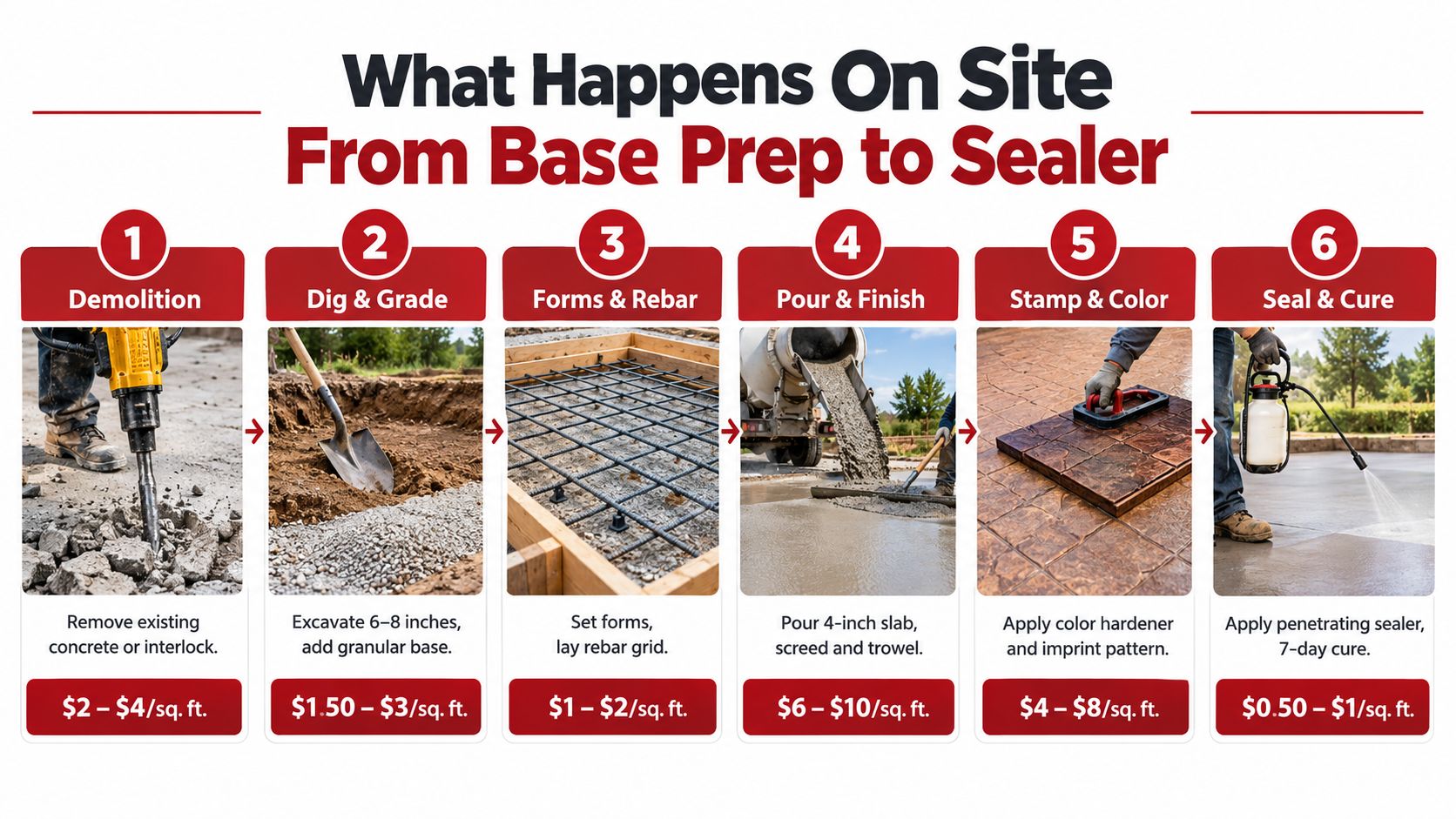
The crew first removes interlock, damaged concrete, soil, or other existing material. Demolition includes breaking, loading, disposal, and protection around coping, plumbing, fences, and landscaping.
Next comes excavation and grading. The crew establishes the finished elevation, digs to the required depth, places granular A or clear stone where the design calls for drainage, and compacts the base in a controlled manner. This preparation affects both the base preparation portion of the price and the future movement of the slab.
Forms and reinforcement set the shape
Forms establish the perimeter, curves, elevations, and coping transition. Rebar or wire mesh is then placed according to the design. Ask whether reinforcement is included, where it will sit within the slab, and how the crew will keep it from resting directly on the base.
Before the truck arrives, the team should confirm drainage falls, equipment clearances, steps, gates, and access. Changes made after the pour begins are expensive and can compromise the finish.
The pour has a narrow timing window
The crew places, screeds, bull floats, and finishes the concrete while it remains workable. Brooming happens at the right stage to create texture. Stamping also depends on timing, since the concrete must accept the impression without tearing or becoming too hard to mark.
Control joints are tooled or cut as part of the finishing plan. Around the pool, the crew must keep the layout visually organized while directing likely movement away from random, prominent cracks.
Curing and sealing protect the result
The deck needs protection while it gains strength. Depending on the specification and weather, the contractor may keep it covered or manage moisture during the cure period. Sealer comes after the appropriate cure stage, not whenever the surface looks dry.
For design planning before construction, an ai deck design tool can help you explore layout ideas, furniture zones, and visual relationships before final measurements are taken. For technical maintenance decisions, review guidance on concrete sealing and staining and ask the installer which product matches pool chemicals, winter exposure, and the selected texture.
Three Ottawa Pool Deck Budget Scenarios
The most useful estimate is one that resembles your lot. These three scenarios show how finish, access, preparation, and size interact. They are planning ranges based on the supplied Ottawa project assumptions, not guaranteed bids.
Scenario | Size (sq ft) | Finish | Neighbourhood Example | Estimated Total Budget |
|---|---|---|---|---|
A | 350 | Broom finish | Centretown or Old Ottawa South | C$7,000 to C$10,000 |
B | 600 | Stamped concrete | Kanata or Barrhaven | C$14,000 to C$20,000 |
C | 900 | Exposed aggregate or premium stamped concrete | Nepean or Orleans | C$22,000 to C$35,000 |
Scenario A
A 350 square foot broom finish surround in Centretown or Old Ottawa South usually has a compact footprint but difficult access. Assume limited equipment access, basic drainage correction, ordinary demolition, a standard base preparation scope, and a straightforward sealer. The budget allows for the fact that hand movement or pumping may be needed even though the deck is small. Permit treatment should be confirmed separately rather than assumed to be included.
Scenario B
A 600 square foot stamped deck in Kanata or Barrhaven has more room for staging and often a better route from the truck to the backyard. Assume a textured stamp, colour, sealer, modest excavation and base preparation, planned control joints, and normal coping edges. The range rises because the finish adds labour and material complexity, while the larger area makes layout and drainage more important.
Scenario C
A 900 square foot deck in Nepean or Orleans may have wider access but a more involved layout. Assume exposed aggregate or premium stamped concrete, more complex drainage, pool equipment clearances, additional edging, and a larger amount of base preparation. The estimate still depends on demolition, property grade, and permit scope. A large deck shouldn't be priced from area alone.
Why a Single Price Number Can Mislead Ottawa Homeowners
A headline rate hides the decision that matters most: repair, overlay, or replacement. If an existing slab is structurally sound, an overlay may provide a new appearance without full demolition. If the slab has heaving, serious settlement, poor drainage, or unstable support, covering it can preserve the underlying problem.
Toronto area 2026 resurfacing figures provide a useful Ontario comparison. A 400 square foot deck is described at about $4,500 to $9,500 for a concrete overlay, compared with $18,000 to $35,000 for full replacement, while quality resurfacing for a 400 to 600 square foot deck often falls around $6,000 to $14,000, according to Ontario resurfacing cost guidance. Those figures aren't an Ottawa quote, but they show why the repair decision deserves its own line in your budget.
Overlay only works on the right slab
An overlay needs a stable, properly draining base. It can modernize colour and pattern, but it won't reliably solve major movement below the surface. In Ottawa, freeze thaw movement makes the inspection especially important. Ask the contractor to identify cracks, settlement, spalling, hollow areas, and the reason water is collecting before you accept an overlay recommendation.
Replacement costs more because it resets the system
Full removal allows the crew to correct grade, rebuild the base, relocate problem areas, and address coping transitions. It also creates demolition and disposal work that a surface treatment avoids. The higher initial cost can make sense when the existing slab has already demonstrated that it can't support another finish.
Repairs need a realistic place in the plan
Winter damage may appear as cracking, scaling, uneven edges, or movement beside the pool. Generic price pages often stop at the installed square foot number and don't isolate the Ottawa premium for frost protection, drainage, and site preparation. Use C$20 to C$40+ per square foot as a starting point for stamped work, then pressure test the quote against the actual slab, soil, access, and drainage.
Your Pre Quote Checklist for an Ottawa Pool Deck
Before signing, make the contractor explain the scope in language you can match against another estimate. A low total isn't useful if it excludes the base, demolition, sealer, or permit work that your property needs.
Confirm the city requirements
Ottawa requires a permit for an attached deck when the walking surface is more than 24 inches above adjacent grade, and for other decks more than 24 inches above grade when the area exceeds 10 square metres, about 108 square feet, as described in the City of Ottawa building permit guidance. The City also distinguishes a simple patio at grade from a deck and identifies a building area threshold of more than 10 square metres, approximately 108 square feet, for many structures and alterations in its deck permit information.
A pool enclosure permit is required before a pool can be commenced, and the published fee is C$241.00. If a deck forms part of the enclosure, a separate building permit application may also be required, according to the Ottawa pool enclosure bylaw. Ask how the contractor is handling the pool enclosure, deck, and any grading documentation.
Check the construction details
Use this checklist during the quote meeting:
Base preparation: Confirm excavation scope, granular material, compaction, drainage, and disposal.
Reinforcement: Specify rebar or wire mesh, placement, and any thickened edges.
Mix: Ask for the concrete specification, air entrainment, fibremesh, and curing instructions.
Finish sample: Approve the colour, stamp pattern, texture, border, and edge profile before the pour.
Drainage: Confirm the planned fall away from the pool, doors, foundation, and property line.
Joints: Review control joint locations around coping, corners, and changes in deck width.
Sealer: Identify the product, application timing, slip considerations, and reapplication schedule.
Access: Document gate width, truck position, pump requirements, landscaping protection, and cleanup.
Warranty: Get workmanship and material warranty terms in writing, including exclusions for movement and damage caused by existing conditions.
Neighbourhoods such as Barrhaven, Kanata, Nepean, Stittsville, and Orleans can have different lot layouts, setbacks, grades, and access challenges. Use the stamped concrete cost calculator as an early planning aid, then obtain at least three itemized site specific quotes and compare them side by side.
Ottawa Stamped Concrete can assess pool deck layout, stamped finishes, repairs, recolouring, and resealing as part of an Ottawa concrete project. Visit Ottawa Stamped Concrete to discuss your pool surround, confirm the repair or replacement path, and request an itemized quote that accounts for winter durability, drainage, access, and permits.
Comments